

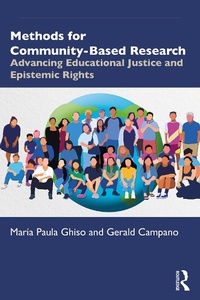
Methods for Community-Based Research
Advancing Educational Justice and Epistemic Rights
1st Edition
Published on 23. April 2024
158 pages
978-1-040-01534-6 (ISBN)
Description

Methods for Community-Based Research describes how Community-Based Research (CBR) is particularly suited to understand and take action on issues of educational justice.
The book shifts assumptions about who is considered a researcher, drawing attention to issues of power and the ethics of collaborations, and foregrounding how those who have often been positioned as the objects of educational interventions can-and have the rights to-play an active role in creating educational arrangements more conducive to their own flourishing.
The authors draw on a decade-long partnership across the boundaries of race, language, immigration status, and institutional affiliation to provide examples that illustrate the complexities and possibilities of this work. They distill principles, practices, and ongoing inquiries for researchers to consider across all aspects of the research process.
The book supports researchers in creating the conditions for collaborative inquiry into issues of educational (in)justice that are salient to community partners. It will be of interest to advanced undergraduate, graduate students and scholars in education, and other disciplines that utilize a CBR method such as healthcare research and anthropology, as well as scholars interested in qualitative methods and issues of social justice in research.
The book shifts assumptions about who is considered a researcher, drawing attention to issues of power and the ethics of collaborations, and foregrounding how those who have often been positioned as the objects of educational interventions can-and have the rights to-play an active role in creating educational arrangements more conducive to their own flourishing.
The authors draw on a decade-long partnership across the boundaries of race, language, immigration status, and institutional affiliation to provide examples that illustrate the complexities and possibilities of this work. They distill principles, practices, and ongoing inquiries for researchers to consider across all aspects of the research process.
The book supports researchers in creating the conditions for collaborative inquiry into issues of educational (in)justice that are salient to community partners. It will be of interest to advanced undergraduate, graduate students and scholars in education, and other disciplines that utilize a CBR method such as healthcare research and anthropology, as well as scholars interested in qualitative methods and issues of social justice in research.
Reviews / Votes
"This book, grounded in more than a decade of partnership work, offers compelling ethical and practical guidance to scholars seeking to learn how to engage in community-based participatory research that embodies a pluralistic stance toward knowledge-building and that works toward educational justice. Its detailed portraits of meeting agendas, dilemmas and ideological tensions of research practice, and jointly constructed artifacts of inquiry provide exemplary models for how to center care, relationship, and justice in research." -- William Penuel, Distinguished Professor, Learning Sciences and Human Development, University of Colorado Boulder, USA"I cannot imagine a more indispensable resource for community-based scholarship! Drawing on rich theory and community knowledges, engrossing narratives, and detailed examples and photos, the authors elaborate the complexities, relationalities, and profound ontologies of collaborative inquiry between university-based researchers, youth, families, communities, and educators. They bring the often-abstract dimensions of partnering with communities to life with piercing, vulnerable insights from their long-standing efforts to realize research methodologies of love in pursuit of pluralistic knowledge and tangible change with and in communities. If you have ever wondered how research might transform its extractive, colonizing legacy to reckon with power, live radical solidarity, and imagine different worlds in the making, look no further than this book to light our way forward!" -- Ann Ishimaru, Associate Professor, Educational Foundations, Leadership, and Policy, University of Washington College of Education, USA
"Methods for Community-Based Research: Advancing Educational Justice and Epistemic Rights is a book for our times. As more communities demand research be conducted "with" rather than "on" them, Ghiso and Campano illuminate the way forward. This book is a compass for fostering collaboration between researchers and communities, paving the way to a more just education system. Through compelling research, this text showcases the transformative power of Community-Based Research, emphasizing community involvement, cultural sensitivity, and empowerment as the cornerstones of change. Ghiso and Campano show that CBRE is more than a methodology; it's a philosophy that respects the wisdom and agency of those most impacted by educational inequities. This book is a guide to conducting research that is not only respectful and inclusive but also effective." -- Yolanda Sealey-Ruiz, Professor of English Education, Teachers College, Columbia University, USA "This book, grounded in more than a decade of partnership work, offers compelling ethical and practical guidance to scholars seeking to learn how to engage in community-based participatory research that embodies a pluralistic stance toward knowledge-building and that works toward educational justice. Its detailed portraits of meeting agendas, dilemmas and ideological tensions of research practice, and jointly constructed artifacts of inquiry provide exemplary models for how to center care, relationship, and justice in research." -- William Penuel, Distinguished Professor, Learning Sciences and Human Development, University of Colorado Boulder, USA
"I cannot imagine a more indispensable resource for community-based scholarship! Drawing on rich theory and community knowledges, engrossing narratives, and detailed examples and photos, the authors elaborate the complexities, relationalities, and profound ontologies of collaborative inquiry between university-based researchers, youth, families, communities, and educators. They bring the often-abstract dimensions of partnering with communities to life with piercing, vulnerable insights from their long-standing efforts to realize research methodologies of love in pursuit of pluralistic knowledge and tangible change with and in communities. If you have ever wondered how research might transform its extractive, colonizing legacy to reckon with power, live radical solidarity, and imagine different worlds in the making, look no further than this book to light our way forward!" -- Ann Ishimaru, Killinger Endowed Chair & Professor, Educational Foundations, Leadership & Policy, College of Education at the University of Washington, USA
"Methods for Community-Based Research: Advancing Educational Justice and Epistemic Rights is a book for our times. As more communities demand research be conducted "with" rather than "on" them, Ghiso and Campano illuminate the way forward. This book is a compass for fostering collaboration between researchers and communities, paving the way to a more just education system. Through compelling research, this text showcases the transformative power of Community-Based Research, emphasizing community involvement, cultural sensitivity, and empowerment as the cornerstones of change. Ghiso and Campano show that CBRE is more than a methodology; it's a philosophy that respects the wisdom and agency of those most impacted by educational inequities. This book is a guide to conducting research that is not only respectful and inclusive but also effective." -- Yolanda Sealey-Ruiz, Professor of English Education, Teachers College, Columbia University, USA
More details
Edition
1. Auflage
Language
English
Place of publication
London
United Kingdom
Publishing group
Taylor & Francis Ltd
Target group
College/higher education
Illustrations
4 Line drawings, black and white; 17 Halftones, color; 17 Illustrations, color; 4 Illustrations, black and white
ISBN-13
978-1-040-01534-6 (9781040015346)
Copyright in bibliographic data and cover images is held by Nielsen Book Services Limited or by the publishers or by their respective licensors: all rights reserved.
Schweitzer Classification
Other editions
Additional editions
Maria Paula Ghiso | Gerald Campano
Methods for Community-Based Research
Advancing Educational Justice and Epistemic Rights
Book
04/2024
1st Edition
Routledge
€217.60
Shipment within 10-20 days
Maria Paula Ghiso | Gerald Campano
Methods for Community-Based Research
Advancing Educational Justice and Epistemic Rights
Book
04/2024
1st Edition
Routledge
€74.50
Shipment within 10-20 days
Persons
Maria Paula Ghiso is Professor of Literacy Education in the Department of Curriculum and Teaching at Teachers College, Columbia University in New York City, USA.
Gerald Campano is Professor of Literacy Studies at the University of Pennsylvania Graduate School of Education in Philadelphia, PA, USA.
Gerald Campano is Professor of Literacy Studies at the University of Pennsylvania Graduate School of Education in Philadelphia, PA, USA.
Content
1. Community-Based Research in the Service of Educational Transformation 2. What is Community-Based Research in Education? Belonging and Common Cause 3. What Does it Mean to Partner? New Images of the Engaged Scholar 4. What Are the Ethics of CBRE? Methodology as a Practice of Love 5. How Do You Develop and Support Collaboration? Consensus Building in CBRE 6. How Does a CBRE Lens Inform Research Design? Collaborative Data Collection and Analysis 7. What Does It Mean to Go Public with Research in CBRE? Scholarship as Intellectual Activism 8. What Is the Impact of CBRE? Individual and Collective Self-Determination 9. Community Perspectives on CBRE
