

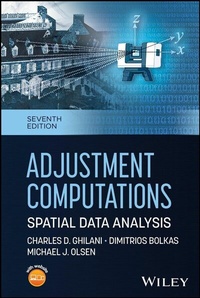
Adjustment Computations
Description

Provides Comprehensive, Up-to-Date Guidance on Spatial Data Accuracy
As modern surveying, mapping, and geospatial technologies continue to evolve, the need for precise data adjustment and error analysis has never been greater. Adjustment Computations: Spatial Data Analysis, Seventh Edition, remains the definitive guide to understanding, applying, and mastering least squares and related techniques that ensure the accuracy of spatial datasets.
This updated edition integrates advances in spatial technologies, with new chapters covering laser scanning, point cloud processing, and parametric model estimation. Updated discussions of ASPRS standards, NSRS updates, and current computational tools reflect the latest professional practices and technologies. The text maintains its clear, pedagogical structure with concise chapters, worked examples, and practical software applications. Providing the analytical tools to deliver high-quality spatial data for diverse applications, this book:
- Includes coverage of laser scanning and its errors, point cloud shape fitting, GNSS networks, coordinate transformations, and parametric modeling
- Incorporates updated standards from ASPRS and the National Spatial Reference System (NSRS)
- Provides access to companion software, MathCAD worksheets, and video lessons for hands-on problem solving
- Balances rigorous mathematics with accessible explanations and real-world surveying applications
- Features real-world case studies of infrastructure documentation, construction, and environmental monitoring
Ideal for undergraduate and graduate courses in surveying, geomatics, and geospatial analysis, Adjustment Computations: Spatial Data Analysis, Seventh Edition, supports curricula in civil engineering, geosciences, and GIS programs. It is also a useful reference for professional surveyors and geospatial analysts seeking to enhance data accuracy and reliability.
More details
Other editions
Additional editions
Content
PREFACE xvii
ACKNOWLEDGMENTS xxiii
ABOUT THE COMPANION WEBSITE xxv
1 Introduction 1
2 Observations and Their Analysis 13
3 Random Error Theory 39
4 Confidence Intervals 57
5 Statistical Testing 81
6 Propagation of Random Errors in Indirectly Measured Quantities 99
7 Error Propagation in Angle and Distance Observations 115
8 Error Propagation in Traverse Surveys 145
9 Error Propagation in Elevation Determination 165
10 Weights of Observations 181
11 Principles of Least Squares 195
12 Adjustment of Level Nets 227
13 Precisions of Indirectly Determined Quantities 245
14 Adjustment of Horizontal Surveys: Trilateration 257
15 Adjustment of Horizontal Surveys: Triangulation 283
16 Adjustment of Horizontal Surveys: Traverses and Horizontal Networks 313
17 Adjustment of GNSS Networks 343
18 Coordinate Transformations 383
19 Error Ellipse 411
20 Constraint Equations 437
21 Blunder Detection in Horizontal Networks 457
22 The General Least-Squares Method and Its Application
23 Three-Dimensional Geodetic Network Adjustment 509
24 Combining GNSS and Terrestrial Observations 535
25 Analyses of Adjustments 567
26 Terrestrial Laser Scanning and Uncertainty Estimation 579
27 Plane, Three-Dimensional Objects, and Elevation Model Estimation with Point Clouds 615
28 Computer Optimization 657
Appendix A Introduction to Matrices 673
Appendix B Solution of Equations by Matrix Methods 689
Appendix C Nonlinear Equations and Taylor's Theorem 703
Appendix D The Normal Error Distribution Curve and Other Statistical Tables 713
Appendix E Confidence Intervals for the Mean 733
Appendix F Companion Website 739
Appendix G Answers to Selected Problems 745
BIBLIOGRAPHY 751
INDEX 757
