

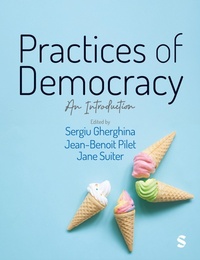
Practices of Democracy
An Introduction
1st Edition
Published on 17. December 2025
304 pages
978-1-0362-0331-3 (ISBN)
Description

The way we engage with politics today has radically shifted. Practices of Democracy: An Introduction is the first comparative politics textbook which offers an engaging assessment of different forms of democracy. With an in-depth yet accessible exploration of four models of democracy - representative, direct, deliberative and technocratic models of government - this book shows how democracy can be strengthened and saved in times of crisis.
Taking a truly global perspective, examples of models of democracy are used to bring theory to life, to show how politics operates today. This pathbreaking new textbook spans all the core concerns of politics - from elections and voting to the role of political parties and legislatures, from political communication to migration and populism. Today, the role of referendums, citizen assemblies and experts shape our societies in profound ways.
Packed with case studies and features, this textbook is essential reading for anyone studying democracies, democratic innovations and Comparative Politics, whether at the undergraduate or postgraduate level.
Sergiu Gherghina is Associate Professor in Comparative Politics at Department of Politics and International Studies, University of Glasgow, UK.
Jean-Benoit Pilet is Professor of Political Science at the Universite libre de Bruxelles, Belgium.
Jane Suiter is Professor of Political Communication in the School of Communications at Dublin City University, Ireland.
Taking a truly global perspective, examples of models of democracy are used to bring theory to life, to show how politics operates today. This pathbreaking new textbook spans all the core concerns of politics - from elections and voting to the role of political parties and legislatures, from political communication to migration and populism. Today, the role of referendums, citizen assemblies and experts shape our societies in profound ways.
Packed with case studies and features, this textbook is essential reading for anyone studying democracies, democratic innovations and Comparative Politics, whether at the undergraduate or postgraduate level.
Sergiu Gherghina is Associate Professor in Comparative Politics at Department of Politics and International Studies, University of Glasgow, UK.
Jean-Benoit Pilet is Professor of Political Science at the Universite libre de Bruxelles, Belgium.
Jane Suiter is Professor of Political Communication in the School of Communications at Dublin City University, Ireland.
Reviews / Votes
A new political science is needed for a new world', wrote Alexis de Tocqueville. This is true as much today as it was in the 19th Century. Combining case studies with grand tour d'horizons, this textbook provides an intelligent and highly readable introduction to the new approaches to the new political climate. This exciting volume not only deserves to be widely read, but it will provide a new standard for textbooks on democracy. -- Matt Qvortrup This book about practices of democracy (institutions, actors, processes) is a timely introduction to democratic government in the 21st century. It goes beyond standard textbooks, because it reflects on most recent developments and provides students with a toolkit to understand and analyse contemporary democracies. -- Brigitte Geissel A timely and insightful contribution, this book offers a clear and systematic exploration of democracy through representative, direct, deliberative and technocratic models. It provides students, scholars and practitioners with a valuable framework for understanding how democracies really function in the 21st century, and how institutions can be strengthened to deal with new challenges. -- Eri Bertsou This book revitalizes comparative politics by organizing learning around democratic practices -representative, direct, deliberative, technocratic- paired with timely, worldwide examples. Students gain analytical traction; instructors gain a flexible structure that translates theory into applied teaching without sacrificing rigor. A welcome innovation. -- Sebastian Lavezzolo This path-breaking textbook starts from the entirely correct premise that to understand contemporary democracy we need to move beyond the common framework of representative democracy. Many of the most significant developments in recent years have been in the areas of direct, deliberative and technocratic democracy. This is definitely going on my course guide! -- David FarrellMore details
Language
English
Place of publication
London
United Kingdom
Publishing group
SAGE Publishing (Digital)
Target group
College/higher education
File size
2,51 MB
ISBN-13
978-1-0362-0331-3 (9781036203313)
Copyright in bibliographic data and cover images is held by Nielsen Book Services Limited or by the publishers or by their respective licensors: all rights reserved.
Schweitzer Classification
Other editions
Additional editions
Book
approx. 12/2025
1st Edition
SAGE Publications Ltd
€113.60
Not yet published
Book
12/2025
1st Edition
SAGE Publications Ltd
€115.50
Shipment within 3-4 weeks
Persons
Sergiu Gherghina is Professor of Comparative Politics at Department of Politics and International Studies, University of Glasgow, UK. His research interests lie in party politics, political participation, democratization and democratic innovations. He advises on several participatory budgeting practices in new democracies. He is the book series editor on democratic innovations for Routledge (since 2021). He published extensively in international peer-reviewed journals including American Journal of Political Science, Comparative Political Studies, Comparative Politics, Electoral Studies, European Political Science Review, International Political Science Review, Party Politics, Political Studies or West European Politics. Jean-Benoit Pilet is Professor of political science at the Universite libre de Bruxelles and member of the CEVIPOL. He has been working on three main topics. The first is elections and electoral systems, with a specific focus on the personalization of electoral systems and on electoral reforms. The second is the transformation of representative democracy, especially looking at the growing impact of direct democracy, deliberative democracy, and technocracy. The third is the role in elected politicians in democracies, and the way they try to connect with citizens. His work has been recently published in some of the top journals in political science, like the American Political Science Review, Comparative Political Studies, the European Journal of Political Research, Political Behavior or the British Journal of Political Science. Jane Suiter is Professor of Political Communication in the School of Communications at Dublin City University and director of DCU's Institute for Future Media, Democracy and Society. Her research focus is on the information environment in the public sphere and in particular on scaling up deliberation and tackling disinformation. She has been involved in various research and oversight capacities on the Irish Citizens' Assembly (2012-2022). She was the joint winner of the Brown Democracy Medal in 2019. She published in international peer-reviewed journals including Electoral Studies, International Political Science Review, Political Communication, Political Studies Review, Representation or Science.
Content
Chapter 1 Practices of Democracy - A theoretical introduction - Sergiu Gherghina, Jean-Benoit Pilet & Jane Suiter
PART I Institutions
Chapter 2 Constitutions and Comparative Politics - Eirikur Bergmann
Chapter 3 Electoral and Voting Systems - Jean-Benoit Pilet and Alan Renwick
Chapter 4 Legislatures - Sofia Serra Silva
Chapter 5 Governments - Keith Dowding and Thiago N. Silva
PART II Actors
Chapter 6 Political Parties - Sergiu Gherghina
Chapter 7 Politicians - Tapio Raunio and Sacha Rangoni
Chapter 8 Civil Society and Social Movements - Ramon A. Feenstra and Juan Merida
PART III Processes and contemporary challenges
Chapter 9 Political Participation - Emilie van Haute and Emilien Paulis
Chapter 10 Political Communication - Jane Suiter and Danicca Fleuss
Chapter 11 Public Opinion - Sebastien Rojon and Davide Vittori
Chapter 12 Migration: From Political Representation to Participation - Sorina Soare and David Talukder
Chapter 13 Populism - Kristof Jacobs
PART I Institutions
Chapter 2 Constitutions and Comparative Politics - Eirikur Bergmann
Chapter 3 Electoral and Voting Systems - Jean-Benoit Pilet and Alan Renwick
Chapter 4 Legislatures - Sofia Serra Silva
Chapter 5 Governments - Keith Dowding and Thiago N. Silva
PART II Actors
Chapter 6 Political Parties - Sergiu Gherghina
Chapter 7 Politicians - Tapio Raunio and Sacha Rangoni
Chapter 8 Civil Society and Social Movements - Ramon A. Feenstra and Juan Merida
PART III Processes and contemporary challenges
Chapter 9 Political Participation - Emilie van Haute and Emilien Paulis
Chapter 10 Political Communication - Jane Suiter and Danicca Fleuss
Chapter 11 Public Opinion - Sebastien Rojon and Davide Vittori
Chapter 12 Migration: From Political Representation to Participation - Sorina Soare and David Talukder
Chapter 13 Populism - Kristof Jacobs
