

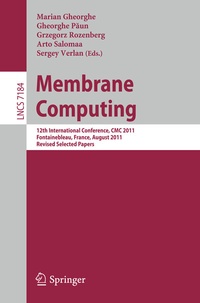
Membrane Computing
12th International Conference, CMC 2011, Fontainebleau, France, August 23-26, 2011, Revised Selected Papers
Published on 13. January 2012
380 pages
978-3-642-28024-5 (ISBN)
Description

This book constitutes the thoroughly refereed post-conference proceedings of the 12th International Conference on Membrane Computing, CMC 2011, held in Fontainebleau, France, in August 2011.
The 19 revised selected papers presented were carefully reviewed and selected from 27 papers and 5 posters presented at the conference. The book also contains full papers or extended abstracts of the 5 invited presentations. The papers address all the main directions of research in membrane computing, ranging from theoretical topics in the mathematics and computer science to application issues.
More details
Other editions
Additional editions
Marian Gheorghe | Gheorghe Paun | Grzegorz Rozenberg
Membrane Computing
12th International Conference, CMC 2011, Fontainebleau, France, August 23-26, 2011, Revised Selected Papers
Book
01/2012
1st Edition
Springer
€53.49
Shipment within 7-9 days
Content
- Title Page
- Preface
- Table of Contents
- Invited Presentations
- Properties of Membrane Systems
- Introduction
- Dynamic Properties
- Effect of Determinism
- Other Models Where Non-determinism Seems Essential
- Effect of Other Variants of Determinism, Reversibility, Confluence and Similar Properties
- Effect of Other Properties
- Self-stabilization
- Conclusions
- References
- Bridging Biology and Engineering Together with Spatial Computing
- Motivation
- Space as a Unifying Abstraction
- Example Applications
- Future Directions
- References
- The Modeling and the Simulation of the Fluid Machines of Synthetic Biology
- Introduction
- A Brief Introduction to MGS
- Lessons from L Systems and P Systems
- The Topological Organization of the State
- Topological Rewriting
- The Modeling of a ``Multicellular Bacteria''
- The international Genetically Engineered Machine (iGEM) Competition
- Objectives of the Synthetic Multicellular Bacterium Project
- The Paris Team Proposal
- One MGS Model of the Synthetic Multicellular Bacterium
- Conclusions
- References
- Parallel and Distributed Algorithms in P Systems
- Introduction
- Preliminaries-Basic Model
- Extensions-P Modules
- Extension-Complex Symbols
- Extension-Generic Rules
- Extension-Cell IDs
- Asynchronous P Systems
- Discovering Neighbours (Async)
- Echo Algorithm (Async)
- Parallel Stereo Matching
- Conclusions
- References
- Variants of Distributed P Automata and the Efficient Parallelizability of Languages
- Introduction
- Preliminaries and Definitions
- The Power of P Automata and the Influence of the Input Mapping
- Distributed P Automata and the Parallelizability of Languages
- The Linear Speedup of P Automata and the Efficiency of Parallelization
- Efficient Parallelizability with More Than a Constant Amount of Inter-component Communication
- Conclusions and Further Suggestions for Research
- References
- Regular Presentations
- Quantitative Causality in Membrane Systems
- Introduction
- Multisets in Membrane Systems
- Specific and General Causality
- Quantitative Results
- Conclusion and Related Work
- References
- Circular Post Machines and P Systems with Exo-insertion and Deletion
- Introduction
- Preliminaries
- Circular Post Machines
- Insertion and Deletion
- Distributed Insertion-Deletion
- Results
- A New Variant of Circular Post Machines
- P Systems with Priority of Exo-deletion
- One-Sided Insertion/Deletion without Priorities
- Conclusions
- References
- A Spiking Neural P System Simulator Based on CUDA
- Introduction
- Spiking Neural P Systems
- The SNP System Model
- Examples of SNP Systems
- Matrix Representation of SNP Systems
- GPU Computing
- Compute Unified Device Architecture (CUDA)
- SNP System GPU Simulation Considerations
- Simulating SNP Systems in CUDA
- Simulation Results and Observations
- Conclusions and Future Work
- References
- Modularity in P Colonies with Checking Rules
- Introduction
- Definitions
- P Colonies
- Register Machines
- Modularity in the Terms of P Colonies
- P Colonies with One Object Inside the Agent
- Conclusion
- References
- Finite dP Automata versus Multi-head Finite Automata
- Introduction
- Preliminaries
- One-Way Multi-head Finite Automata versus Finite dP Automata
- Two-Way Multi-head Finite Automata versus Finite dP Automata
- Further Remarks
- References
- An Adaptive Algorithm for P System Synchronization
- Introduction
- Preliminaries
- Deterministic FSSP Solution for Rooted Trees
- P Systems for Solving the FSSP for Rooted Trees
- Phase I: Find the Middle Cell of Rooted Trees
- Phase II: Determine the Step to Enter the Firing State
- Empirical Work
- FSSP Solution for Digraphs
- P Systems for Solving the FSSP for Digraphs
- Phase I: Find the Middle Cell of a BFS Spanning Tree
- Phase II: Determine the Step to Enter the Firing State
- Empirical Work
- Conclusions and Future Works
- References
- P Systems with Active Membranes Operating under Minimal Parallelism
- Introduction
- Basic Definitions
- Operational Modes in P Systems
- Solving NP-Complete and PP-Complete Problems
- Computational Power
- Final Remarks
- References
- Chemical Analog Computers for Clock Frequency Control Based on P Modules
- Introduction
- P Modules
- Chemical Analog Computer Components
- Mass-Action Kinetics
- Addition
- Non-negative Subtraction
- Multiplication
- Division
- Square Root
- Low-Pass Filter
- Integrator and Differentiator
- Clock Frequency Control Using Phase-Locked Loops
- A Controllable Goodwin-Type Core Oscillator
- Goodwin-Type Circadian Clock Control by Phase-Locked Loop
- Conclusions
- References
- Evolutionary Design of a Simple Membrane System
- Introduction
- Problem Description
- Cell-Like P Systems
- Problem Statement
- Evolutionary Design
- Experiments and Results
- An Example for Computing n2
- Comparison with Genetic Algorithms
- Conclusions
- References
- Formal Verification of P Systems with Active Membranes through Model Checking
- Introduction
- Background
- P Systems
- Linear Temporal Logic
- Theoretical Basis for Model Checking of P Systems with Active Membranes
- Case Study: The Subset Sum Problem
- Experimental Results
- Related Work
- Conclusions and Future Work
- References
- Basic Concurrency Resolution in Clock-Free P Systems
- Introduction
- Concurrency: Clock-Free P Systems vs. P Systems with a Global Clock
- Preliminaries
- P Systems
- Concurrency
- Strategies
- Synchronisation of Rule Applications
- Sequential Strategy
- Barrier Synchronisation Strategy
- Synchronisation of Processes
- Lock
- Semaphore
- The Dining Philosophers Problem
- Conclusion
- References
- Asynchronous Extended Spiking Neural P Systems with Astrocytes
- Introduction
- Prerequisites
- Spiking Neural P Systems with Astrocytes
- Universality of ASNPA Systems
- Conclusions and Remarks
- References
- A P--Lingua Based Simulator for Spiking Neural P Systems
- Introduction
- Preliminaries
- P-Lingua Syntax for SN P Systems
- Regular Expressions
- Model Specification
- Sample of the First Few Lines of a P-Lingua SN P System Definition File
- Definition of Multisets
- Definition of Rules
- Definition of the Output
- Reserved Words
- A Simulator Software for SN P Systems
- An Example: A Family of SN P Systems Solving SAT
- Description of the Family
- A P-Lingua Source Code. Particular Instance Solution of SAT Problem
- Generalized P-Lingua Source Code for the Family of SN P Systems Solving SAT
- Simulation Results
- Performance
- Conclusions and Future Work
- References
- Computing with Multi-membranes
- Introduction
- Multi-membranes
- Computing with Multi-membranes
- Examples of Multi-membrane Systems
- Computational Universality
- More Complex Examples of Computation
- Conclusions
- References
- A Methodology Based on MP Theory for Gene Expression Analysis
- Introduction
- Gene Networks
- MP Modelling of Gene Networks
- From Raw Data to MP Models
- Normalization and Reduction of Raw Data
- Data Filtering
- Data Clustering
- From Data Clustering to Gene Networks via MP Systems
- Conclusions
- References
- Generalized Gandy-P\?aun-Rozenberg Machines for Tile Systems and Cellular Automata
- Introduction
- generalized Gandy-¶-Rozenberg Machines
- generalized G-P-R Machines for Cellular Automata
- Conclusion
- Appendix
- References
- Sequentiality Induced by Spike Number in SNP Systems: Small Universal Machines
- Introduction
- Basic Description and Definitions
- Spiking Neural P Systems
- Max Pseudo-sequentiality Result
- Final Remarks
- References
- P Systems Simulating Oracle Computations
- Introduction
- Definitions
- Simulating Turing Machines
- Simulating Oracle Machines
- Informal Description of the Simulation of Oracle Queries
- Technical Details
- Main Result
- Conclusions
- References
- P Systems with Chained Rules
- Introduction
- Preliminaries
- Lindenmayer Systems
- Register Machines
- P Systems with Chained Rules
- Conclusions
- References
- Author Index
