

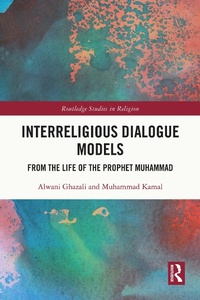
Interreligious Dialogue Models
From the Life of the Prophet Muhammad
1st Edition
Published on 15. December 2023
166 pages
978-1-003-81206-7 (ISBN)
Description

How did the Prophet Muhammad (pbuh) converse and engage with other religious believers? Did he start off with prejudice and mistrust? Or was he convivial and open-minded? This book analyses six models of the dealings in the lifetime of the Prophet Muhammad (pbuh), specifically, but not restricted, to the siblings of Abrahamic religious believers.
The six models of dialogue analysed in the book are dialogue with Ashamah, Najashi of Abyssinia, delegation of Najran Christians, different Jews of Yathrib, and emperors of Byzantine and Sassanid. The analysis applies Ibn Khaldun's (d. 1406) historical approach which the author termed as Khaldunian Hermeneutics due to the similarity between his ideas to that of Johann Gustav Droysen (d. 1884), a German philosopher, in historical hermeneutics. As such, the analysis goes beyond the dialogue content, taking into consideration the immediate and larger contextual settings, and changes of the contexts due to the passage of time. It critically considers the suitability of each model due to the difference in times and contexts.
The book serves as a reference for Muslim dialogue advocates and practitioners, to provide substantial evidence of the dialogue application by the role model of Muslims - the Prophet Muhammad (pbuh) whom they hold very dear to their hearts.
The six models of dialogue analysed in the book are dialogue with Ashamah, Najashi of Abyssinia, delegation of Najran Christians, different Jews of Yathrib, and emperors of Byzantine and Sassanid. The analysis applies Ibn Khaldun's (d. 1406) historical approach which the author termed as Khaldunian Hermeneutics due to the similarity between his ideas to that of Johann Gustav Droysen (d. 1884), a German philosopher, in historical hermeneutics. As such, the analysis goes beyond the dialogue content, taking into consideration the immediate and larger contextual settings, and changes of the contexts due to the passage of time. It critically considers the suitability of each model due to the difference in times and contexts.
The book serves as a reference for Muslim dialogue advocates and practitioners, to provide substantial evidence of the dialogue application by the role model of Muslims - the Prophet Muhammad (pbuh) whom they hold very dear to their hearts.
More details
Series
Edition
1. Auflage
Language
English
Place of publication
London
United Kingdom
Publishing group
Taylor & Francis Ebooks
Target group
College/higher education
Illustrations
1 Tables, black and white
ISBN-13
978-1-003-81206-7 (9781003812067)
Copyright in bibliographic data and cover images is held by Nielsen Book Services Limited or by the publishers or by their respective licensors: all rights reserved.
Schweitzer Classification
Other editions
Additional editions
Book
05/2025
1st Edition
Routledge
€66.80
Shipment within 10-20 days
Book
12/2023
1st Edition
Routledge
€205.80
Shipment within 10-20 days
Persons
Alwani Ghazali is Senior Lecturer of the Department of Aqidah and Islamic Thought, Academy of Islamic Studies, Universiti Malaya. She is a member of King Abdullah bin Abdulaziz International Centre for Interreligious and Intercultural Dialogue (KAICIID) Fellowship. Her research interests are in the areas of religions, dialogue and peaceful coexistence, and she has published on topics such as interreligious dialogue and Prophetic Dialogue.
Muhammad Kamal is a Kurd from Iraq. He obtained his BA (Honours), MA and PhD degrees in Philosophy at the University of Karachi, Pakistan where he taught first as a lecturer and then as an assistant professor in the Department of Philosophy. He went to Germany on DAAD scholarship for postdoctoral research and is currently a senior lecturer at the University of Melbourne. He has published extensively in the area of Muslim philosophy.
Muhammad Kamal is a Kurd from Iraq. He obtained his BA (Honours), MA and PhD degrees in Philosophy at the University of Karachi, Pakistan where he taught first as a lecturer and then as an assistant professor in the Department of Philosophy. He went to Germany on DAAD scholarship for postdoctoral research and is currently a senior lecturer at the University of Melbourne. He has published extensively in the area of Muslim philosophy.
Content
Table of Contents
Acknowledgments
Foreword
Preface
Introduction
Chapter 1
Dialogue and Islam: An Introduction
Chapter 2
On Dialogue in The Qur'an and The Sunnah
Chapter 3
Christian-Muslim Dialogue in The Sirah - Two Scenes
Chapter 4
Jews Muslims in The Sirah - Was There A Dialogue?
Chapter 5
Widening the Horizon -From Inter-Faith Dialogue in The City to Dialogue Between Civilisations
Chapter 6
From Text to Context -Bridging The Historical Interval
Conclusion
Bibliography
Appendix
Index
Acknowledgments
Foreword
Preface
Introduction
Chapter 1
Dialogue and Islam: An Introduction
Chapter 2
On Dialogue in The Qur'an and The Sunnah
Chapter 3
Christian-Muslim Dialogue in The Sirah - Two Scenes
Chapter 4
Jews Muslims in The Sirah - Was There A Dialogue?
Chapter 5
Widening the Horizon -From Inter-Faith Dialogue in The City to Dialogue Between Civilisations
Chapter 6
From Text to Context -Bridging The Historical Interval
Conclusion
Bibliography
Appendix
Index
