

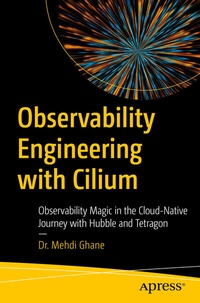
Observability Engineering with Cilium
Description

In the dynamic realm of software deployment, the rise of cloud-native technologies has transformed technological and cultural standards. This shift, while bringing innovation and agility, also introduces paradigms and complexities with the interplay of microservices in on-prem, multi and hybrid cloud. To address these challenges, Observability engineering is now a necessity and is crucial for survival in the competitive world of Industry 4.0, AI and cloud native.
Observability Engineering with Cilium dives into the cloud-native ecosystem, exploring observability's core principles and applications. The goal is to delve into the under-addressed aspects of observability critical for cloud-native deployment. It aims to provide a deep understanding of cloud-native environments. Throughout, we demystify key definitions, paradigms and shed light on socio-economic and socio-technical change, Conway's Law, maturity models and other less-discussed aspects to guide you in designing, building, and operating a comprehensive Observability platform, leveraging technologies like Kubernetes, service mesh and eBPF and tools like Cilium, Hubble, Tetragon, Prometheus, OpenTelemetry, Cribl, Splunk, Pixie, Falco, Grafana Beyla and Alloy.
By the end of this book, you'll have the tools to level up your knowledge base to become a sophisticated cloud-native observability engineer.
You Will Learn:
- The complexities of cloud-native environments by exploring modern observability patterns with technologies like eBPF, Cisco Cilium, and innovative methodologies
- How to effectively utilize eBPF across on-prem and hybrid cloud environments
- How to identify risks in your cloud-native journey as well as how to mitigate them
- Insights into software instrumentation essential for effective monitoring and diagnostics
- How to navigate trade-offs, processes, and challenges to enhance observability efficiency KPIs
This Book is for:
Kubernetes specialists, and application architects, as well as CISOs, CTOs, and CIOs who wish to learn how to utilize modern concepts to plan, design and operate a flexible Observability platform that backs you during migration from current state of operation to the cloud-native state.
More details
Other editions
Additional editions
Person
Dr Mehdi Ghane is a Cloud-Native and DataCenter Delivery Director, recognized for expertise in FinOps, MLOps, NoOps coaching and Disciplined Agile Delivery. With a significant impact on both DataCenter and Cloud landscapes, he specializes in cloud-native software delivery, focusing on observability and scalability in hybrid cloud infrastructure. Mehdi is a thought leader at the intersection of socio-technical and socio-economic mentoring. As a dedicated scholar, Mehdi holds a Ph.D in DataCenter Energy Engineering and serves as a Professor of Engineering Mathematics, and Scientific Computing. His academic contributions span textbooks, high-impact papers, seminars, and workshops, covering topics such as DataCenter consolidation, reliability engineering, and scientific computing.
Residing in Frankfurt, Mehdi has built an extensive career, holding key roles such as CIO, Design Manager, Technology Architect, Engineering Manager, Principal SRE in hyperscale DataCenters, capital markets, financial institutions, and other mission-critical infrastructures. For more information, visit his LinkedIn page.
Content
Part One.- Chapter 1: The Groundwork.- Chapter 2: Cloud Native Phenomena.- Chapter 3: Cloud Native Maturity Models.- Chapter 4: Observability Engineering Fundamentals.- Chapter 5: Instrumentation Engineering Fundamentals.- Chapter 6: Demystifying Cilium Spellbinding Nature.- Part Two .- Chapter 7: Delineating Cilium Core Architecture.- Chapter 8: Portraying Cilium Use Cases.- Chapter 9: Observing the Unseen with Cilium and Grafana.- Chapter 10: Cilium Outstanding, Yet Not Alone.
