

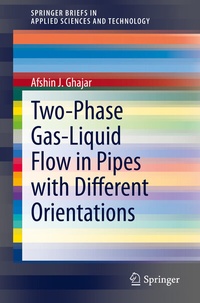
Two-Phase Gas-Liquid Flow in Pipes with Different Orientations
Description

This book provides design engineers using gas-liquid two-phase flow in different industrial applications the necessary fundamental understanding of the two-phase flow variables. Two-phase flow literature reports a plethora of correlations for determination of flow patterns, void fraction, two- phase pressure drop and non-boiling heat transfer correlations. However, the validity of a majority of these correlations is restricted over a narrow range of two -phase flow conditions. Consequently, it is quite a challenging task for the end user to select an appropriate correlation/model for the type of two-phase flow under consideration. Selection of a correct correlation also requires some fundamental understanding of the two-phase flow physics and the underlying principles/assumptions/limitations associated with these correlations. Thus, it is of significant interest for a design engineer to have knowledge of the flow patterns and their transitions and their influence on two-phase flow variables. To address some of these issues and facilitate selection of appropriate two-phase flow models, this volume presents a succinct review of the flow patterns, void fraction, pressure drop and non-boiling heat transfer phenomenon and recommend some of the well scrutinized modeling techniques.
More details
Other editions
Additional editions
Person
Dr. Afshin J. Ghajar is Regents and John Brammer Endowed Professor in the School of Mechanical and Aerospace Engineering at Oklahoma State University, Stillwater, Oklahoma, USA and an Honorary Professor of Xi'an Jiaotong University, Xi'an, China. Professor Ghajar and his co-workers have published over 250 reviewed research papers and 11 book/handbook chapters. His latest awards are the 75 th Anniversary Medal of the ASME Heat Transfer Division (2013), the ASME ICNMM Outstanding Leadership Award (2016), and the Donald Q. Kern Award (2017). He is a Fellow of ASME, Heat Transfer Series Editor for CRC Press/Taylor & Francis, and Editor-in-Chief of Heat Transfer Engineering, He is also the co-author of the 6 th Edition of Cengel and Ghajar, Heat and Mass Transfer - Fundamentals and Applications , McGraw-Hill Education, 2020
Content
Nomenclature.- Introduction.- Two-Phase Flow Experimental Setup for Inclined Systems.- Flow Patterns, Flow Pattern Maps, and Flow Pattern Transition Models.- Void Fraction.- Pressure Drop.- Entrainment.- Non-Boiling Two-Phase Heat Transfer.- References.
