

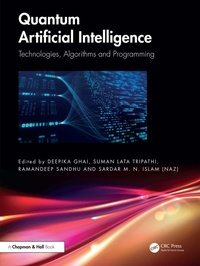
Quantum Artificial Intelligence
Technologies, Algorithms and Programming
1st Edition
Published on 5. June 2026
160 pages
978-1-040-67645-5 (ISBN)
Description

This book explores the transformative potential of quantum computing in artificial intelligence (AI) and its impact on various fields. It delves into the foundational concepts, mathematical frameworks, and algorithmic paradigms, providing a roadmap for interdisciplinary research of quantum computing in AI. With a focus on practical applications and prospects, this book bridges the gap between theory and practice, empowering readers to harness the transformative power of quantum technologies for societal and technological advancement.
Key Features
* Examines the architecture, foundations, mathematics, algorithms, programming, encryption techniques, predictive data analysis, tools/software, and applications associated with quantum computing in AI.
* Explores the challenges of quantum hardware scalability and stability, and outlines error correction and mitigation strategies in quantum computing.
* Discusses applications in industries like finance, healthcare, cybersecurity, and transportation, offering innovative solutions to complex challenges.
* Provides analysis of quantum encryption methods for enhanced data security in AI systems.
* Offers an evaluation of the cost-effectiveness and practicality of quantum computing solutions.
It is a reference work for academics, scholars, and researchers interested in quantum computing in AI.
Key Features
* Examines the architecture, foundations, mathematics, algorithms, programming, encryption techniques, predictive data analysis, tools/software, and applications associated with quantum computing in AI.
* Explores the challenges of quantum hardware scalability and stability, and outlines error correction and mitigation strategies in quantum computing.
* Discusses applications in industries like finance, healthcare, cybersecurity, and transportation, offering innovative solutions to complex challenges.
* Provides analysis of quantum encryption methods for enhanced data security in AI systems.
* Offers an evaluation of the cost-effectiveness and practicality of quantum computing solutions.
It is a reference work for academics, scholars, and researchers interested in quantum computing in AI.
More details
Edition
1. Auflage
Language
English
Place of publication
London
United Kingdom
Publishing group
Taylor & Francis Ltd
Target group
Professional and scholarly
Product notice
Reflowable
Illustrations
16 Tables, black and white; 76 Line drawings, black and white; 21 Halftones, black and white; 97 Illustrations, black and white
File size
6,52 MB
ISBN-13
978-1-040-67645-5 (9781040676455)
Copyright in bibliographic data and cover images is held by Nielsen Book Services Limited or by the publishers or by their respective licensors: all rights reserved.
Schweitzer Classification
Other editions
Additional editions
Deepika Ghai | Suman Lata Tripathi | Ramandeep Sandhu
Quantum Artificial Intelligence
Technologies, Algorithms and Programming
Book
approx. 06/2026
1st Edition
Chapman & Hall/CRC
€160.50
Not yet published
Persons
Deepika Ghai earned her Ph.D in Signal and Image Processing from Punjab Engineering College (Deemed to be University), Chandigarh. She did her M.Tech in VLSI Design & CAD at Thapar University, Patiala, and B.Tech in Electronics and Communications Engineering at Rayat Institute of Engineering and Technology, Ropar. At Lovely Professional University, she is an Associate Professor with more than eight years of experience in academics. She received the Dr. C.B. Gupta Award in 2021 at Lovely Professional University. She has published more than 50 research papers in refereed journals and conferences. Her area of expertise includes Signal and Image Processing, Bio-medical Signal and Image Processing, Artificial Intelligence, Machine Learning, Deep Learning, and VLSI Signal Processing.
Suman Lata Tripathi is a Professor at Symbiosis Institute of Technology (SIT), Symbiosis International (Deemed University), Pune, with more than 23 years of experience in academics. She earned her Ph.D. in microelectronics and VLSI Design from MNNIT, Allahabad. She did her M.Tech in Electronics Engineering at UP Technical University, Lucknow, and her B.Tech in Electrical Engineering at Purvanchal University, Jaunpur. She was also a remote post-doc researcher at Nottingham Trent University, London, UK, in 2022. She has published more than 181 research papers in refereed Springer, Elsevier, IEEE, and IOP science journals, conference proceedings, and e-books. She received the "Research Excellence Award" in 2019 and "Research Appreciation Award" in 2020-2024 at Lovely Professional University, India. She has also received a funded project from SERB DST under the TARE scheme in the area of microelectronic devices. Her area of expertise includes microelectronics device modeling and characterization, low-power VLSI circuit design, VLSI design of testing, advanced FET design for IoT, Embedded System Design, reconfigurable architecture with FPGAs and biomedical applications.
Ramandeep Sandhu is an Associate Professor at Lovely Professional University with more than 17 years of experience in academics. She earned her Ph.D. in Computer Science and Engineering from Lovely Professional University, Phagwara, Punjab, India. She did her M.Tech and B.Tech in Computer Science and Engineering at Guru Nanak Dev Engineering College, Ludhiana, Punjab, India. She has published more than 30 research papers in journals & conferences. Her academic and research expertise includes Cloud Computing, Cloud Optimization, Machine Learning, Quantum Computing, Data Sciences, Opinion Mining/Sentiment Analysis, C/C++, and Python. She has also published 2 authored books on C++.
Sardar M. N. Islam (Naz) Ph. D, LL.B. (Law) is a Professor, ISILC, & Victoria University, Australia. He is also a Distinguished Visiting Professor of Artificial Intelligence, UniSri, and an Adjunct Professor of IT and Business at Armstrong Institute, Melbourne, Australia. He has published 31 authored books, plus 4 edited books and about 250 articles, including 60 Q1 and Q2 grade journal articles. He is the Editor-in-Chief of International Transactions on Artificial Intelligence - An AI and Modelling journal. His area of research includes Quantum Computing and Artificial Intelligence.
Suman Lata Tripathi is a Professor at Symbiosis Institute of Technology (SIT), Symbiosis International (Deemed University), Pune, with more than 23 years of experience in academics. She earned her Ph.D. in microelectronics and VLSI Design from MNNIT, Allahabad. She did her M.Tech in Electronics Engineering at UP Technical University, Lucknow, and her B.Tech in Electrical Engineering at Purvanchal University, Jaunpur. She was also a remote post-doc researcher at Nottingham Trent University, London, UK, in 2022. She has published more than 181 research papers in refereed Springer, Elsevier, IEEE, and IOP science journals, conference proceedings, and e-books. She received the "Research Excellence Award" in 2019 and "Research Appreciation Award" in 2020-2024 at Lovely Professional University, India. She has also received a funded project from SERB DST under the TARE scheme in the area of microelectronic devices. Her area of expertise includes microelectronics device modeling and characterization, low-power VLSI circuit design, VLSI design of testing, advanced FET design for IoT, Embedded System Design, reconfigurable architecture with FPGAs and biomedical applications.
Ramandeep Sandhu is an Associate Professor at Lovely Professional University with more than 17 years of experience in academics. She earned her Ph.D. in Computer Science and Engineering from Lovely Professional University, Phagwara, Punjab, India. She did her M.Tech and B.Tech in Computer Science and Engineering at Guru Nanak Dev Engineering College, Ludhiana, Punjab, India. She has published more than 30 research papers in journals & conferences. Her academic and research expertise includes Cloud Computing, Cloud Optimization, Machine Learning, Quantum Computing, Data Sciences, Opinion Mining/Sentiment Analysis, C/C++, and Python. She has also published 2 authored books on C++.
Sardar M. N. Islam (Naz) Ph. D, LL.B. (Law) is a Professor, ISILC, & Victoria University, Australia. He is also a Distinguished Visiting Professor of Artificial Intelligence, UniSri, and an Adjunct Professor of IT and Business at Armstrong Institute, Melbourne, Australia. He has published 31 authored books, plus 4 edited books and about 250 articles, including 60 Q1 and Q2 grade journal articles. He is the Editor-in-Chief of International Transactions on Artificial Intelligence - An AI and Modelling journal. His area of research includes Quantum Computing and Artificial Intelligence.
Content
1. Introduction to Quantum Computing and Artificial Intelligence 2. Role of Artificial Intelligence in Quantum Computers: A New Era of Advancements 3. Navigating the Fusion of Quantum Artificial Intelligence Paradigm Principles and Algorithms 4. Future of Quantum Computing: Emerging Trends, Challenges and Applications 5. Quantum Encryption Techniques for Quantum Computers 6. Quantum Artificial Intelligence and its Benefits for Businesses 7. E-business using Quantum Computing and Quantum Artificial Intelligence Methodologies 8. A Comprehensive Analysis of the Integration of Quantum Artificial Intelligence with the Internet of Things 9. Quantum Adaptive Key Management and Optimization Network (QAKM-ON): Blockchain Integration to Enhance the Efficiency and Privacy in Quantum Networks 10. Blockchain-Powered Framework Scheme for Quantum Defensive Artificial Intelligence 11. Utilizing Quantum Computing for Modern Agriculture 12. Pros and Cons of Quantum Artificial Intelligence w.r.t. Applications 13. Unravelling the Mysteries of Quantum Entanglement's Revolution in Computing and Communication 14. Quantum Artificial Intelligence for Environmental Management
