

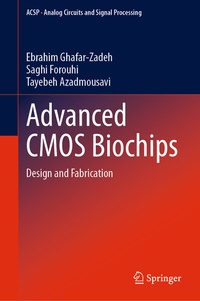
Advanced CMOS Biochips
Description

Biochips incorporate a verity of means including electronic, photonic and microfluidic devices; biological materials (living cells, tissue, enzymes, nucleic acid and etc.) and chemical analysis to produce the detectable signals for identification of biological phenomena. Among several competing biochip technologies, Complementary Metal Oxide Semiconductor (CMOS) process offers the advantages of low cost, integrated, high precision and portable techniques suitable for point-of-care diagnostics.
Advanced CMOS Biochip takes multi-path approach: microelectronic design and implementation of bio-interfaces offering a vital contemporary view of a wide range of integrated circuits and system for electrical, magnetic, optical and mechanical sensing and actuating blocks and much more; classical knowledge of biology, biochemistry as well as microfluidics. The coverage is both practical and in depth integrating experimental, theoretical and simulation examples. By using Advanced CMOS Biochip , readers will have the fundamentals and design techniques to grasp the situation which arise typically in CMOS biochip devices.
More details
Other editions
Additional editions
Persons
Ebrahim Ghafar-Zadeh received his BSc and MSc in Electrical Engineering from KNT University (1995) and Tehran University (1997), both in Tehran. From 2004 to 2008, he pursued his PhD studies at École Polytechnique de Montréal (Montreal, Canada). In 2008, Dr. Ghafar-Zadeh received several postdoctoral fellowship awards, including the PDF NSERC Canada and PDF FQRNT Quebec, which allowed him to continue his research in CMOS biochip design in the Departments of Electrical Engineering and Bioengineering at McGill University and the University of California, Berkeley. In 2023, he joined the Department of Electrical Engineering and Computer Science at the Lassonde School of Engineering, York University, where he is currently an Associate Professor and directs a biologically inspired Sensors and Actuators (BioSA) laboratory. His research is supported by NSERC Canada, CIHR, Mitacs, and other funding agencies in Canada. Dr. Ghafar-Zadeh's research focuses on CMOS sensors, artificial intelligence (AI)-based sensing mechanisms, and point-of-care diagnostics. To date, he has trained more than 60 highly qualified personnel and published over 200 papers in conferences and journals, as well as four books on the topic of CMOS sensor.
Saghi Forouhi earned her B.Sc. and M.Sc. degrees in Electronics Engineering from Guilan University, Iran, in 2010 and 2012, respectively. She received her Ph.D. from Isfahan University of Technology (IUT), Iran, in 2019, through active collaboration between IUT and York University, Canada. She subsequently continued her work with York University as a research associate and postdoctoral researcher. She also worked as a research associate in collaboration with York University and the University of Calgary in Canada. She later joined the Department of Electrical Engineering (ISY), Division of Electronics and Computer Engineering (ELDA), at Linköping University, Sweden. Her research focuses on CMOS analog and mixed-signal integrated circuits, particularly integrated sensors and biosensors.
Tayebeh Azadmousavi earned both her B.Sc. and M.Sc. degrees in electronic engineering from Urmia University, located in Urmia, Iran, in 2011 and 2013 respectively. She later achieved her Ph.D. degree in electronic engineering from Sahand University of Technology in Sahand New Town, Tabriz, Iran, in 2019. During her academic journey, Dr. Azadmousavi's exceptional accomplishments stood out. She was notably recognized as a distinguished Ph.D. researcher by the Faculty of Electrical Engineering at Sahand University of Technology in 2019. Additionally, she secured the distinction of being the top Ph.D. graduate from Iran's National Elites Foundation in the same year. Currently serving as an Assistant Professor at the University of Bonab in Bonab, Iran. Her research pursuits encompass a diverse array of topics, including low voltage/low power analog and digital integrated circuits, analog integrated circuits operating in current mode and voltage mode, wireless RFIC design, as well as the innovative field of biosensors.
