

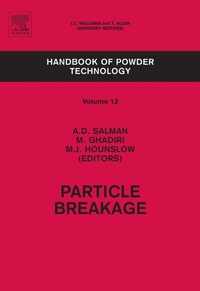
Particle Breakage
Published on 14. May 2014
1240 pages
978-0-08-055346-7 (ISBN)
Description

Particle breakage is an important process within a wide range of solids processing industries, including pharmaceuticals, food, agricultural and mining. Breakage of particles can be defined as intentional and unintentional, depending on whether it is desired or not. Through understanding of the science and underlying mechanisms behind this phenomenon, particle breakage can be either minimised or encouraged within an efficient and effective process. Particle Breakage examines particle breakage at three different length scales, ranging from single particle studies through groups of particles and looking at solid processing steps as a whole. This book is the widest ranging book in the field and includes the most up-to-date techniques such as Distinct Element Method (DEM), Monte Carlo simulations and Population Balance Equations (PBE). This handbook provides an overview of the current state-of-the- art and particle breakage. From the small scale of a single particle, to the study of whole processes for breakage; both by experimental study and mathematical modelling.* Covering a wide range of subjects and industrial applications* Allows the reader an understanding of the science behind engineered breakage processes* Giving an unrestrictive and interdisciplinary approach
More details
Series
Edition
New ed.
Language
English
Place of publication
Amsterdam
Netherlands
Product notice
Windows
Illustrations
Illustrated
ISBN-13
978-0-08-055346-7 (9780080553467)
Copyright in bibliographic data and cover images is held by Nielsen Book Services Limited or by the publishers or by their respective licensors: all rights reserved.
Schweitzer Classification
Other editions
Additional editions
Agba D. Salman | Mojtaba Ghadiri | Michael Hounslow
Particle Breakage: Volume 12
Book
10/2007
Elsevier
€346.64
Withdrawn from sale
Content
- Cover
- Contents
- Contributors
- Foreword
- Part I: Fundamental
- Chapter 1. Breakage of Single Particles: Quasi-Static
- 1. Introduction
- 2. Single-Particle Impact Testing
- 3. Drop Weight Testing
- 4. Pendulum Testing
- 5. Compression Testing
- 6. Hopkinson Pressure Bar and Impact Load Cell
- 7. Particle Breakage Characteristics
- 8. Influence of Selected Variables on Particle Breakage Characteristics
- 9. Application to Comminution
- Acknowledgements
- Appendix: Definition of terms
- References
- Chapter 2. Impact Breakage of Single Particles: Double Impact Test
- 1. Introduction
- 2. Background and Literature Review
- 3. Double Impact Tests
- 4. Key Issues
- 5. Summaries of Recent Development
- 6. Forward Look
- Acknowledgments
- References
- Chapter 3. Particle Breakage due to Bulk Shear
- 1. Breakage in the Bulk
- 2. Testing Methods
- 3. Understanding and Application
- 4. Subject Development
- 5. Recent Work
- 6. What Next?
- References
- Chapter 4. The Principles of Single-Particle Crushing
- 1. Introduction
- 2. Terminology
- 3. Definition
- 4. Concepts of Investigation
- 5. Crusher as a System
- 6. Crushing Parameters
- 7. Applications
- Acknowledgements
- References
- Part II: Milling
- Chapter 5. Rotor Impact Mills
- 1. Introduction
- 2. Model of the Milling Process in Rotor Impact Mills
- 3. Control of Fineness
- 4. Scale-Up
- 5. Designs
- References
- Chapter 6. Wet Grinding in Stirred Media Mills
- 1. Introduction: Design and Principal Operation of Stirred Media Mills
- 2. Fundamental Considerations
- 3. Influence of Important Operating Parameters on the Grinding and Dispersing Result
- 4. Transport Behaviour and Operation Mode
- 5. Operation of Stirred Media Mills
- 6. Scale-Up
- References
- Chapter 7. Roller Milling of Wheat
- 1. Introduction
- 2. The Structure of the Wheat Kernel
- 3. The International Development of Modern Flour Milling
- 4. Roller Milling of Wheat Kernels
- 5. Key Issues in Milling of Wheat
- 6. Breakage of Wheat Kernels During First Break Roller Milling
- 7. Pearling of Wheat Prior to Milling
- 8. Conclusions
- Acknowledgements
- References
- Chapter 8. Air Jet Milling
- 1. Introduction
- 2. The Different Types of Air Jet Mill
- 3. Modelling
- 4. Examples of Application
- References
- Chapter 9. Breakage and Morphological Parameters Determined by Laboratory Tests
- 1. Introduction
- 2. Operation of Ball Mills
- 3. Morphological Parameters of Minerals Ground by Different Mills
- 4. Summary
- 5. Concluding Remarks
- References
- Chapter 10. Selection of Fine Grinding Mills
- 1. Introduction
- 2. Classification of Fine Grinding Mills
- 3. Features and Selections of Fine Grinding Mills
- 4. Selection After the Particle Size of Feed and Product
- 5. Selection After the Feed Properties
- 6. Fine Grinding Operation and Mill Selection
- 7. Applications of Fine Grinding Mills to Particle Modification
- 8. Conclusions
- References
- Chapter 11. Fine Grinding of Materials in Dry Systems and Mechanochemistry
- 1. Introduction
- 2. Fine Grinding Mills
- 3. Rate Process of Grinding Phenomena
- 4. Simulation of Media Motion During Milling
- 5. Mechanochemistry and Nano-Particles Formation by Dry Grinding
- References
- Chapter 12. Comminution Energy and Evaluation in Fine Grinding
- 1. Introduction
- 2. Laws of Comminution Energy
- 3. Crushing of Single Particles
- 4. Crushing Resistance and Grindability
- 5. Ball Mill Grinding
- References
- Chapter 13. Enabling Nanomilling through Control of Particulate Interfaces
- 1. Introduction
- 2. Particle Interactions in Suspensions
- 3. Stabilization of Particles Against Aggregation
- 4. Influence of Particle Interactions on Suspension Rheology in Stirred Media Mills
- 5. Experiments in Nanomilling
- 6. Mechano-Chemical Effects During Nanomilling
- 7. Summary
- References
- Chapter 14. Analysis of Milling and the Role of Feed Properties
- 1. Introduction
- 2. Energy Laws Revisited
- 3. Evaluation of Milling Rate
- 4. Population Balance Models
- 5. Role of Feed Properties and Definition of Dimensionless Groups Describing the Breakage Propensity
- 6. Analysis of Milling Rate Based on the Input Power and Material Properties
- 7. Conclusions
- References
- Part III: Modelling
- Chapter 15. Monte Carlo Method for the Analysis of Particle Breakage
- 1. Introduction
- 2. Particle Breakage and Grinding
- 3. Monte Carlo Method
- 4. Monte Carlo Approach to Batch Grinding
- 5. Numerical Results and Discussion
- 6. Summary
- References
- Chapter 16. Numerical Investigation of Particle Breakage as Applied to Mechanical Crushing
- 1. Particle Breakage Modelling
- 2. Realistic Failure Process Analysis (RFPA) Code and Verification
- 3. Particle Breakage Under Static Loading
- 4. Particle Breakage Under Dynamic Loading
- 5. Single-Particle Breakage Under Various Loading Conditions
- 6. Inter-Particle Breakage
- 7. Summary
- Acknowledgements
- References
- Chapter 17. The Cohesion of Fractal Agglomerates: An Elementary Numerical Model
- 1. Introduction
- 2. Universality of the Fractal Structures
- 3. The Cohesion Concept
- 4. Background and Literature Review
- 5. The Cohesion of Fractal Agglomerates: An Elementary Model
- 6. Forward Look
- 7. Conclusion
- Acknowledgements
- References
- Chapter 18. The Linear Breakage Equation: From Fundamental Issues to Numerical Solution Techniques
- 1. Introduction
- 2. Problem Formulation
- 3. Iterative and Analytical Solutions of the Breakage Equation
- 4. Self-Similar Solutions of the Breakage Equation
- 5. Special Cases of Breakage
- 6. Methods of Moments
- 7. Sectional Methods
- 8. Current and Future Research Topics on Breakage Equation
- References
- Chapter 19. Analysis of Agglomerate Breakage
- 1. Introduction
- 2. Models of Agglomerate Strength and Failure
- 3. Distinct Element Method
- 4. Agglomerate Behaviour in a Bed of Particles Subjected to Shearing
- References
- Chapter 20. Modelling of Mills and Milling Circuits
- 1. Introduction
- 2. Examples of Milling Circuits
- 3. Modelling Levels for Milling Circuits
- 4. Determination of Model Parameters
- 5. Flowsheeting for Solid Processes
- 6. Discussion of the Main Influencing Parameters
- References
- Part IV: Applications
- Chapter 21. Particle Strength in an Industrial Environment
- 1. Introduction
- 2. Particle Breakage and Wear
- 3. Simulating Particle Strength by Numerical Modelling
- 4. Fatigue by Repeated Loading
- 5. Fundamental Multiple Granule Breakage Tests
- 6. Experimental Studies on Multi Particle Breakage
- 7. Relation Between Single- And Multi-Particle
- References
- Chapter 22. The strength of pharmaceutical tablets
- 1. Introduction
- 2. Tablet Compaction
- 3. Measurement of Tablet Strength
- 4. Effect of Process Parameters on Tablet Strength
- 5. Compaction Simulators and Intelligent Industrialisation
- 6. The Effect of Tablet Structure on Strength
- 7. Summary and Conclusions
- References
- Chapter 23. Crystal Growth and Dissolution with Breakage: Distribution Kinetics Modelling
- 1. Introduction
- 2. Experimental Background
- 3. Distribution Kinetics
- 4. Results and Discussion
- 5. Conclusions
- References
- Chapter 24. Liberation of Valuables Embedded in Particle Compounds and Solid Waste
- 1. Amount of Particle Compounds and Solid Waste
- 2. Waste Comminution in the Recycling Industry
- 3. Classification of Waste Into Brittle, Rubber-Elastic and Ductile
- 4. Crushing of Solid Waste and Particle Compounds
- 5. Simulation of Breakage and Liberation of Particle Compounds Using the Discrete Element Method
- 6. Conclusions
- References
- Chapter 25. Attrition in Fluidised Beds
- 1. Introduction
- 2. Process-Dependent Attrition
- 3. Main Hydrodynamic Effects
- 4. Attrition in wet Systems
- 5. Attrition in Reacting Systems
- 6. Standard Tests and Characterisations
- 7. Conclusions
- Acknowledgements
- References
- Chapter 26. A Mechanistic Description of Granule Deformation and Breakage
- 1. Introduction
- 2. Origin of Granule Strength
- 3. Macroscopic Granule Strength
- 4. Practical Considerations
- 5. Concluding Remarks
- References
- Chapter 27. Descriptive Classification: Failure Modes of Particles by Compression
- 1. Introduction
- 2. Experimental Setup
- 3. Results
- 4. Summary
- References
- Chapter 28. A New Concept for Addressing Bulk Solids Attrition in Pneumatic Conveying
- 1. Introduction
- 2. Fundamentals
- 3. A New Concept for Addressing Attrition in Pneumatic Conveying
- 4. Determination of the Process Function
- 5. Determination of the Material Function
- 6. Bridging the Gap Between Academic Research and Industrial Needs
- 7. Summary
- References
- Subject Index
