

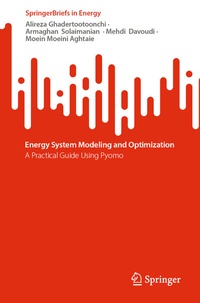
Energy System Modeling and Optimization
Description

This brief serves as a comprehensive and practical guide to energy system optimization utilizing the Pyomo optimization package in Python. It thoroughly explains the mathematical foundations of energy system technologies and how to employ Pyomo for addressing optimization challenges. The book highlights the significance of energy system optimization in terms of economic and environmental impacts, followed by a detailed exploration of Pyomo, an advanced mathematical programming language. It covers a wide spectrum of problem types, introducing various open-source solvers and outlining the steps involved in developing Python-based Pyomo code to solve optimization problems. Furthermore, the book provides mathematical formulations and Python code for diverse energy technologies, including thermal power plants, renewable energy sources like wind and solar, power transmission lines, and electricity storage systems. It also discusses topics like reliability, load loss, demand-side flexibility, and linearization techniques. To demonstrate practical application, the book offers a case study that progressively builds in complexity, guiding readers in optimizing intricate energy systems based on the models and constraints explained earlier. Targeted at professionals, researchers, and students, it is suitable for those with a foundational understanding of Python and mathematical optimization, and it underscores the crucial role of energy system optimization in addressing contemporary energy sector concerns such as environmental impact reduction and sustainable development.
More details
Other editions
Additional editions
Persons
Alireza Ghadertootoonchi received his BSc in Energy Engineering from the Department of Energy Engineering and Physics at Amirkabir University of Technology (Tehran Polytechnic) in Sep 2020 and his MSc in Energy Systems Engineering from the Department of Energy Engineering at Sharif University of Technology in May 2023. He is currently a PhD student at the Department of Civil and Mineral Engineering at the University of Toronto and a student member of ASHRAE. His current research focuses on developing scalable, reliable, accurate, and efficient modeling frameworks for building energy systems and using optimization strategies to improve the energy efficiency of smart grid-interactive buildings.
Armaghan Solaimanian received her BSc in Energy Engineering from the Department of Energy Engineering and Physics at Amirkabir University of Technology (Tehran Polytechnic) in Sep 2020 and her MSc in Energy Systems Engineering from the Department of Energy Engineering at Sharif University of Technology in May 2023. Her MSc thesis is about evaluating the potential of renewable energy integration in greenhouse systems to reduce the environmental impacts of greenhouse cultivation. Her current research interests are smart and energy-efficient buildings, modeling energy systems considering the role of renewable sources, and sustainable greenhouse systems.
Mehdi Davoudi received his BSc in electrical engineering from the Ferdowsi University of Mashhad, Mashhad, Iran, in 2017, and the MSc degree in energy systems engineering from the Sharif University of Technology, Tehran, Iran, in 2021. He is currently a Ph.D. student in Electrical Engineering at Purdue University, West Lafayette, USA. His research interests include renewable integration, energy markets, network planning, battery energy storage, and energy hub operation and planning.
Moein Moeini-Aghtaie , a Senior Member of the IEEE, earned his M.Sc. and Ph.D. degrees in electrical engineering in Tehran, Iran, in 2010 and 2014, respectively. Currently holding the position of Assistant Professor his research primarily focuses on the reliability and resilience of contemporary distribution systems, especially in the context of multi-carrier energy environments, as well as the management of charging for plug-in hybrid electric vehicles. Dr. Moeini-Moghtaie is actively involved in teaching courses related to energy hub simulation and optimization and applied optimization in energy systems, emphasizing the significance of economic and environmental optimization within energy systems. Furthermore, he boasts an extensive publication record, with over 180 journal and conference papers and book chapters in the domain of energy systems modeling and optimization.
Content
Introduction.- How to Use Pyomo.- Electricity System Modeling.- Pyomo Formulation of Electricity System Optimization Problem.- Analyzing Optimization Results.
