

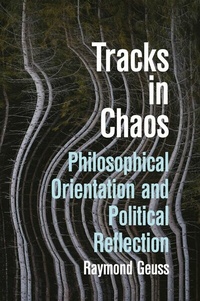
Tracks in Chaos
Description

When political action is imperative, we can be tempted to look to philosophy for guiding principles. This project, however, historically has been doomed to fail. Throughout Tracks in Chaos, philosopher Raymond Geuss examines closely the consequences of this failure. In crisp and lucid prose, he ranges over topics that include political realism, reflection in politics, universalism, solidarity, our utopian aspirations, and the role of fear in motivating censorship. Geuss ultimately paints a picture that is both rich and uncompromising, as is his conclusion: that we must learn to accept incompleteness, contingency and pluralism in our search for orientation. This is an incisive and elegant new collection of essays by one of our finest moral and political philosophers.
More details
Other editions
Additional editions
Person
Raymond Geuss is Emeritus Professor of Philosophy at the University of Cambridge. His books include Seeing Double, Not Thinking Like a Liberal, Changing the Subject, Reality and Its Dreams, Who Needs a World View?, and The Idea of a Critical Theory.
Content
1. These interminable discussions that lead nowhere
2. He/she/they and we ourselves
4. Republic, democracy, electronics
5. Realism, yet again
6. Universalism
7. Must philosophy know its own history?
8. On Alasdair MacIntyre
9. Some varieties of utopia
10. Don't say that - you're frightening me
11. Solidarity
12. A conversation on politics
Notes
Index
PREFACE AND ACKNOWLEDGEMENTS
Since late antiquity a certain dream has been a recurrent obsession for thinking people in the West. The more chaotic the external circumstances, the more vivid this dream has been. It is the idea that philosophy could give us a form of knowledge that provides all humans with a well-grounded orientation in life and tells us how to live. In general it seems reasonable to say that most philosophers in the past, except those of an especially religious disposition - and most notably so-called 'mystics' - thought that the way philosophy could become a guide for living was by mobilizing some combination of observation of the world and careful consideration of - that is, sustained reflection on - the way things are. There has never been agreement about the relations that should exist between these two components - observation and reflection. Are the two of them independent? Is one more important than the other? If they need to cohere or fit together, how is that coherence to be described and how is it possible to attain it?
The unpolitical Sokrates1 did not think he had the knowledge which should or could orient us as individuals in our living, but he felt obliged to seek it without ceasing. He did clearly believe that whatever form the knowledge he sought would eventually turn out to have, the person who had it would also be able to justify intellectually, through argumentation, any actions he or she would recommend that we perform. Sokrates' follower Plato expanded his approach to include not just individual, but collective political action. Some people have been immune to the idea that there could be a free-standing cognitively based doctrine that could guide us through life - including, for a long time, Christians, who thought that religious revelation rather than philosophical doctrine provides us with our basic orientation. Even some Christians, however, pursued the ideal of a final convergence between the voice of reason, which could be heard in philosophical argument, and the imperative demands of the Christian God. The occasional sceptic, such as Montaigne, resisted the blandishments of philosophical or religious dogmas but, by and large, such sceptics have been few and far between.
Those under the spell of this project, then, hope to be able to find in philosophy some incontrovertible justification for acting one way rather than another. In general they also tend to think that philosophic reflection is not just one way or the best way of orienting ourselves in life, in the sense in which using an electric mixer is perhaps the best way to produce a certain kind of puree, but other ways of doing it are possible (for instance, mashing by hand). Rather, they think that philosophizing is the only way forward, and even think that we all in some sense owe it to ourselves to try to discover 'the right' philosophy and allow ourselves to be guided by it in all our actions, including our political actions.
Even if we in the modern world are more sceptical than many of our predecessors were about the realizability of this dream as a whole, components of it continue to form parts of the set of assumptions most of us make. Many continue, for instance, to believe in the possibility of some kind of normative political theory.2 If philosophy cannot be a guide to political action, it seems reasonable to wonder what its point could be.
One traditional way to begin thinking about this would be to start with some kind of clear general definition of what we mean by 'philosophy' and what we mean by 'politics', and then try to see what connection there exists between these two. Unfortunately, both the terms involved - 'politics' and 'philosophy' - are accordion-like in that they can be used in a variety of broader and narrower senses. They are also both necessarily very vague. Even if we cannot give a formal 'definition' of either of them, we must surely be able to say something about the way they are used and what they mean.
To begin with, it might seem that 'politics' is universal and everything is political. There is no reason to recoil in horror at this statement and assume that if one accepts it, our next step would have to be to crawl into the darkest corner of the basement, while trembling as we await the knock of the Secret Police on the door, who have come because of deviant remarks one of us once made about the text of Sophokles, or the history of the logorithm. 'Everything is political' just means 'anything you want can be viewed in its relation to politics'. That, in turn, means that one can consider anything whatever in its relation to the distribution and exercise of organized social power, and political institutions are especially clear and deliberate mechanisms for focusing and managing social power. It does not follow from this that it is always necessary, useful, or enlightening to look at some given human phenomenon in this way.
To put it slightly differently, 'being political' is not a property things have or do not have, but refers to a particular way we decide to look at them. 'Being political' is like 'being useful', in that to say something is useful is to evaluate it relative to some envisaged standard or plan of action outside itself. I can look at a given group portrait painted on canvas and ask myself if it is 'useful'. That may mean, depending on my needs and purposes, 'Will it make a good fire to warm me on this cold evening?' or 'Could I sell it for a lot of money?' or 'Is the image sufficiently like the people portrayed to permit the police to identify them in real life?' I could, of course, also look at this painting as a political phenomenon, asking about the working conditions of those who wove the canvas, ground the paint, and applied it, about the social standing and power of the people being portrayed, about the possible political effect of looking at the painting on the average contemporary viewer. No one forces me to evaluate the painting as potentially useful (or not), just as no one forces me to look at it politically. I can do neither and simply enjoy the painting as a play of colours and shapes. All of these possible attitudes seem prima facie legitimate.
Furthermore, there is no reason to think that the attitude which I as an external observer of some human action adopt (for my own purposes) must be the same as that of the agents who perform it. Thus, if a religious group systematically aids displaced people or illegal migrants, the members of this group may intend to serve God, and claim with complete honesty to have no special political purposes or agenda at all. If, however, a certain political party in the country in which the religious group operates decides that it wishes to make life as hard as possible for displaced people in order to discourage them from remaining in the country, that party may construe the actions of the members of the religious group as 'political' - after all, these actions will in fact have effects on the distribution of power and the ability of the political party to implement its programme. We may judge that the political party in question is making a mistake, or that it is being intolerant, short-sighted, or inhumane, but it is not doing something that is incoherent or even something that is irrational. It reserves to itself the right to use its own standards for judging action, just as the religious group may use its own standards for deciding what must be done. There is nothing inherently wrong with the fact that this discrepancy exists. It is a basic fact of human life. The alternative would be to demand that we always take others' way of looking at their own action as inviolable, and the consequences of that would be very hard to bear.
The 'power' which is at issue in calling something a matter of politics can mean a number of different things. I have power if I can speak well and thus influence people, or if I am strong and can force them to do what I want, or if I can, for whatever reason, command the obedience of others who will do as I order (or simply as I wish). The 'power' in question when one speaks of 'politics' covers a much wider range of phenomena than simply those concerned in one way or another with the wielding of 'state power', that is the monopolistic control of an apparatus of organized, purportedly legitimate coercion. The exercise of state power is politics in a narrower sense, but there is also a wider sense in which the term 'power' is used.3 Think of the politics of the family, sexual politics, and the politicking that goes on in clubs or neighbourhoods or religious organizations about who is appointed to which offices and what policies the club or organization will adopt and implement. It would be a mistake simply to identify the exercise of power with direct coercion, because it includes things like manipulation, enticement and influence.
Given the flexibility of the idea of 'human power', this means that virtually anything can in some sense be political. From the universal possibility of construing everything in the human world as 'political' it does not follow that it is always useful or enlightening to adopt the framework of human power for evaluating everything. Whether or not seeing something as 'political' is a valuable, informative or relevant way to proceed...
