

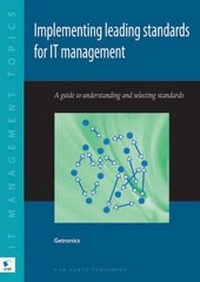
Implementing Leading Standards for IT Management -
1st Edition
Published on 30. September 2006
136 pages
978-90-8753-842-2 (ISBN)
Description

In a world in which people and organizations have to communicate in constantly changing settings standards play a big role. By standards we mean established, described, and widely accepted agreements that make communication between systems - people process and technology - possible and predictable.
Getronics has a long history in using and developing IT standards. In 1990 they introduced ITIL into the Dutch market. Subsequently they have helped redevelop ITIL and at the same time expanded the best practices with the development of ASL and BiSL. They have demonstrated their thought leadership and practical knowledge in all areas of IT management and always shared this knowledge with others. In their view a common language to communicate at different levels seems a prerequisite of the network society.
This publication Leading standards for IT Management gives the vision of Getronics on standardization in IT. It explains why standards are so important today and the way in which standards come about en how they are accepted. The book describes why IT professionals should adopt and use standards.
This publication does not pretend to give an overview of all standards available. On the contrary, it is the selection of standards that was made by Getronics that makes this book useful. It is their conviction or vision that these standards are dominant, inescapable or promising. These standards are: EFQM, Six Sigma, Malcolm Baldrige, CobiT, ITIL, ASL, BiSL, ISO/IEC 20000, CMMI, ISO 17799, MOF, ISPL, PRINCE2, IPMA, PMI-PMBOK, MSP, XML, J2EE,.NET, MDA, UML
The cooperation of people, processes and technology play an important role in the provision of good information services. Standards play a vital role in communication at all levels between the components of information services. With this book the authors want to help organizations making the right choices.
More details
Other editions
Additional editions
Tom van Sante | Getronics
Implementing Leading Standards for IT Management
A Guide to Understanding and Selecting Standards
Book
12/2006
Van Haren Publishing BV
€37.33
Shipment within 10-15 days
Content
1 - Foreword [Seite 6]
2 - 1 Introduction [Seite 12]
2.1 - 1.1 INTRODUCTION [Seite 12]
2.2 - 1.2 OBJECTIVE OF THE BOOK [Seite 12]
2.3 - 1.3 STRUCTURE OF THIS BOOK [Seite 13]
2.4 - 1.4 DEFINITIONS [Seite 14]
2.5 - 1.5 WHO BENEFITS FROM THIS BOOK? [Seite 14]
3 - 2 Standards: why? [Seite 16]
3.1 - 2.1 A CHANGING SOCIETY [Seite 16]
3.2 - 2.2 TECHNOLOGICAL DEVELOPMENTS [Seite 18]
3.3 - 2.3 CHANGES IN ORGANIZATIONS [Seite 19]
3.4 - 2.4 INFORMATION PROVISION [Seite 21]
4 - 3 Standards: what types? [Seite 26]
4.1 - 3.1 INTRODUCTION [Seite 26]
4.2 - 3.2 WHAT ARE STANDARDS [Seite 26]
4.3 - 3.3 CLASSIFICATION [Seite 29]
5 - 4 Which standard and when? [Seite 34]
5.1 - 4.1 INTRODUCTION [Seite 34]
5.2 - 4.2 ORGANIZATION-RELATED STANDARDS [Seite 34]
5.3 - 4.3 THE CHOICE OF AN ORGANIZATION-RELATED STANDARD [Seite 37]
5.4 - 4.4 TECHNOLOGY-RELATED STANDARDS [Seite 40]
5.5 - 4.5 THE CHOICE OF A TECHNOLOGY-RELATED STANDARD [Seite 42]
6 - 5 Dealing with standards [Seite 48]
6.1 - 5.1 INTRODUCTION [Seite 48]
6.2 - 5.2 ENFORCING VERSUS ADOPTING [Seite 48]
6.3 - 5.3 ACCEPTING STANDARDS [Seite 48]
6.4 - 5.4 A BUSINESS CASE FOR STANDARDS [Seite 51]
7 - 6 Standards in sevenquestions [Seite 58]
7.1 - 6.1 Seven questions about EFQM [Seite 60]
7.2 - 6.2 Seven questions about Six Sigma [Seite 63]
7.3 - 6.3 Seven questions about Malcolm Baldrige [Seite 66]
7.4 - 6.4 Seven questions about CobiT [Seite 69]
7.5 - 6.5 Seven questions about ITIL® [Seite 72]
7.6 - 6.6 Seven questions about ASL [Seite 75]
7.7 - 6.7 Seven questions about BiSL [Seite 78]
7.8 - 6.8 Seven questions about ISO/IEC 20000 [Seite 81]
7.9 - 6.9 Seven questions about CMMI [Seite 84]
7.10 - 6.10 Seven questions about ISO 17799 [Seite 88]
7.11 - 6.11 Seven questions about MOF [Seite 92]
7.12 - 6.12 Seven questions about ISPL [Seite 95]
7.13 - 6.13 Seven questions about PRINCE2T [Seite 98]
7.14 - 6.14 Seven questions about IPMA/ICB [Seite 101]
7.15 - 6.15 Seven questions about PMBoK [Seite 104]
7.16 - 6.16 Seven questions about MSP [Seite 108]
7.17 - 6.17 Seven questions about XML [Seite 111]
7.18 - 6.18 Seven questions about J2EE [Seite 114]
7.19 - 6.19 Seven questions about .NET [Seite 117]
7.20 - 6.20 Seven questions about UML [Seite 120]
7.21 - 6.21 Seven questions about MDA [Seite 123]
8 - 7 References [Seite 128]
9 - 8 Index [Seite 132]
2 - 1 Introduction [Seite 12]
2.1 - 1.1 INTRODUCTION [Seite 12]
2.2 - 1.2 OBJECTIVE OF THE BOOK [Seite 12]
2.3 - 1.3 STRUCTURE OF THIS BOOK [Seite 13]
2.4 - 1.4 DEFINITIONS [Seite 14]
2.5 - 1.5 WHO BENEFITS FROM THIS BOOK? [Seite 14]
3 - 2 Standards: why? [Seite 16]
3.1 - 2.1 A CHANGING SOCIETY [Seite 16]
3.2 - 2.2 TECHNOLOGICAL DEVELOPMENTS [Seite 18]
3.3 - 2.3 CHANGES IN ORGANIZATIONS [Seite 19]
3.4 - 2.4 INFORMATION PROVISION [Seite 21]
4 - 3 Standards: what types? [Seite 26]
4.1 - 3.1 INTRODUCTION [Seite 26]
4.2 - 3.2 WHAT ARE STANDARDS [Seite 26]
4.3 - 3.3 CLASSIFICATION [Seite 29]
5 - 4 Which standard and when? [Seite 34]
5.1 - 4.1 INTRODUCTION [Seite 34]
5.2 - 4.2 ORGANIZATION-RELATED STANDARDS [Seite 34]
5.3 - 4.3 THE CHOICE OF AN ORGANIZATION-RELATED STANDARD [Seite 37]
5.4 - 4.4 TECHNOLOGY-RELATED STANDARDS [Seite 40]
5.5 - 4.5 THE CHOICE OF A TECHNOLOGY-RELATED STANDARD [Seite 42]
6 - 5 Dealing with standards [Seite 48]
6.1 - 5.1 INTRODUCTION [Seite 48]
6.2 - 5.2 ENFORCING VERSUS ADOPTING [Seite 48]
6.3 - 5.3 ACCEPTING STANDARDS [Seite 48]
6.4 - 5.4 A BUSINESS CASE FOR STANDARDS [Seite 51]
7 - 6 Standards in sevenquestions [Seite 58]
7.1 - 6.1 Seven questions about EFQM [Seite 60]
7.2 - 6.2 Seven questions about Six Sigma [Seite 63]
7.3 - 6.3 Seven questions about Malcolm Baldrige [Seite 66]
7.4 - 6.4 Seven questions about CobiT [Seite 69]
7.5 - 6.5 Seven questions about ITIL® [Seite 72]
7.6 - 6.6 Seven questions about ASL [Seite 75]
7.7 - 6.7 Seven questions about BiSL [Seite 78]
7.8 - 6.8 Seven questions about ISO/IEC 20000 [Seite 81]
7.9 - 6.9 Seven questions about CMMI [Seite 84]
7.10 - 6.10 Seven questions about ISO 17799 [Seite 88]
7.11 - 6.11 Seven questions about MOF [Seite 92]
7.12 - 6.12 Seven questions about ISPL [Seite 95]
7.13 - 6.13 Seven questions about PRINCE2T [Seite 98]
7.14 - 6.14 Seven questions about IPMA/ICB [Seite 101]
7.15 - 6.15 Seven questions about PMBoK [Seite 104]
7.16 - 6.16 Seven questions about MSP [Seite 108]
7.17 - 6.17 Seven questions about XML [Seite 111]
7.18 - 6.18 Seven questions about J2EE [Seite 114]
7.19 - 6.19 Seven questions about .NET [Seite 117]
7.20 - 6.20 Seven questions about UML [Seite 120]
7.21 - 6.21 Seven questions about MDA [Seite 123]
8 - 7 References [Seite 128]
9 - 8 Index [Seite 132]
