

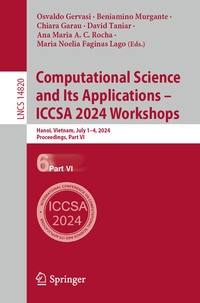
Computational Science and Its Applications - ICCSA 2024 Workshops
Description

This eleven-volume set LNCS 14815 - 14825 constitutes the refereed workshop proceedings of the 24th International Conference on Computational Science and Its Applications, ICCSA 2024, held at Hanoi, Vietnam, during July 1-4, 2024.
The 281 full papers, 17 short papers and 2 PHD showcase papers included in this volume were carefully reviewed and selected from a total of 450 submissions.
In addition, the conference consisted of 55 workshops, focusing on very topical issues of importance to science, technology and society: from new mathematical approaches for solving complex computational systems, to information and knowledge in the Internet of Things, new statistical and optimization methods, several Artificial Intelligence approaches, sustainability issues, smart cities and related technologies.
More details
Other editions
Additional editions
Content
- Intro
- Preface
- Welcome Message from Organizers
- Organization
- Plenary Lectures
- Harnessing Artificial Intelligence for Enhanced Spatial Analysis of Natural Hazard Assessments
- Software Engineering Research in a New Situation
- Interpretability and Privacy Preservation in Large Language Models (LLMs)
- Contents - Part VI
- International Workshop on Information and Knowledge in the Internet of Thing (IKIT 2024)
- Analysis and Simulation of an IoT System for Measuring Soil Moisture in Avocado Plantations
- 1 Introduction
- 2 Related Work
- 3 Methodology
- 4 Development Process
- 4.1 Relevant Literature Review
- 4.2 Technological Architecture
- 4.3 Validation by Discrete Simulation
- 5 Preliminary Results and Discussion
- 6 Conclusions
- References
- Charting the Path of Reading Development: A Study on the Importance and Effective Strategies for Reading in Early Ages Based on Technology
- 1 Introduction
- 2 Methodology
- 2.1 Document Search
- 2.2 Research Questions
- 2.3 Article Selection
- 2.4 Extraction of Relevant Data
- 3 Analysis and Results
- 4 Discussion
- 5 Conclusions
- References
- A High-Throughput FPGA-Based Elliptic Curve Digital Signature Core for IoT Edge Platforms
- 1 Introduction
- 2 Preliminaries and Related Work
- 2.1 Digital Signature for Data Security
- 2.2 Elliptic Curve Digital Signature Algorithm
- 2.3 Related Work
- 3 Proposed ECDSA Hardware Architecture
- 3.1 Overview Architecture
- 3.2 ECDSA Signature Generation
- 4 FPGA Edge Computing Prototype
- 5 Experiments
- 5.1 Experimental Setup
- 5.2 Synthesis Results
- 5.3 Performance Evaluation and Comparison
- 6 Conclusion
- References
- Internet of Things for Plastic Bottle Recycling: A Case Study for Salinas
- 1 Introduction
- 2 Materials and Methods
- 2.1 Study Area
- 2.2 Methodology
- 3 Results and Discussion
- 4 Conclusions
- References
- Evaluation of a Fintech Sales Synthetic Data Generation Model Using a Generative Adversarial Network
- 1 Introduction
- 2 Background and Related Work
- 3 Material and Methods
- 3.1 Project Execution
- 4 Preliminary Results and Discussion
- 5 Conclusions
- References
- Hybrid Information Security Framework Based on ISO/IEC 27005:2022 and the NIST Framework for the Ministry of Education of Ecuador (TIC)
- 1 Introduction
- 2 Methodology
- 2.1 Document Search
- 2.2 Research Questions
- 2.3 Article Selection
- 2.4 Extraction of Relevant Data
- 3 Analysis
- 4 Results
- 5 Conclusions
- References
- regeneratIng browNFields Enhancing uRban rEsilieNCe appEal (INFERENCE 2024)
- Waterfronts in the Straits Port Areas, Between Architecture and Town Planning
- 1 Introduction
- 2 Cities in the Straits of Europe, Review
- 3 Coastal Cities and Coastal Facades of the Strait, Such as Works and Infrastructures in View of the Bridge
- 4 From Cities to the City of the Strait of Messina: For a New Waterfront
- 5 Conclusions
- References
- The Recovery of Disused Infrastructure and Military Areas in Spain and Italy, Contributions to the Regeneration of Territories
- 1 Introduction
- 1.1 The Complex Scenario of the Restoration of Decommissioned Military and Infrastructure Areas
- 2 State of the Art on the Rehabilitation of Disused Military and Strategic Infrastructure Areas, Focus on Italy
- 2.1 Challenges and Opportunities in the Rehabilitation of Disused Military Facilities in Italy: Case Studies and Strategic Considerations
- 3 Significant Materials and Methods of the Case Studies. Decommissioned Military Infrastructures in Spain: Ideas and Projects for Their Redevelopment
- 3.1 La Real Fábrica De Armas De Orbaizeta (Navarra, Spain) as an Engine for Local Revitalization
- 3.2 Regeneration Process of the Case Study of the Disused Military Area of Gefate (Madrid, Spain)
- 4 Conclusions
- 4.1 Strategies and Opportunities for the Sustainable Redevelopment of Disused Military Sites
- References
- A Valuable Brownfield Site by the Sea Awaiting Regeneration: The Case of the Lipari Pumice Quarries
- 1 Introduction. Disused Industrial Landscapes by the Sea: The Special Case of the Lipari Pumice Quarries
- 2 A Precious Former Industrial Area by the Sea on Lipari Awaiting Regeneration
- 3 Ideas for a Possible Urban and Environmental Regeneration Project for the Lipari Pumice Quarry Areas
- 4 Conclusions. Pathways to Be Taken to Preserve and Enhance Industrial Heritage, Memory, History and Identity of the White Aeolian Shores
- References
- Contexts of Reuse and Regeneration. Defense Sites and Disused Infrastructure in Coastal Areas
- 1 Introduction: Urban Regeneration and Reuse of Brownfield
- 2 Case Studies
- 3 Conclusions
- References
- The Role of Beauty in the Sustainable Regeneration of the Historical Centres: The Upper Town of Bergamo
- 1 Introduction
- 2 The Upper City of Bergamo: A Valued Historical Centre
- 3 Tourism in Bergamo: Origins and Developments
- 4 The Caravaggio Airport and the Tourism Boom
- 5 The Adaptive Reuse of the Upper Town
- 6 The New Strategies Implemented by the Municipality and Local Actors for the Sustainable Valorisation of Upper Town
- 7 Bergamo Brescia Italian Capital of Culture 2023
- 8 Conclusions
- References
- Territorial Dynamics and Community Resilience: Transient Housing in Post-earthquake in Al Haouz Rural Regions in Morocco
- 1 Introduction
- 2 Case Study and Methods
- 2.1 Sample Villages Selection
- 2.2 Data Collection and Analysis Methods
- 3 Results
- 3.1 Spatial Analysis of Transient Housing Initiatives
- 3.2 Adaptations Analysis
- 4 Discussion
- 5 Conclusion
- References
- The Landscape from Architecture to the City: Strategies and Methods to Regenerate Through Design
- 1 Introduction
- 2 Literature Review
- 2.1 Landscape Conservation/Transformation in Regeneration Process
- 2.2 Architecture and Urban Reforestation in Sicily
- 3 Discussion
- 3.1 Rural Built Heritage and Landscape Conservation
- 3.2 Regeneration and Coastal Urban Landscapes, Methods and Results from International Cases in Progress
- 4 Conclusions
- References
- International Workshop on Territorial Planning to Integrate Risk and Urban Ontologies (IWPRO 2024)
- Enhancing Urban Resilience Strategic Planning with MetaSWOT in Tehran's Historic Residential Districts
- 1 Introduction
- 2 Methodology
- 3 Definition of Concepts
- 3.1 Resiliency
- 3.2 Urban Resilience
- 3.3 Physical and Social Resilience
- 3.4 Neighborhood Resilience
- 4 Introduction of the Study Area
- 5 Findings
- 5.1 Stage One: Determining Research Objectives and Prioritization
- 5.2 Stage Two: Identification and Rating of Resources and Capabilities
- 5.3 Step Three: Identification of Competitive Dimensions
- 5.4 Stage Four: Evaluation of Resources and Capabilities Based on the VIRO Criteria
- 5.5 Stage Five: Identification and Analysis of External Factors
- 5.6 Stage Six: Alignment Strategy
- 5.7 Stage Seven: Drawing the Strategic Map
- 5.8 Analysis of Strategic Map
- 6 Conclusion
- References
- Gamification: A Catalyst to Achieve Carbon-Neutral Cities
- 1 Introduction
- 2 Methodology
- 3 Carbon-Neutral Cities
- 3.1 Sustainable Communities to Implement Climate Policies
- 4 Gamification
- 4.1 Game Apps: Enhancing Engagement and Awareness
- 4.2 Gamified Places: Transforming Physical Spaces
- 5 Gamification for Carbon-Neutral Cities
- 5.1 Increasing Social Participation
- 5.2 Education and Awareness
- 5.3 Creating a Sense of Community
- 5.4 Lifestyle and Behavioral Change
- 6 Gamification Strategies for Carbon-Neutral Communities
- 7 Choosing the Right Approach-Game App or Gamified Place
- 8 Conclusion
- References
- Analysis of Seismic Risk and Vulnerability of the Historical Context of Tehran with Emphasis on Resilience Zoning
- 1 Introduction
- 2 Research Method and Case Study
- 2.1 Research Method
- 2.2 Case Study
- 3 Discussion and Findings
- 3.1 First Stage
- 3.2 Second Stage
- 4 Conclusion
- References
- Supporting Global Knowledge Concerning Risk Domain: Ontologies Put into Practice
- 1 Introduction
- 2 Multi-risk Approach
- 2.1 The Multi-risk Approach in the Italian Civil Protection Plan
- 3 Understanding the Significance of Ontology
- 4 Applying the Ontology Tool to the Risk Domain
- 4.1 The Protégé Tool
- 5 Discussion and Conclusions
- References
- Architectural Design Strategies and Tactics as Driver of Critical Awareness: A Research by Design Application for Vulnerable Communities in Ciudad Juárez
- 1 Introduction
- 2 Research Framework: Method and Research by Design Approach
- 3 Research Domain, Context Description, Historical Background and Current Status
- 3.1 The Architecture and Urban Spatial Structure of a Borderland
- 3.2 A New Urban Centrality
- 3.3 The Identity of Transitional Architecture
- 3.4 The Values of Informal Urbanism and Architecture
- 3.5 The Re-Appropriation of the Public/collective Space
- 4 Design Phase and Project Visualization
- 4.1 Three Selected Projects for Three Design Strategies
- 5 Conclusion
- References
- The Integration of Decarbonization and Resilience Strategies in Shaping Sustainable Cities
- 1 Introduction
- 2 Methodology
- 3 Definition of Concepts
- 3.1 Resiliency and Resilience Cities
- 3.2 Decarbonization and Carbon-Neutral Cities
- 3.3 Sustainable Cities
- 4 Synthesizing Concepts
- 4.1 Synthesizing Decarbonization and Resiliency
- 4.2 Toward Sustainable Cities-Synergy Between Decarbonization and Resilience
- 5 Conceptual Framework
- 6 Conclusion
- References
- MOdels and Indicators for Assessing and Measuring the Urban Settlement DeVElopment in the View of ZERO Net Land Take by 2050 (MOVEto0 2024)
- Planning Without Shared Strategies. Impacts and Perspectives Along the Abruzzo Adriatic Coastal Belt
- 1 Introduction
- 2 Case Study
- 3 Materials and Methods
- 4 Results
- 5 Discussion and Conclusion
- References
- Investigating Avalanche Risk Impact on Accommodation Facilities in the Municipalities of Abruzzo Region
- 1 Introduction
- 2 Study Area
- 3 Materials and Methods
- 3.1 Dataset
- 3.2 Validation and Density Map
- 4 Results
- 5 Discussion and Conclusions
- References
- Multidimensional Evolutionary Evaluations for Transformative Approaches (MEETA 2024)
- A Data-Driven Approach to Monitor Sustainable Development Transition in Italian Regions Through SDG 11 Indicators
- 1 Introduction
- 2 Research Design
- 2.1 Multilevel Governance Analysis About SDG 11 Indicators (Phase 1)
- 2.2 SDG 11 Indicators Within the Italian Regional Sustainable Development Strategy (Phase 2)
- 2.3 The Scientific Landscape (Phase 3)
- 3 Normative, Assessment, and Methodological Gaps
- 4 Comparing Italian Regions Against SDG 11 Indicators: An Assessment Framework
- 5 Results
- 5.1 A Predictive Model Based on the KNN ML Algorithm
- 5.2 Exploratory Data Analysis (EDA)
- 6 Discussion and Conclusion
- References
- Assemblages for Cultural Heritage: A Methodological Approach of Heritage-Driven Enhancement
- 1 Introduction
- 1.1 Historic Urban Landscape: A Landscape Point of View
- 1.2 Assemblages as Dynamic Processes for Urban Transformations
- 1.3 The Quintuple Helix Innovation Model
- 2 Materials and Methods
- 2.1 Heritage Values Assessment Approaches
- 2.2 Heritage-Based Innovation Models
- 2.3 The Cultural Values Model
- 3 Case Study
- 3.1 Hadrian's Wall: An Eco-System of Values
- 4 Conclusions
- 4.1 Values, Cultural Significance and Policies
- References
- A Decision Support System for Cultural and Territorial Infrastructures: A Place-Based and Community-Driven Strategy in Inner Italy
- 1 Introduction
- 2 The Case Study
- 3 Material and Methods
- 3.1 Knowledge Phase
- 3.2 Evaluation Phase
- 4 Results
- 5 Conclusion
- References
- A Data-Driven Design Approach for Multi-scale Green Infrastructure Design: Integrating Landscape Connectivity and Phytoremediation in the Piedmont Region (IT)
- 1 Introduction
- 2 Theoretical Background
- 2.1 Data-Driven Spatial Design
- 2.2 Landscape Ecology and the Role of Green Infrastructure
- 2.3 Phytoremediation and Adaptive Transformation
- 3 Materials and Methods
- 3.1 Study Area
- 3.2 Data Sources
- 3.3 Regional Scale: Landscape Connectivity Analysis
- 3.4 Local Scale: Mapping and Characterization of Polluted Sites
- 4 Results and Discussion
- 4.1 Landscape Connectivity Analysis
- 4.2 Contaminated Site Typologies
- 5 Conclusions
- References
- Introducing Principles of Antifragility in World Heritage Management Evaluation Tools: The Case of City of Vicenza and Palladian Villas of the Veneto
- 1 Introduction
- 2 Management and Evaluation Practices of UNESCO
- 2.1 Management Systems and Documentation
- 2.2 Local Evolution and Development Dimension
- 2.3 Monitoring Tools
- 2.4 Enhancing Our Heritage Toolkit 2.0
- 3 Antifragility Orientation
- 3.1 The Essence of Antifragility
- 3.2 Antifragility in Planning
- 4 New Governance System for the World Heritage Site City of Vicenza and Palladian Villas of the Veneto
- 4.1 Case Study
- 4.2 Ongoing Proposal
- 4.3 Principles of Antifragility
- 4.4 Integrated Tool Applied to the Case Study
- 5 Conclusions
- References
- A Methodological Approach for Activate a Community-Based Archive as a Decision-Support System in Urban Regeneration Processes
- 1 Introduction
- 2 Methodological Proposal
- 3 Case Study
- 3.1 The Contest
- 3.2 Mutual Learning Experience
- 4 Discussion and Conclusion
- References
- Author Index
