

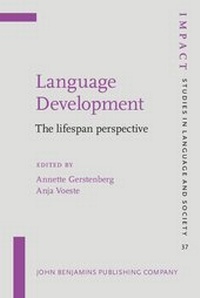
Language Development
The lifespan perspective
1st Edition
Published on 22. July 2015
VII, 233 pages
978-90-272-6866-2 (ISBN)
Description

Language Development: The lifespan perspective generates insights into the central issues of age-dependent language change, focusing especially on the middle and later stages of life. The contributors exploit contemporary and historical longitudinal data, adopting psycholinguistic, corpus linguistic and sociolinguistic approaches. Linguistic changes are discussed against the background of cognitive, somatic and social factors. Bringing the resulting contributions together, the volume aims to resume the discussion of contradictions between the models of change and constancy over an individual's lifespan that have not been sufficiently resolved to date. The volume is intended to serve as an interdisciplinary reference resource for those conducting research on language development and the aging process and as a supplementary course book on language variability and change.
More details
Other editions
Additional editions
Book
07/2015
John Benjamins Publishing Co
€100.70
Shipment within 10-15 days
Persons
Content
- Language Development
- Editorial page
- Title page
- LCC data
- Table of contents
- List of abbreviations
- Investigating the lifespan perspective
- 1. Introduction
- 2. Basic problems and questions
- 2.1 Age and lifespan
- 2.2 Age, lifespan, and language
- 3. Problems and questions - and the papers
- 3.1 The linguistic lifespan: Patterns and configurations
- 3.2 The linguistic lifespan: Determinants and contexts
- References
- Disassociating the effects of age from phonetic change
- 1. Introduction
- 2. Data
- 2.1 Speaker
- 2.2 Materials
- 3. General method
- 4. Previous results and conclusions
- 4.1 Results of Reubold, Harrington & Kleber (2010)
- 4.2 Conclusions from Reubold, Harrington & Kleber (2010)
- 4.3 Informal descriptive analysis of phonetic changes
- 5. Aims of the current study
- 5.1 Age-related changes
- 5.2 Phonetic changes
- 6. Experiment I
- 6.1 Method
- 6.2 Results
- 6.3 Discussion
- 7. Experiment II
- 7.1 Method
- 7.2 Results
- 7.3 Discussion
- 8. Experiment III
- 8.1 Method
- 8.2 Results
- 8.3 Discussion
- 9. Summary and conclusions
- References
- Phonological variation in real time
- 1. Adult linguistic stability and apparent time
- 2. Data source and speakers
- 3. Variable and general patterns
- 4. Individual results
- 5. Discussion and conclusions
- References
- Language production in late life
- 1. Introduction
- 2. Aging and neurological function
- 2.1 Word finding
- 2.2 Working memory, executive functions, and language production
- 2.2.1 Ceiling on production
- 2.2.2 Dual-tasking
- 2.2.3 Aging and social interactions
- 2.2.4 Elderspeak
- 2.2.5 Off-target verbosity
- 3. Conclusions
- References
- Vocabulary and dementia in six novelists
- 1. Language and dementia
- 2. Agatha Christie
- 3. Six writers
- 4. Iris Murdoch
- 5. Enid Blyton
- 6. Ross Macdonald
- 7. Frank Baum, R.A. Freeman, and James Hilton
- 8. Conclusions
- References
- Appendix A: Novels analyzed
- 1. Frank Baum
- 2. R.A. Freeman
- 3. James Hilton
- 4. Enid Blyton
- 5. Ross Macdonald
- 6. Iris Murdoch
- Appendix B
- 1. Blyton: The opening of Five are Together Again
- 2. Macdonald: The opening of Winnipeg, 1929
- 3. Murdoch: The close of Jackson's Dilemma
- A sociolinguistic perspective on vocabulary richness in a seven-year comparison of French-speaking elderly
- 1. Lifespan and the lexicon
- 1.1 Introduction
- 1.2 Vocabulary in old age
- 1.3 Language change
- 2. Lexical richness
- 2.1 Types
- 2.2 Growth rates
- 2.3 Fillers
- 3. Analysis
- 3.1 Data
- 3.2 Methodological remarks
- 3.3 Analysis
- 3.3.1 Types (V)
- 3.3.2 Growth rate
- 3.3.3 Parts of speech: Fillers
- 4. Discussion
- 5. Conclusion
- References
- Age-related variation and language change in Early Modern English
- 1. Introduction
- 2. Generational and lifespan changes
- 3. Linguistic variables
- 4. Data and method
- 4.1 Principles of data retrieval
- 4.2 Estimating progressive and conservative individuals
- 5. Results of the analysis
- 5.1 Overall findings
- 5.2 The (you) variable
- 6. Discussion
- 7. Conclusion
- References
- Lifespan and linguistic awareness
- 1. Introduction
- 2. Language and lifespan in Italian literature
- 3. Significance of the 18th-century autobiography for the development of linguistic awareness
- 4. Lifespan as a linguistic adventure: The Life of Vittorio Alfieri
- 5. The linguistic education of the writer as a literary topos
- 6. Dialects and foreign languages
- 7. In lieu of a conclusion
- References
- Tired mind or tired hand?
- 1. The correspondents and their background
- 2. Syntactic complexity and lexical richness
- 3. The loss of graphomotoric abilities
- 4. Semantic text analysis
- 4.1 Cognitive processes
- 4.2 Time orientation
- 4.3 Social references
- 5. Conclusions
- References
- Kriegsausbruch, Kriegs Ausbruch, KriegsAusbruch
- 1. Introduction
- 2. Basis of analysis
- 2.1 Corpus
- 2.2 General features
- 3. Endogenous and exogenous factors of language variation
- 3.1 The development of compound spelling, separate spelling and hyphenation
- 3.2 Hypotheses about factors which promote and hinder spelling variation
- 3.3 Exogenous factors which increase variation
- 3.3.1 The increase of variation via language contact and multilingualism
- 3.3.2 Variation in nature of the text
- 4. Classification of word formation
- 5. Evaluation of Thomas Mann's writing
- 5.1 Structural complexity of compounds
- 5.2 Lexical-semantic characteristics
- 5.2.1 Separate spelling, compound spelling and hyphenation in the case of hybrid formations
- 5.2.2 Compound spelling, separate spelling and hyphenation of compounds with a name, a clipping or an abbreviation
- 5.2.3 A changed writing routine - a new style for Mann's old age?
- 6. Evaluation of Harry Graf Kessler's writings
- 6.1 Standardized writing in 1892/1893
- 6.2 Lexical-semantic particularities: Separate spelling in the military lexis?
- 6.3 Separate spellings and their possible causes
- 6.3.1 Separate spellings linked to names, words of foreign origin and political communication
- 6.3.2 Separate spelling used for highlighting?
- 7. Further discussion
- References
- Index
