

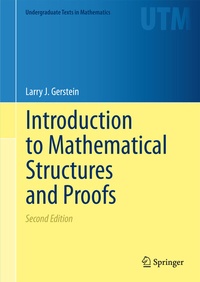
Introduction to Mathematical Structures and Proofs
Description

As a student moves from basic calculus courses into upper-division courses in linear and abstract algebra, real and complex analysis, number theory, topology, and so on, a "bridge" course can help ensure a smooth transition. Introduction to Mathematical Structures and Proofs is a textbook intended for such a course, or for self-study. This book introduces an array of fundamental mathematical structures. It also explores the delicate balance of intuition and rigor-and the flexible thinking-required to prove a nontrivial result. In short, this book seeks to enhance the mathematical maturity of the reader.
The new material in this second edition includes a section on graph theory, several new sections on number theory (including primitive roots, with an application to card-shuffling), and a brief introduction to the complex numbers (including a section on the arithmetic of the Gaussian integers). Solutions for even numbered exercises are available on springer.com forinstructors adopting the text for a course.
More details
Other editions
Additional editions
Person
Content
Preface to the Second Edition.- Preface to the First Edition.- 1. Logic.- 2. Sets.- 3. Functions.- 4. Finite and Infinite Sets.- 5. Combinatorics.- 6. Number Theory.- 7. Complex Numbers.- Hints and Partial Solutions to Selected Odd-Numbered Exercises.- Index.
