

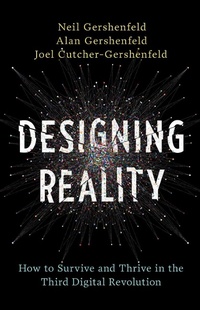
Designing Reality
How to Survive and Thrive in the Third Digital Revolution
Published on 14. November 2017
304 pages
978-0-465-09348-9 (ISBN)
Description

That's the promise, and peril, of the third digital revolution, where anyone will be able to make (almost) anything
Two digital revolutions -- computing and communication -- have radically transformed our economy and lives. A third digital revolution is here: fabrication. Today's 3D printers are only the start of a trend, accelerating exponentially, to turn data into objects: Neil Gershenfeld and his collaborators ultimately aim to create a universal replicator straight out of Star Trek. While digital fabrication promises us self-sufficient cities and the ability to make (almost) anything, it could also lead to massive inequality. The first two digital revolutions caught most of the world flat-footed, thanks to Designing Reality that won't be true this time.
Two digital revolutions -- computing and communication -- have radically transformed our economy and lives. A third digital revolution is here: fabrication. Today's 3D printers are only the start of a trend, accelerating exponentially, to turn data into objects: Neil Gershenfeld and his collaborators ultimately aim to create a universal replicator straight out of Star Trek. While digital fabrication promises us self-sufficient cities and the ability to make (almost) anything, it could also lead to massive inequality. The first two digital revolutions caught most of the world flat-footed, thanks to Designing Reality that won't be true this time.
More details
Other editions
Additional editions
Neil Gershenfeld | Alan Gershenfeld | Joel Cutcher-Gershenfeld
Designing Reality
How to Survive and Thrive in the Third Digital Revolution
Book
11/2017
Basic Books
€35.00
Article not available at the moment
Persons
Neil Gershenfeld has been called the intellectual father of the maker movement. He leads MIT's Center for Bits and Atoms, and is the founder of the global network of over 1,000 community fab labs.
Alan Gershenfeld is president of E-Line Media and former chairman of Games for Change. He is currently working with the Center for Bits and Atoms and Fab Foundation on a DARPA funded game to fire the imagination of a generation around the future of digital fabrication.
Joel Cutcher-Gershenfeld is a professor at the Heller School for Social Policy and Management at Brandeis University and former president of the Labor and Employment Relations Association. He is a pioneer in high performance work systems and has led U.S. and global mapping of stakeholder alignment around digital fabrication.
Alan Gershenfeld is president of E-Line Media and former chairman of Games for Change. He is currently working with the Center for Bits and Atoms and Fab Foundation on a DARPA funded game to fire the imagination of a generation around the future of digital fabrication.
Joel Cutcher-Gershenfeld is a professor at the Heller School for Social Policy and Management at Brandeis University and former president of the Labor and Employment Relations Association. He is a pioneer in high performance work systems and has led U.S. and global mapping of stakeholder alignment around digital fabrication.
Content
- Intro
- Title Page
- Copyright
- Table of Contents
- Dedication
- Introduction
- Chapter 1: How to Make (almost) Anything
- Fabrication
- Education
- Application
- Implication
- Organization
- Chapter 2: How to (almost) Make Anything
- Fab Access
- Fab Literacy
- Enabling Ecosystems
- Mitigating Risk
- Grand Challenges
- Chapter 3: The Science
- From Moore's Law to Lass' Law
- Communication, Computation, Fabrication
- Four Billion Years of Digitization
- Intelligent Design
- Chapter 4: The Social Science
- Moore's Law Versus Lass' Law
- Reactive Versus Proactive Social Science
- Rates of Change
- Ecosystems
- Propagate Versus Scale
- Chapter 5: The Roadmap
- Community Fabrication: 1 to 1,000
- Personal Fabrication: 1,000 to 1,000,000
- Universal Fabrication: 1,000,000 to 1,000,000,000
- Ubiquitous Fabrication: 1,000,000,000 to 1,000,000,000,000
- Chapter 6: The Opportunity
- How to Envision (almost) Anything
- Predictive Transformation
- Assembling Assemblers and Pancake Breakfasts
- Conclusion
- Goals and Recommendations
- Epilogue
- Acknowledgments
- About The Authors
- Also by Neil Gershenfeld
- More Praise For Designing Reality
- Resources
- Index
