

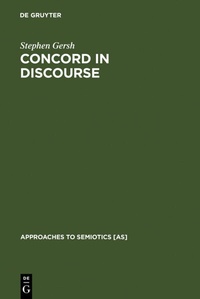
Concord in Discourse
Harmonics and Semiotics in Late Classical and Early Medieval Platonism
1st Edition
Published on 21. November 2011
XI, 390 pages
978-3-11-081918-2 (ISBN)
Description

No detailed description available for "Concord in Discourse".
More details
Other editions
Additional editions
Stephen Gersh
Concord in Discourse
Harmonics and Semiotics in Late Classical and Early Medieval Platonism
Book
04/1996
1st Edition
De Gruyter Mouton
€220.00
Shipment within 7-9 days
Stephen Gersh
Concord in Discourse
Harmonics and Semiotics in Late Classical and Early Medieval Platonism
Book
01/1996
1st Edition
De Gruyter Mouton
€309.00
Article exhausted; check different version
Content
- Intro
- Conventions of translation and transliteration
- Introduction
- 0.1 Modern notions of structure and signification
- Part I: Concord
- Chapter 1: Concord in general
- 1.1 Harmony, signification, and the structure of semantic fields
- 1.2 The schemata of writing and reading
- 1.3 Augustine's understanding of order and concord
- 1.4 Eriugena's understanding of order and harmony
- 1.5 Musical paradigms in Augustine and Boethius
- 1.6 The concept of relation in ancient and modern philosophy
- Excursus to Chapter 1
- Excursus to section 1.3
- Excursus to section 1.5
- Part II: The logical
- Chapter 2: Components of concord - Binary relations (ontological)
- 2.1 Eriugena and the square of opposition
- 2.2 Relation in ps.-Augustine: Categoriae decem
- 2.3 Eriugena's theory of relation
- 2.4 Ratio in Boethius' De institutione arithmetica
- 2.5 Eriugena's theory of ratio
- 2.6 Extensions of the Eriugenian theory of ratio
- Excursus to Chapter 2
- Excursus to section 2.2
- Excursus to section 2.4
- Excursus to section 2.6
- Part III: The harmonic
- Chapter 3: Components of concord - Ternary relations (ontological)
- 3.1 Trinitarian concord in Thierry of Chartres and his sources
- 3.2 The resolution of oppositions according to Augustine
- 3.3 Mediation in the cosmology and psychology of Calcidius
- 3.4 Ancient and medieval antecedents of the "semiotic square"
- 3.5 Mediation in the cosmology and angelology of Eriugena
- 3.6 The Eriugenian transcendent harmony
- Excursus to Chapter 3
- Excursus 1 to section 3.4
- Excursus 2 to section 3.4
- Excursus 3 to section 3.4
- Part IV: The semiotic
- Chapter 4: Components of concord - Ternary relations (semantic)
- 4.1 Eriugena and the triad of signifier, signified, and signification
- 4.2 Signification in Martianus Capella: De nuptiis Philologiae et Mercurii
- 4.3 Eriugena's theory of signification
- 4.4 Symbolism in ps.-Dionysius' De caelesti hierarchia
- 4.5 Eriugena's theory of symbolism
- 4.6 Extensions of the Eriugenian theory of symbolism
- Excursus to Chapter 4
- Excursus to section 4.2
- Excursus to section 4.4
- Excursus to section 4.6
- Part V: Translations and commentary
- Chapter 5: The notion of concord in ancient and medieval philosophy
- 5.1 Concord among angels and saints
- 5.2 Concord in the spiritual world
- 5.3 Concord in the world soul
- 5.4 Concord of the elements in the world
- 5.5 Concord among planets and stars
- 5.6 Concord in the celestial world
- 5.7 Concord in the human soul
- 5.8 Concord of the elements in man
- Notes
- Bibliographies
- Addenda to bibliography (1995)
- Index
