

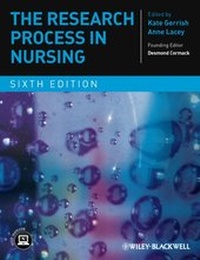
The Research Process in Nursing
6th Edition
Published on 13. March 2013
586 pages
978-1-118-68210-4 (ISBN)
Description

'The perfect text for any health care professional whowishes to gain a sound understanding of research...This textsucceeds where others fail in terms of the thoroughness of theresearch process and the accessible style in which the material ispresented. In an age when nursing and health care research is goingfrom strength to strength this book offers those in the world ofacademia and practice an excellent and essential 'bible' that is amust on any bookshelf'
Dr Aisha Holloway, Lecturer Adult Health, Division of Nursing,The University of Nottingham
'a book that helps you each step of the way. A veryunderstandable and enjoyable publication'
Accident and Emergency Nursing Journal
'key reference resource that students of research can useat various levels of study. It is comprehensive, user friendly andvery easy to read and make sense of'
Gillian E Lang, Amazon reviewer
The sixth edition of this book reflects significant developments innursing research in recent years, ensuring the reader is providedwith the very latest information on research processes and methods.It continues to explore how to undertake research as well asevaluating and using research findings in clinical practice, in away that is suitable for both novice researchers and those withmore experience.
Divided into six sections, the chapters are ordered in a logicalfashion that also allows the reader to dip in and out. The firsttwo sections of the book provide a comprehensive background toresearch in nursing. The third section presents a variety ofqualitative and quantitative approaches, both new andwell-established. The final three sections then look at collectingand making sense of the resulting data and putting the researchfindings into clinical practice.
* Summarises key points at the start of each chapter to guide youthrough
* Includes contributions from a wide range of experts in thefield
* Accessible but doesn't shrink away from complex debatesand technical issues
New to this edition:
* Accompanying website (www.wiley.com/go/gerrish)
* Ten completely new chapters including Narrative Research, MixedMethods and Using Research in Clinical Practice
* 'Research Example' boxes from a wide variety ofresearch types
Dr Aisha Holloway, Lecturer Adult Health, Division of Nursing,The University of Nottingham
'a book that helps you each step of the way. A veryunderstandable and enjoyable publication'
Accident and Emergency Nursing Journal
'key reference resource that students of research can useat various levels of study. It is comprehensive, user friendly andvery easy to read and make sense of'
Gillian E Lang, Amazon reviewer
The sixth edition of this book reflects significant developments innursing research in recent years, ensuring the reader is providedwith the very latest information on research processes and methods.It continues to explore how to undertake research as well asevaluating and using research findings in clinical practice, in away that is suitable for both novice researchers and those withmore experience.
Divided into six sections, the chapters are ordered in a logicalfashion that also allows the reader to dip in and out. The firsttwo sections of the book provide a comprehensive background toresearch in nursing. The third section presents a variety ofqualitative and quantitative approaches, both new andwell-established. The final three sections then look at collectingand making sense of the resulting data and putting the researchfindings into clinical practice.
* Summarises key points at the start of each chapter to guide youthrough
* Includes contributions from a wide range of experts in thefield
* Accessible but doesn't shrink away from complex debatesand technical issues
New to this edition:
* Accompanying website (www.wiley.com/go/gerrish)
* Ten completely new chapters including Narrative Research, MixedMethods and Using Research in Clinical Practice
* 'Research Example' boxes from a wide variety ofresearch types
More details
Other editions
Additional editions
Kate Gerrish | Anne Lacey
The Research Process in Nursing
Book
04/2010
6th Edition
Wiley-Blackwell
€32.18
Article exhausted; check for reprint
Persons
Kate Gerrish is Professor of Nursing, Sheffield HallamUniversity / Sheffield Teaching Hospitals NHS FoundationTrust
Anne Lacey is currently working with a mission agency asDiocesan Health Coordinator in Northern Uganda. She was formerlySenior Research Fellow, School of Health and Related Research,University of Sheffield
Anne Lacey is currently working with a mission agency asDiocesan Health Coordinator in Northern Uganda. She was formerlySenior Research Fellow, School of Health and Related Research,University of Sheffield
Content
Contributors
Introduction
Section 1 Setting the Scene
Chapter 1 Research and Development in Nursing (Kate Gerrishand Anne Lacey).
Chapter 2 The Research Process (Anne Lacey).
Chapter 3 Research Ethics (Martin Johnson and TonyLong).
Chapter 4 User Involvement in Research (Gordon Grant and PaulRamcharan).
Chapter 5 Research for a Multi-ethnic Society (Sarah Salwayand George Ellison).
Section 2 Preparing the Ground
Chapter 6 Finding the Evidence (Claire Beecroft, Andrew Boothand Angie Rees).
Chapter 7 Critical Appraisal of the Evidence (Angie Rees,Claire Beecroft and Andrew Booth).
Chapter 8 Preparing a Research Proposal (JulieTaylor).
Chapter 9 Planning and Managing a Research Project (CarolHaigh).
Chapter 10 Gaining Access to the Research Site (LeslieGelling).
Section 3 Choosing the Right Approach
Chapter 11 The Quantitative-Qualitative Continuum(Annie Topping).
Chapter 12 Sampling (Susan Procter, Teresa Allan and AnneLacey).
Chapter 13 Grounded Theory (Immy Holloway and LesTodres).
Chapter 14 Ethnography 165 (Immy Holloway and LesTodres).
Chapter 15 Phenomenological Research (Les Todres and ImmyHolloway).
Chapter 16 Narrative Research (Dawn Freshwater and ImmyHolloway).
Chapter 17 Experimental Research (Andrea Nelson, Jo Dumvilleand David Torgerson).
Chapter 18 Surveys (Hugh McKenna, Felicity Hasson and SineadKeeney).
Chapter 19 The Delphi Technique (Sinead Keeney).
Chapter 20 Case Study Research (Charlotte L Clarke and JanReed).
Chapter 21 Evaluation Research (Colin Robson).
Chapter 22 Action Research (Julienne Meyer)
Chapter 23 Practitioner Research (Jan Reed).
Chapter 24 Systematic Reviews and Evidence Syntheses (AndrewBooth, Angie Rees and Claire Beecroft).
Chapter 25 Realist Synthesis (Jo Rycroft-Malone, BrendanMcCormack, Kara DeCorby and Alison Hutchinson).
Chapter 26 Historical Research (Anne Marie Rafferty andRosemary Wall).
Chapter 27 Mixed Methods (Lucy Simons and JudithLathlean).
Chapter 28 Interviewing (Angela Tod).
Chapter 29 Focus Groups (Claire Goodman and CatherineEvans).
Chapter 30 Questionnaire Design (Martyn Jones and JaniceRattray).
Chapter 31 Observation (Hazel Watson, Jo Booth and RosemaryWhyte).
Chapter 32 Think Aloud Technique (Tracey Bucknall and LeanneM Aitken).
Chapter 33 Outcome Measures (Peter Griffiths).
Section 5 Making Sense of the Data
Chapter 34 Qualitative Analysis (Judith Lathlean).
Chapter 35 Descriptive Analysis of Quantitative Data (StephenWalters and Jenny Freeman).
Chapter 36 Examining Relationships in Quantitative Data(Jenny Freeman and Stephen Walters).
Section 6 Putting Research into Practice
Chapter 37 Disseminating Research Findings (Kate Gerrish andAnne Lacey).
Chapter 38 Evidence-based Practice (Kate Gerrish).
Chapter 39 Translating Research Findings into Practice (KateGerrish).
Chapter 40 The Future of Nursing Research (AnnMcMahon).
Glossary.
Index.
Introduction
Section 1 Setting the Scene
Chapter 1 Research and Development in Nursing (Kate Gerrishand Anne Lacey).
Chapter 2 The Research Process (Anne Lacey).
Chapter 3 Research Ethics (Martin Johnson and TonyLong).
Chapter 4 User Involvement in Research (Gordon Grant and PaulRamcharan).
Chapter 5 Research for a Multi-ethnic Society (Sarah Salwayand George Ellison).
Section 2 Preparing the Ground
Chapter 6 Finding the Evidence (Claire Beecroft, Andrew Boothand Angie Rees).
Chapter 7 Critical Appraisal of the Evidence (Angie Rees,Claire Beecroft and Andrew Booth).
Chapter 8 Preparing a Research Proposal (JulieTaylor).
Chapter 9 Planning and Managing a Research Project (CarolHaigh).
Chapter 10 Gaining Access to the Research Site (LeslieGelling).
Section 3 Choosing the Right Approach
Chapter 11 The Quantitative-Qualitative Continuum(Annie Topping).
Chapter 12 Sampling (Susan Procter, Teresa Allan and AnneLacey).
Chapter 13 Grounded Theory (Immy Holloway and LesTodres).
Chapter 14 Ethnography 165 (Immy Holloway and LesTodres).
Chapter 15 Phenomenological Research (Les Todres and ImmyHolloway).
Chapter 16 Narrative Research (Dawn Freshwater and ImmyHolloway).
Chapter 17 Experimental Research (Andrea Nelson, Jo Dumvilleand David Torgerson).
Chapter 18 Surveys (Hugh McKenna, Felicity Hasson and SineadKeeney).
Chapter 19 The Delphi Technique (Sinead Keeney).
Chapter 20 Case Study Research (Charlotte L Clarke and JanReed).
Chapter 21 Evaluation Research (Colin Robson).
Chapter 22 Action Research (Julienne Meyer)
Chapter 23 Practitioner Research (Jan Reed).
Chapter 24 Systematic Reviews and Evidence Syntheses (AndrewBooth, Angie Rees and Claire Beecroft).
Chapter 25 Realist Synthesis (Jo Rycroft-Malone, BrendanMcCormack, Kara DeCorby and Alison Hutchinson).
Chapter 26 Historical Research (Anne Marie Rafferty andRosemary Wall).
Chapter 27 Mixed Methods (Lucy Simons and JudithLathlean).
Chapter 28 Interviewing (Angela Tod).
Chapter 29 Focus Groups (Claire Goodman and CatherineEvans).
Chapter 30 Questionnaire Design (Martyn Jones and JaniceRattray).
Chapter 31 Observation (Hazel Watson, Jo Booth and RosemaryWhyte).
Chapter 32 Think Aloud Technique (Tracey Bucknall and LeanneM Aitken).
Chapter 33 Outcome Measures (Peter Griffiths).
Section 5 Making Sense of the Data
Chapter 34 Qualitative Analysis (Judith Lathlean).
Chapter 35 Descriptive Analysis of Quantitative Data (StephenWalters and Jenny Freeman).
Chapter 36 Examining Relationships in Quantitative Data(Jenny Freeman and Stephen Walters).
Section 6 Putting Research into Practice
Chapter 37 Disseminating Research Findings (Kate Gerrish andAnne Lacey).
Chapter 38 Evidence-based Practice (Kate Gerrish).
Chapter 39 Translating Research Findings into Practice (KateGerrish).
Chapter 40 The Future of Nursing Research (AnnMcMahon).
Glossary.
Index.
