

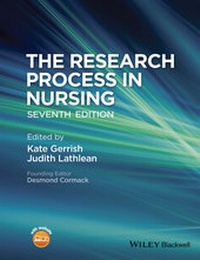
The Research Process in Nursing
Description

Reviews / Votes
Praise for previous editions: 'The perfect text for any health care professional whowishes to gain a sound understanding of research...This textsucceeds where others fail in terms of the thoroughness of theresearch process and the accessible style in which the material ispresented. In an age when nursing and health care research is goingfrom strength to strength this book offers those in the world ofacademia and practice an excellent and essential 'bible' that is amust on any bookshelf' (Dr Aisha Holloway, Lecturer AdultHealth, Division of Nursing, The University ofNottingham) "This new edition is worth buying," (Nursing Standard,July 2010) "The first edition of this book was published 20 years ago and Iwish I had seen it then. It is only over the last 10 years or sothat I have actively become more interested and this book wouldhave certainly stimulated my interest much sooner. If you areundertaking a research activity it is a book that helps you eachstep of the way. A very understandable and enjoyable publication.(Accident and Emergency Nursing Journal)More details
Other editions
Additional editions
Persons
Kate Gerrish is Professor of Nursing Research at the School of Nursing and Midwifery, University of Sheffield and Sheffield Teaching Hospitals NHS Foundation Trust, UK.
Judith Lathlean is Professor of Health Research within the Faculty of Health Sciences, University of Southampton, UK.
Content
Chapter 1
Research and Development in Nursing
Kate Gerrish
Key points
- Research is concerned with generating new knowledge through a process of systematic scientific enquiry, the research process.
- Research in nursing can provide new insights into nursing practice, develop and improve methods of caring and test the effectiveness of care.
- Whereas comparatively few nurses may undertake research, all nurses should develop research awareness and use research findings in their practice.
- Evidence-based practice involves integrating the best available research evidence with professional expertise whilst also taking account of patient preferences, the patient's state, setting and circumstances and health-care resources.
Introduction
Significant changes in health care have taken place in the three decades since the first edition of this book was published, and these changes are set to continue. Technological developments have led to improved health outcomes and at the same time have raised public expectations of health-care services. Increased life expectancy and lower birth rates mean that the population in the United Kingdom is ageing. An older population is more likely to experience complex health needs, especially in regard to chronic disease, and this places additional demands on an already pressurised health service. At the same time, the escalating cost of health care is leading to a shift from expensive resource-intensive hospital care to more services being provided in the primary and community care sectors. In response to these changes, government health policy is increasingly focused on improving the clinical and cost-effectiveness of health care while at the same time reducing the burden of ill health through active public health and health promotion strategies. These changes in the United Kingdom are reflected in other high-income countries internationally.
In order to respond to these challenges, the UK government has identified a number of priorities that need to be progressed in order to provide high-quality care for patients and promote the health of the population at large. These include improving health outcomes by preventing illness as well as enhancing the quality of care provided to people with particular needs, for example, patients with common long-term conditions such as diabetes or those in need of palliative and end-of-life care (Department of Health 2012a, 2013a). In order to achieve the aspirations for enhancing quality and improving health and health outcomes, there is a need to change the way health-care professionals work and the way health services fit together and ensure that patients have access to the best available treatments. However, achieving quality in health care is a moving target. What was considered high-quality care in 1948 when the NHS was first founded is no longer considered to be the case nearly seven decades later. Knowledge about effective health-care interventions has increased by leaps and bounds, and this is certainly the case with nursing interventions.
It is essential that nurses respond proactively to the developments in nursing and health-care delivery outlined earlier in order to provide high-quality care in response to the needs of the individuals and communities with whom they work. To do this, they need up-to-date knowledge to inform their practice. Such knowledge is generated through research. This chapter introduces the concept of nursing research and considers how research contributes to the development of nursing knowledge. In recognising that nursing is a practice-based profession, the relevance of research to nursing policy and practice is examined within the context of evidence-based practice, and the responsibilities of nurses are explored in respect of research awareness, research utilisation and research activity.
Nursing Research and Development
The definition of research provided by Hockey (1984) in the first edition of this book is still pertinent today:
Research is an attempt to increase the sum of what is known, usually referred to as a 'body of knowledge' by the discovery of new facts or relationships through a process of systematic scientific enquiry, the research process. (Hockey 1984: 4)
Other definitions of research emphasise the importance of the knowledge generated through research being applicable beyond the research setting in which it was undertaken, that is, that it is generalisable to other similar populations or settings. The Department of Health, for example, defines research as
the attempt to derive generalisable new knowledge by addressing clearly defined questions with systematic and rigorous methods. (Department of Health 2005: 3, section 1.10)
Research is designed to investigate explicit questions. In the case of nursing research, these questions relate to professional activities and concerns that are primarily the responsibility of nurses. The International Council of Nurses' (ICN) definition of nursing research captures these broad areas of interest that are relevant to nurse researchers:
Nursing research is a systematic enquiry that seeks to add new nursing knowledge to benefit patients, families and communities. It encompasses all aspects of health that are of interest to nursing, including promotion of health, prevention of illness, care of people of all ages during illness and recovery or towards a peaceful and dignified death. (ICN 2009)
The ICN has identified nursing research priorities in two broad areas, namely, health and illness and the delivery of care services. These priority areas are outlined in Box 1.1. In further developing the nursing research agenda, various organisations have identified priorities for specific areas of nursing practice. For example, a recent consultative exercise in the United Kingdom involving patients, carers, health-care professionals and researchers identified 12 research priorities into the prevention and management of pressure ulcers (James Lind Alliance Pressure Ulcer Partnership 2013). Box 1.2 shows that these priorities are broad ranging and cover not only aspects of nursing care but also education, service delivery, surgical interventions and patient/carer involvement.
Box 1.1 Priorities for nursing research identified by the International Council of Nurses
Health and illness
Nursing research priorities in health and illness focuses on:
- health promotion
- prevention of illness
- control of symptoms
- living with chronic conditions and enhancing quality of life
- caring for clients experiencing changes in their health and illness
- assessing and monitoring client problems
- providing and testing nursing care interventions
- measuring the outcomes of care
Delivery of care services
Nursing research priorities in delivery of care services focus on:
- quality and cost-effectiveness of care
- impact of nursing interventions on client outcomes
- evidence-based nursing practice
- community and primary health care
- nursing workforce to include quality of nurses' work life, retention and satisfaction with work
- impact of health-care reform on health policy, programme planning and evaluation
- impact upon equity and access to nursing care and its effects on nursing
- financing of health care
ICN (2009)
Box 1.2 Top 12 pressure ulcer research priorities
- How effective is repositioning in the prevention of pressure ulcers?
- How effective at preventing pressure ulcers is involving patients, family and lay carers in patient care?
- Does the education of health and social care staff on prevention lead to a reduction in the incidence of pressure ulcers, and, if so, which education programmes are most effective?
- What is the relative effectiveness of the different types of pressure-relieving beds, mattresses, overlays, heel protectors and cushions?
- What impact do different service models have on the incidence of pressure ulcers including staffing levels, continuity of care and the current organisation of nursing care in hospitals?
- What are the best service models to ensure that patients with pressure ulcers receive the best treatment outcomes?
- For wheelchair users sitting on a pressure ulcer, how effective is bed rest in promoting pressure ulcer healing?
- How effective are wound dressings in the promotion of pressure ulcer healing?
- Does regular turning of patients in bed promote healing of pressure ulcers?
- Does improving diet and hydration promote pressure ulcer healing?
- How effective are surgical operations to close pressure ulcers?
- How effective are topical skin care products and skin care regimes at preventing pressure ulcers?
James Lind Alliance Pressure Ulcer Partnership (2013)
Research in the field of nursing education is also important, for unless nurses are prepared appropriately for their role, they will not be able to respond to the needs of patients, families and communities. Some examples of priorities for research in nursing education are identified in Box 1.3.
Box 1.3 Priorities for research in nursing education
Education-practice linkages
- Education models focused on delivery...
