

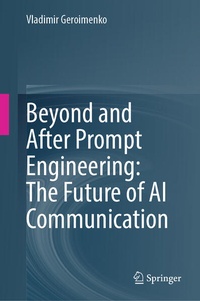
Beyond and After Prompt Engineering: The Future of AI Communication
Description

This pioneering book offers both a practical guide and a conceptual manifesto for rethinking our relationship with AI, exploring the future of AI communication and moving beyond traditional prompt engineering towards more natural, intuitive, multimodal, and context-aware interactions.
It examines the personal, cultural, ethical, and philosophical aspects of AI communication, providing insights into how machines can comprehend context, establish rapport, exhibit emotional intelligence, and collaborate effectively with humans. The book outlines the key communication principles essential for ensuring clarity, trust, adaptability, and mutual understanding in increasingly complex human-AI dialogues.
Structured across 16 chapters and organised into three parts (conceptual foundations, communicative principles, and future trajectories), this volume combines in-depth analysis with numerous real-world examples and forward-looking scenarios. It is richly illustrated with 142 conceptual diagrams that clarify complex ideas and serve as visual companions to the narrative.
Covering both near-term advancements and long-term speculative trends, this book serves as an essential guide for AI developers, practitioners, educators, students, and anyone interested in communicating more effectively with increasingly sophisticated AI systems.
More details
Other editions
Additional editions
Person
Content
Introduction to the future of traditional prompt engineering.- Part 1: Key concepts of future AI communication.- The evolution of AI communication.- The future is personal, social, and cultural.- The future is contextual.- The future is multimodal.- The future is intuitive and emotional.- The future is collaborative and co-creative.- The future is ethical and philosophical.- Part 2: Key principles of present and future AI communication.- Foundational communication principles: Ensuring clarity, precision, and effectiveness in AI interaction.- Context management and adaptability: Enhancing AI's ability to understand and recall context.- Feedback and iterative Rrefinement: Improving AI responses through interaction cycles.- Ethical alignment and trust calibration: Managing AI reliability, biases, and ethical constraints.- Enhancing AI's cognitive abilities: Optimising AI's reasoning, creativity, and knowledge application.- Emotional and relational aspects: Building rapport and human-like interaction with AI.- Part 3: Preparing for the future: From readiness to radical transformation.- Preparing for the foreseeable future.- The more distant future is symbiotic and unfamiliar.- Concluding remarks.
