

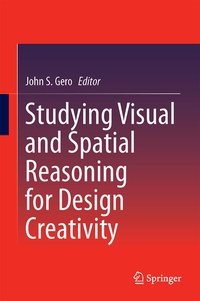
Studying Visual and Spatial Reasoning for Design Creativity
Description

Creativity and design creativity in particular are being recognized as playing an increasing role in the social and economic wellbeing of a society. As a consequence creativity is becoming a focus of research. However, much of this burgeoning research is distributed across multiple disciplines that normally do not intersect with each other and researchers in one discipline are often unaware of related research in another discipline.
This volume brings together contributions from design science, computer science, cognitive science and neuroscience on studying visual and spatial reasoning applicable to design creativity. The book is the result of a unique NSF-funded workshop held in Aix-en-Provence, France. The aim of the workshop and the resulting volume was to allow researchers in disparate disciplines to be exposed to the other's research, research methods and research results within the context of design creativity.
Fifteen of the papers presented and discussed at the workshop are contained in this volume. The contributors come from Germany, Israel, Netherlands, Poland, Singapore, UK and USA, indicating the international spread of the research presented in this volume.
More details
Other editions
Additional editions
Content
Preface.- DESIGN SCIENCE - STATE-OF-THE-ART.- Navigating Complex Buildings: Cognition, Neuroscience and Architectural Design.- Showing Connection.- The Theoretical Framework for Creative Visual Thinking.- Sortal Grammars for Urban Design.- Bridging Parametric Shape and Parametric Design.- COMPUTER SCIENCE - STATE-OF-THE-ART.- Dialectical Creativity: Sketch-Negate-Create.- Spatial Computing for Design: An Artificial Intelligence Perspective.- SIRN - Synergetic Inter-Representation Networks: An Approach to Urban Planning and Design with Implications to Visual-Spatial Reasoning.- Qualitative Spatial-Relation Reasoning for Design.- COGNITIVE SCIENCE - STATE-OF-THE-ART.- Thinking about Spatial Thinking: New Typology, New Assessments.- Visual-object Versus Visual-spatial Representations: Insights from Studying Visualization in Artists and Scientists.- Ubiquitous Serendipity: Potential Visual Design Stimuli are Everywhere.- On Abstraction and Ambiguity.- NEUROSCIENCE - STATE-OF-THE-ART.- Creative States: A Cognitive Neuroscience Approach to Understanding and Improving Creativity in Design.- Spatial Transformations of Scene Stimuli: It's an Upright World.- Index.
