

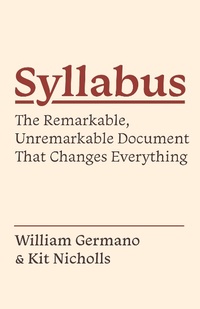
Syllabus
Description

How redesigning your syllabus can transform your teaching, your classroom, and the way your students learn
Generations of teachers have built their classes around the course syllabus, a semester-long contract that spells out what each class meeting will focus on (readings, problem sets, case studies, experiments), and what the student has to turn in by a given date. But what does that way of thinking about the syllabus leave out-about our teaching and, more importantly, about our students' learning?
In Syllabus, William Germano and Kit Nicholls take a fresh look at this essential but almost invisible bureaucratic document and use it as a starting point for rethinking what students-and teachers-do. What if a teacher built a semester's worth of teaching and learning backward-starting from what students need to learn to do by the end of the term, and only then selecting and arranging the material students need to study?
Thinking through the lived moments of classroom engagement-what the authors call "coursetime"-becomes a way of striking a balance between improv and order. With fresh insights and concrete suggestions, Syllabus shifts the focus away from the teacher to the work and growth of students, moving the classroom closer to the genuinely collaborative learning community we all want to create.
More details
Other editions
Additional editions
Persons
Content
- Cover
- Skills for Scholars
- Contents
- Acknowledgments
- 1. What You Do, What They Do
- The Syllabus We Have
- The Syllabus We Could Have
- The Pedagogical Contract
- 2. Turning the Classroom into a Community
- Students and Sovereigns
- Classroom Composition
- Finding the Center
- The Classroom Community as a Working Community
- True Believers
- 3. Clock and Calendar
- Two Kinds of Time
- Coursetime
- Off-Season
- 4. What's a Reading List? And What's It For?
- Not Quite a Short History of the Reading List
- Required Reading, Recommended Reading
- Thinking with the Incomplete
- Making Use of Everything
- How to Read a List, or Pretty Much Anything Else
- 5. Their Work and Why They Do It
- Starting from the Work
- Of Students and Stories
- Facts and Concepts
- Putting It All Together
- 6. Our Work and How We Do It
- The Trouble with Grades
- Feedback, Feed Forward
- Honesty and Other Best Policies
- 7. What Does Learning Sound Like?
- Group Improvisation
- What Teaching Sounds Like
- Together and Apart
- 8. For Your Eyes Only
- The Instructor's Copy
- Reflective Teaching
- A Teaching Philosophy, with Oranges
- 9. The Syllabus as a Theory of Teaching
- A Design for Possibilities
- Us and Them
- The Real Life of a Syllabus
- The Syllabus at the End of the Mind
- Further Reading
- Index
