

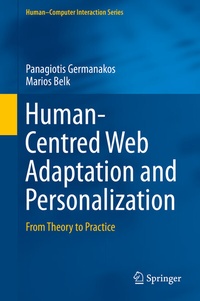
Human-Centred Web Adaptation and Personalization
Description

This book focuses on the importance of adaptation and personalization in today's society and the upgraded role computational systems and the Internet play in our day-to-day activities. In this era of wireless communication, pervasive computing and the Internet of Things, it is becoming increasingly critical to ensure humans remain central in the developmental process of new technologies to guarantee their continued usefulness and a positive end-user experience.
Organized into three clear parts - theory, principles and practice, a holistic approach to designing and developing adaptive interactive systems and services has been adopted. With an emphasis on distinct human factors, both basic and applied research topics are explored, extending from human-centred user models, driven by user's individual differences in cognitive processing and emotions, to the creation of smart interfaces that can handle the ever increasing volume and complexity of information to thebenefit of the end-user.
Human-Centred Web Adaptation and Personalization - From Theory to Practice is meticulously crafted to serve researchers, practitioners, and students who wish to have an end-to-end understanding of how to convert pure research and scientific results into viable user interfaces, system components and applications. It will serve to bridge the knowledge gap that still remains by suggesting interaction design and implementation guidelines for areas like E-Commerce, E-Learning and Usable Security.
Reviews / Votes
"This book covers a very new and interesting topic of improving user interfaces (UIs) by making them friendly to each particular user. The reader can find a lot of information about the history of UIs and the current ways to make them more efficient. There are also hundreds of references, which will provide the reader with details from many fields. . The book is useful for researchers who would like to study many aspects of the field." (Claudiu Popescu, Computing Reviews, April, 2017)More details
Other editions
Additional editions
Persons
Content
Foreword.- Preface.- Acknowledgements.- Overview of Book.- List of Abbreviations.- Part I: Theory: The Human in the Centre of Web Personalization.- Personalization in the Digital Era.-Human Factors in Web Adaptation and Personalization.- Part II: Principles: Web Adaptation and Personalization Processes and Techniques.-User Modeling.- Personalization Categories and Adaptation Technologies.- A Generic Human-Centred Personalization Framework - The Case of mapU.- Part III: Practice: A Practical Guide and Empirical Evaluation in Three Distinct Application Areas.- The E-Learning Case.- The E-Commerce Case.- The Usability Security Case.- Epilogue.
