

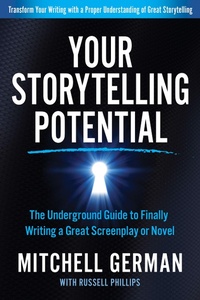
Your Storytelling Potential
Description

Writers seeking to create novels and screenplays with genuine layers and depth will find essential insight in Mitchell German's Your Storytelling Potential!
After studying filmmaking and screenwriting at NYU?one of the premier film studies programs in the United States (if not the world)?Mitchell German graduated with a complete doctrine on storytelling theory in his arsenal; yet his screenplays still lacked the potency he desired. He spent ten years studying every available book and ?expert? on storytelling, but it wasn't until 2002, after endlessly studying the movie Liar Liar, that Mitchell found the key and developed the Your Storytelling Potential Method.
The truth about great storytelling is hidden in plain view for anyone to see, but nearly every expert ignores the most basic story construct. In Your Storytelling Potential, writers who seek to tell great stories will find:
- A complete understanding of the Identifiable Traits great novels and screenplays (namely movies) have that distinguish them from the other 99.99% of books and screenplays written every year
- How to use Two Stories within a screenplay and novel, which exponentially increases the chances of those stories gaining buzz and attention
- A proper understanding of the critical and essential role of Subplots to create genuine character depth and relationships
- How to properly integrate a Theme for stories to convey deep, relevant, and amazing ideas
- An outline for utilizing A/B Parallel Story Structure and the Simple Story Timeline to build multi-dimensional stories with the required converging events of the A-Story/B-Story relationship
How the premise of every great story is created by the convergence of the A & B Storylines, and how this Key Information can unlock Your Storytelling Potential
More details
Other editions
Additional editions

Persons
Motivated to become an exceptional storyteller through film and visual media, Mitchell German studied filmmaking and screenwriting at NYU's Tisch School of the Arts?one of the premier film studies programs in the United States (if not the world). He graduated with a complete doctrine on storytelling theory in his arsenal; yet something was still missing in his understanding of the way stories operated.
Mitchell spent ten years studying every available book and ?expert? on storytelling, but he found they mostly taught the same regurgitated information. It wasn't until 2002, after endlessly studying the movie Liar Liar, that Mitchell discovered the key and developed his unique approach to story construction that would become Your Storytelling Potential.
His storytelling method formed the basis of the first instructional course he compiled for screenwriters?the Mega Course?as well as his enormously successful Plot Control screenwriting software that has since been adapted for novelists (Chapter Control), television writers and producers (Episode Control), college essay writers (Essay Dog), and even business entrepreneurs running webinars and launching new products. Today, Mitchell's book Your Storytelling Potential is an essential resource for writers of all backgrounds and experience levels. He currently resides outside of West Palm Beach, FL.
Content
- Intro
- Title
- Copyright
- Table of Contents
- Acknowledgments
- A Note from the Author
- CHAPTER 1: Hidden, Revealed and Unknown
- Your Story
- The First Takeaway
- The A-Story Element in the Your Storytelling Potential Method
- What Your Storytelling Potential is NOT (And a bit about what it is.)
- Three Branches
- Hidden, Revealed and Unknown Outer and Inner Worlds
- Three Branches, Part II:
- The Your Storytelling Potential Story Model Illustrated
- Embrace the Method!
- CHAPTER 2: The Beginning Is Not the Beginning
- Time Traveling Transition
- The Beginning Is Not the Beginning
- CHAPTER 3: Theme: The Conceptual War
- Theme and the Core Elements
- Theme: The Conceptual War
- CHAPTER 4: Three-Branch Reasons and Thematic Connections
- "The Reason We Asked You Here Today."
- CHAPTER 5: A Journey of Mind: Logic, Despair, Clarity
- The Underlying Cause: A Journey of Mind
- Transitional Doorways: Logic, Despair, and Clarity
- CHAPTER 6: Structural Connection Points
- The Primary Situation Movements
- Structural Connection Points
- Introduction
- Logic
- Obstacles
- Failure
- Desire
- Reversals
- Resolution
- Character Wave Summaries Four Example IPs
- Star Wars
- Die Hard
- Rocky
- The Harry Potter Series
- Quick Word: Solutions/Motivation Alignment
- CHAPTER 7: Twelve Core Elements
- How to think about the Twelve Core Elements
- Layers: Brick-by-Brick
- Introduction
- Act I
- Act II
- Subplots (Thematic Layer)
- Closer Look: The B-Story Elements
- Closer Look: The Character Elements
- Closer Look: The A-Story Elements
- Case Studies: The Core Elements of the Example IPs
- CHAPTER 8: The Theory of Subplot Relativity
- Types and Functions of Subplots: The Theory of Subplot Relativity
- Implementing Subplots
- Subplot Case Studies: The Thematic Conflict Arena
- Liar Liar
- Star Wars
- Die Hard
- Rocky
- Harry Potter Series
- CHAPTER 9: The Simple Story Timeline
- Act I Structural Phases Breakdown
- Act I in Action
- Act II Structural Phases Breakdown
- Act II In Action
- Act III Structural Phases Breakdown
- Act III In Action
- Structural Phases of the Simple Story Timeline And Full Plot Dynamics Graphs
- CHAPTER 10: Characters as Cause
- Characters as Cause
- Situation Cause Characters I: The Proximate Cause Character
- Proximate Cause Character Characteristics
- Secondary Cause Characters
- Cause of a Cause
- Situation Cause Characters II: Underlying Cause Characters
- Underlying Cause Character Characteristics
- Timeline Movements as Causation Chains
- Timeline Causation Flow Illustrated: Case Study- Liar Liar
- CHAPTER 11: Your Revealed Storytelling Potential
- Brainstorming the Core Elements
- Brainstorming the Structure
- Brainstorming for Relevant Characters
- Creating Your Final Outline with the Simple Story Timeline
- THE END
- About The Author
- Additional Resources
- Glossary
