

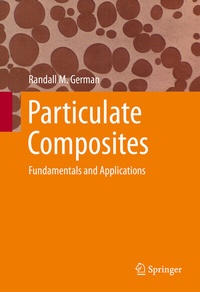
Particulate Composites
Description

This book is focused on composites involving powders as the starting materials. It provides relevant information for questions related to the selection of constituent phases, most economic fabrication routes, proper testing procedures, and product optimization. The field is sufficiently advanced that predictive models guide many decisions. Applications are illustrated over a broad range of material and property combinations. This title includes:
Selection of phases with consideration of intersolubility & interface
Microstructure, especially the role of phase connectivity
Fabrication approaches, especially net-shape consolidation
Assessment of typical properties, testing techniques & industry standards
Design & trade-off decisions involved in optimization, including cost
Applications, both those that have matured and some emerging prospects.
The reader may have little appreciation for how particulate composites are literallyeverywhere. Examples include new wear resistant consumer products(Apple watch), longer lasting automotive tires with reduced rolling resistance(Yokohama tires), and new diamond heat sinks for computers(Element Six substrates). Particulate composites also form critical components in applications such as magnets, dental fillings, brakes, darts, bio-implants, & cutting tools. Particulate composites are a multi-billion dollar industry, and can be a cost-effective solution ripe for innovation and continued rapid growth. For the engineer, the wide range of particulate composite formulation and property combinations offers the ability to design for a variety of application and provides ample opportunity for innovation.
Particulate Composites: Fundamentals & Applications is ideal for use in a one-semester eng. course at the senior UG/graduate level, and is also suitable as a practical reference for materials scientists in academia and industry.
More details
Other editions
Additional editions

Person
Rand obtained his PhD from the University of California at Davis, MS from The Ohio State University, and an honor's BS degree from San Jose State University. He completed management development programs at Hartford Graduate Center and Harvard.
He has an honorary doctorate from the Universdad Carlos III de Madrid, and is a Fellow of three professional organizations. His awards include the Tesla Medal,Nanyang Professorship, Japan Institute for Materials Research Lectureship, Penn State Engineering Society Premiere Research Award, University of California at Davis Distinguished Engineering Alumni Award, The Ohio State University Distinguished Engineering Alumnus Award, San Jose State University Award of Distinction, and Honorary Member of Alpha Sigma Mu. He served on three National Academy review boards and helped form a dozen start-up companies.
Rand has supervised more than 100 theses and 200 postdoctoral fellows. These efforts have resulted in 1,025 published articles, 25 patents, and 18 books, including Sintering Theory and Practice . He has edited 19 books and co-chaired 30 conferences. His publications have been cited more than 22,000 times.
