

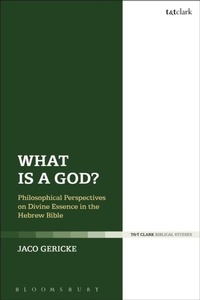
What is a God?
Philosophical Perspectives on Divine Essence in the Hebrew Bible
1st Edition
Published on 26. January 2017
176 pages
978-0-567-67170-7 (ISBN)
Description

In this book Jaco Gericke is concerned with different ways of approaching the question of what, according to the Hebrew Bible, a god was assumed to be. As a supplement to the tradition of predominantly linguistic, historical, literary, comparative, social-scientific and related ways of looking at the research problem, Gericke offers a variety of experimental philosophical perspectives that aim to take a step back from the scholarly discussion as it has unfolded hitherto in order to provide a new type of worry when looking at the riddle of what the biblical texts assumed made a god divine.
Consisting of a brief history of philosophical interpretations of the concepts of whatness and essence from Socrates to Derrida, the relevant ideas are adapted and reapplied to look at some interesting metaphysical oddities arising from generic uses of elohim/el/eloah as common noun in the Hebrew Bible. As such the study seeks to be a prolegomenon to all future research in that, instead of answering the question regarding a supposed nature of divinity, it aims to complicate it beyond expectation. In this way a case is made for a more nuanced and indeterminate manner of constructing the problem of what it meant to call something a god.
Consisting of a brief history of philosophical interpretations of the concepts of whatness and essence from Socrates to Derrida, the relevant ideas are adapted and reapplied to look at some interesting metaphysical oddities arising from generic uses of elohim/el/eloah as common noun in the Hebrew Bible. As such the study seeks to be a prolegomenon to all future research in that, instead of answering the question regarding a supposed nature of divinity, it aims to complicate it beyond expectation. In this way a case is made for a more nuanced and indeterminate manner of constructing the problem of what it meant to call something a god.
More details
Edition
1. Auflage
Language
English
Place of publication
London
United Kingdom
Publishing group
Bloomsbury Publishing PLC
Target group
Professional and scholarly
ISBN-13
978-0-567-67170-7 (9780567671707)
Copyright in bibliographic data and cover images is held by Nielsen Book Services Limited or by the publishers or by their respective licensors: all rights reserved.
Schweitzer Classification
Other editions
Additional editions
Book
07/2018
T.& T.Clark Ltd
€63.32
Shipment within 3-4 weeks
Book
01/2017
T.& T.Clark Ltd
€193.13
Shipment within 3-4 weeks
Person
Jaco Gericke is Associate Research Professor of Theology and Philosophy at North-West University, South Africa.
Content
Foreword
Acknowledgements
Abbreviations
1. Introduction: What is a God?
2. Whatness and a Socratic Definition of God-ness via Common Properties
3. Whatness and a Platonist Perspective on God-ness as Form/Universal
4. Whatness and Aristotelian Essentialism about a God as Secondary Substance
5. Whatness and a Porphyrian Tree of God as Species/Genus
6. Whatness and a Boethian Distinction between Essence/Existence in a God
7. Whatness and an Avicennian View on the Quiddity of a God
8. Whatness and Abelardian Nominalism about the Status of a God
9. Whatness and a Thomistic Perspective on the Complexity of a God
10. Whatness and a Scotian Interpretation of a God's Haecceity
11. Whatness and a Cartesian Notion of a God's Principle Attribute
12. Whatness and Lockean Anti-Essentialism about God as Sortal
13. Whatness and Leibnizian Superessentialism about Necessity in a God
14. Whatness and a Kantian Concept of a God as Thing-in-Itself
15. Whatness and a Hegelian View of the Essence of a God in Appearances
16. Whatness and a Nietzschean Interpretation of a God as Will-to-Power
17. Whatness and Wittgensteinian Family Resemblances among the God
18. Whatness and a Husserlian Reduction of a God's Essence as Intentional Object
19. Whatness and a Heideggerian View of what is Ownmost in a God Identity over Time
20. Whatness and a Sartrean Idea of Existence preceding Essence in a God
21. Whatness and a Quinean denial of Necessary and Sufficient Conditions for being a God
22. Whatness and the Popperian Essentialist Fallacy in Defining a God
23. Whatness and Kripkean Modal Neo-Essentialism about God as Rigid Designator
24. Whatness and Derridian Differential Ontology for a God beyond Anti-/Essentialism
25. Summary and Conclusions
Bibliography
Index of Biblical References
Index of Classical Sources
Index of Subjects
Index of Authors
Acknowledgements
Abbreviations
1. Introduction: What is a God?
2. Whatness and a Socratic Definition of God-ness via Common Properties
3. Whatness and a Platonist Perspective on God-ness as Form/Universal
4. Whatness and Aristotelian Essentialism about a God as Secondary Substance
5. Whatness and a Porphyrian Tree of God as Species/Genus
6. Whatness and a Boethian Distinction between Essence/Existence in a God
7. Whatness and an Avicennian View on the Quiddity of a God
8. Whatness and Abelardian Nominalism about the Status of a God
9. Whatness and a Thomistic Perspective on the Complexity of a God
10. Whatness and a Scotian Interpretation of a God's Haecceity
11. Whatness and a Cartesian Notion of a God's Principle Attribute
12. Whatness and Lockean Anti-Essentialism about God as Sortal
13. Whatness and Leibnizian Superessentialism about Necessity in a God
14. Whatness and a Kantian Concept of a God as Thing-in-Itself
15. Whatness and a Hegelian View of the Essence of a God in Appearances
16. Whatness and a Nietzschean Interpretation of a God as Will-to-Power
17. Whatness and Wittgensteinian Family Resemblances among the God
18. Whatness and a Husserlian Reduction of a God's Essence as Intentional Object
19. Whatness and a Heideggerian View of what is Ownmost in a God Identity over Time
20. Whatness and a Sartrean Idea of Existence preceding Essence in a God
21. Whatness and a Quinean denial of Necessary and Sufficient Conditions for being a God
22. Whatness and the Popperian Essentialist Fallacy in Defining a God
23. Whatness and Kripkean Modal Neo-Essentialism about God as Rigid Designator
24. Whatness and Derridian Differential Ontology for a God beyond Anti-/Essentialism
25. Summary and Conclusions
Bibliography
Index of Biblical References
Index of Classical Sources
Index of Subjects
Index of Authors
