

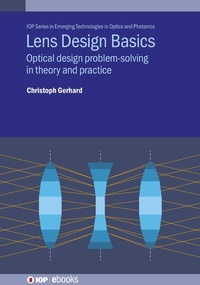
Lens Design Basics
Description

To this day, optical design plays a vital role in the development of multiple scientific disciplines. From machine imaging to microscopes, a lens quality and optimisation remains of fundamental importance. This book gives a comprehensive overview of the principles of optical imaging. The first seven chapters provide an extensive summary of optical design, as well as the mechanisms and interrelations leading to the formation of aberrations and the accompanying decrease in imaging performance. Aside from the fundamentals of optics and imaging models, topics covered include calculations of simple optical components and systems, characterisation and quantification of aberrations and defects in optical systems, and optimisation of imaging performance. The second part focuses on problem-based learning via multiple exercises and case examples derived from the first seven chapters. It is an ideal guide for optics and photonics students.
More details
Other editions
Additional editions
Person
Christoph Gerhard is a professor of physics and instrumental analytics and is the head of the Laboratory of Analytical Measurement Technology at the University of Applied Sciences and Arts in Göttingen, Germany. He has published more than 50 articles on optics and optical system design. This is his fourth textbook in the field of optics.
Content
- Intro
- Foreword
- How to use this book
- Acknowledgments
- Author biography
- Christoph Gerhard
- Chapter 1 Fundamentals
- 1.1 Light waves and light rays
- 1.2 Refraction
- 1.3 Dispersion
- 1.4 Reflection
- 1.5 Absorption and transmission
- 1.6 Interference
- 1.7 Diffraction and optical resolution
- 1.8 Fundamentals-bottom line
- References
- Chapter 2 Introduction to imaging models
- 2.1 The paraxial or Gaussian imaging model
- 2.2 Geometric-optical imaging
- 2.3 Wave optics
- 2.4 Introduction to imaging models-bottom line
- References
- Chapter 3 Calculation of simple optical components and systems
- 3.1 Lens types and basic lens parameters
- 3.1.1 Lens shapes
- 3.1.2 Principal planes
- 3.1.3 Cardinal elements
- 3.2 The lensmaker's equations
- 3.2.1 Thin lenses
- 3.2.2 Thick lenses
- 3.3 Conjugated parameters of optical imaging
- 3.3.1 Definition of conjugated parameters
- 3.3.2 Construction rays
- 3.4 The imaging equation and magnification
- 3.5 Calculation of compound lenses
- 3.6 Condition for achromatism
- 3.7 Calculation of aplanatic lenses
- 3.8 Calculation of simple optical systems-bottom line
- References
- Chapter 4 Aberrations and defects in optical systems
- 4.1 Seidel aberrations
- 4.1.1 Calculation of Seidel coefficients
- 4.1.2 Spherical aberration
- 4.1.3 Coma
- 4.1.4 Astigmatism
- 4.1.5 Petzval field curvature
- 4.1.6 Distortion
- 4.2 Chromatic aberration
- 4.2.1 Longitudinal chromatic aberration
- 4.2.2 Lateral chromatic aberration
- 4.3 Vignetting
- 4.4 Ghost images
- 4.5 Wave aberrations
- 4.6 Contrast and contrast transfer
- 4.7 Aberrations and defects in optical systems-bottom line
- References
- Chapter 5 Evaluation of imaging performance
- 5.1 Evaluation graphs
- 5.1.1 The spot diagram
- 5.1.2 The transverse ray aberration diagram
- 5.1.3 Field diagrams
- 5.1.4 Wave front plots
- 5.1.5 Modular transfer function diagrams
- 5.1.6 The longitudinal aberration diagram
- 5.1.7 The chromatic aberration diagram
- 5.1.8 The Seidel bar chart
- 5.1.9 Transmission graphs
- 5.2 Tables and data
- 5.3 Evaluation of imaging performance-bottom line
- References
- Chapter 6 From task to solution
- 6.1 Basic considerations for lens design
- 6.1.1 Analysis of given imaging tasks
- 6.1.2 Definition and choice of start systems
- 6.1.3 Evaluation of lenses and optical systems
- 6.2 Optimisation
- 6.2.1 Direct optimisation via merit functions
- 6.2.2 Direct optimisation via manual modifications
- 6.2.3 Indirect optimisation
- 6.3 Determination of manufacturing tolerances
- 6.4 From task to solution-bottom line
- References
- Chapter 7 Impact of manufacturing tolerances on imaging performance
- 7.1 Bulk defects in optical glasses
- 7.1.1 Stress birefringence
- 7.1.2 Bubbles and inclusions
- 7.1.3 Inhomogeneity and striae
- 7.2 Form deviations and surface defects of optical components
- 7.2.1 Surface accuracy
- 7.2.2 Surface cleanliness
- 7.2.3 Surface roughness
- 7.3 Position tolerances
- 7.3.1 The centring error
- 7.3.2 Defects of cemented lens groups
- 7.3.3 Defects of mounted opto-mechanic assemblies
- 7.4 Impact of manufacturing tolerances on imaging performance-bottom line
- References
- Chapter 8 Hands-on training
- 8.1 Introduction to used software
- 8.1.1 The calculation tool PreDesigner
- 8.1.2 The ray tracing software WinLens
- 8.2 Exercises
- 8.2.1 Topic: basic considerations and definition of start systems
- 8.2.2 Topic: creating and evaluating lenses and systems
- 8.2.3 Topic: optimisation of optical systems
- 8.2.4 Topic: simulation of manufacturing errors and tolerances
- References
- Chapter
- A.1 Solutions of exercises
- A.1.1 Topic: basic considerations and definition of start systems
- A.1.2 Topic: creating and evaluating lenses and systems
- A.1.3 Topic: optimisation of optical systems
- A.1.4 Topic: simulation of manufacturing errors and tolerances
- A.2 Formulary
- A.3 Further reading
- A.3.1 Books
- A.3.2 Articles and conference proceedings
