

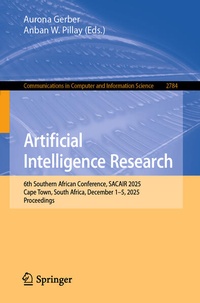
Artificial Intelligence Research
Description

This book constitutes the refereed proceedings of the 6th Southern African Conference on Artificial Intelligence Research, SACAIR 2025, held in Cape Town, South Africa, during December 1-5, 2025.
The 36 full papers presented in this volume were carefully reviewed and selected from 150 submissions.The papers are organized into the following topical sections: Algorithmic and Data Driven AI; Socio-technical and Human-Centred AI; and Responsible and Ethical AI.
More details
Other editions
Additional editions
Content
.- Algorithmic and Data Driven AI.
.- Which contextual topic modelling algorithm is the best?.
.- Leveraging Language Models for Document Type Classification in
Low-Resource Afrikaans Archives.
.- Hybrid Automatic Modulation Classification for Increased Robustness
under White-Box Adversarial Attacks.
.- Counterfactual Explanation Model for Personalised Dietary
Interventions in Anaemia Patients.
.- Feature extraction for plant growth estimation.
.- Exploring the impact of different loss functions for anomaly prediction
in a mineral processing plant.
.- Modifying class distributions to improve the classification of minority
group examples in a class-imbalanced dataset.
.- Evaluating OCR performance on food packaging labels in South Africa.
.- Investigating the Impact of Multilingual Pre-trained Speech Models on
Gender Bias in ASR for Low Resource African Languages.
.- A Two Stage Pipeline for Automated Caries Detection on Single Tooth
Images from Panoramic Radiographs.
.- Exploring syllable similarity across South African languages through
self-supervised speech representation.
.- Data Pruning: Redundant, Problematic, and Interdependent Samples.
.- Restoring Neural Network Plasticity for Faster Transfer Learning.
.- AfroXLMR-Comet: Multilingual Knowledge Distillation with Attention
Matching for Low-Resource Languages.
.- Code-Switch Pretraining for Improved Cross-Lingual Alignment in
Low-Resource Languages.
.- Identification of Social Media Users that Perpetuate Xenophobic
Attitudes and Hate Speech Narratives in South Africa.
.- HAPI-FedProx: Heterogeneity-Aware Adaptive Proximal Optimization
for Federated Learning.
.- Fog-Based Deep Learning for Real-Time Cold Chain Temperature
Prediction Using IoT Data.
.- Robust Driver Distraction Recognition via Lightweight Body-Part
Association and Object Context on NVIDIA Jetson.
.- Nearest-Class Mean and Logits Agreement for Wildlife Open-Set
Recognition.
.- Semi-Supervised Object Segmentation via Active Learning for Efficient
Ecological Monitoring.
.- Scaling behavior of Encoder Language Models in Low-Resource Settings.
.- Enhancing Target Re-Identification via Model Fusion and
Knowledge Distillation of Pre-trained Foundation Models.
.- Heart Disease Prediction: A Comparative Study of Optimizers'
Performance in Deep Neural Networks.
.- Socio-technical and Human-Centred AI.
.- AI-Enabled Cybersecurity Implementation: A Case Study of Critical
Success Factors in a South African SOE.
.- Large Language Model Evaluation: From Model-Centric Benchmarks
to System-Level Metrics.
.- Exploring Postgraduate Students' Use and Perceptions of Generative
AI as a Research Support Tool: A South African Case.
.- An Awareness Framework for Sustainable Selection of LLMs in Business.
.- Synthesizing Insights from AI in Africa: A Comprehensive Qualitative
Analysis.
.- Factors influencing the use of Autonomous Vehicles on Traditional
Road Infrastructure in The Western Cape.
.- An Agentic LLM-Powered Framework for Cholera Risk Prediction and
Actionable Insights from Explainable ML and Statistical Insights.
.- A Scoping Review on Generative AI prompting to optimize the
workflow of healthcare professionals in sub-Saharan Africa.
.- Detection Of Power Line Insulator Defects Using YOLOv10-N.
.- Responsible and Ethical AI.
.- Artificially Generated Minorities (AGMs): The Veneer of Algorithmic
Bias Correction.
.- Under-resourced and over-reseached: The ELSA approach to
transdisciplinary AI research in low-trust neighborhoods.
.- From Principles to Practice: Extracting Human-Centred AI
Components from Governance Frameworks.
