

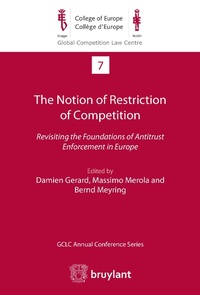
The Notion of Restriction of Competition
Revisiting the Foundations of Antitrust Enforcement in Europe
Published on 16. March 2017
392 pages
978-2-8027-5755-9 (ISBN)
Description

The transformations induced by the process of "modernisation", including in its substantive dimension, as well as recent judgments by the EU Courts, have left many lawyers and economists wary as to the standards actually governing findings of antitrust infringement under EU competition law, thereby affecting their ability to advise businesses effectively on the design of their commercial practices.
While not ignoring institutional constraints, this volume revisits the notion of restriction of competition in the framework of Articles 101 and 102 TFEU with a view to taking stock of recent developments, to identifying common trends and to informing the application of core EU antitrust principles in current market contexts.
Associating lawyers and economists, practitioners and academics, it seeks both to revisit long-standing theories of harm to competition and to explore novel forms of antitrust concerns.
While not ignoring institutional constraints, this volume revisits the notion of restriction of competition in the framework of Articles 101 and 102 TFEU with a view to taking stock of recent developments, to identifying common trends and to informing the application of core EU antitrust principles in current market contexts.
Associating lawyers and economists, practitioners and academics, it seeks both to revisit long-standing theories of harm to competition and to explore novel forms of antitrust concerns.
More details
Other editions
Additional editions
Damien Gerard | Massimo Merola | Bernd Meyring
The Notion of Restriction of Competition
Revisiting the Foundations of Antitrust Enforcement in Europe
Book
01/2017
Editions juridiques Bruylant
€116.56
Article exhausted; check different version
Content
- Intro
- Couverture
- Titre
- Copyright
- Foreword
- Setting Priorities in Antitrust
- Commissioner Margrethe Vestager
- Part I. Mapping the notion of restriction of competition
- "Restriction of competition" - A historical perspective
- Sir Christopher Bellamy
- I. Ancient times
- II. The early law
- III. 1966 to 2004: The Great Confusion
- IV. 2004 onwards
- Identifying "restrictions of competition" Some comments from a law and economics perspective
- Damien J. Neven
- I. A framework of sequential decisions
- II. Object and effect as sequential decisions
- III. Acquisition of more information
- IV. Conclusion
- The bifurcated approach and its practical impact on the establishment of harm to competition
- Ben Smulders
- I. The implications of the bifurcated approach
- II. The bifurcated approach in the application of Article 101
- A. First Step of Analysis under Article 101(1)
- B. Second Step of the Analysis under Article 101(3)
- III. The bifurcated approach in the application of Article 102
- A. First Step of Analysis under Article 102
- B. Second Step of Analysis under Article 102
- IV. Does it make sense to rely on efficiency defences?
- V. Burden of proof
- VI. Convergence in the application of the two provisions
- The object-effect dichotomy and the requirement of harm to competition: on the road to clarity after Cartes Bancaires?
- Bernard Amory, Geoffroy van de Walle and Nathalie A. Smuha
- I. The court before Cartes Bancaires
- A. Standard of Harm: "Capability" or "Sufficient Degree" of Harm?
- B. Level of Scrutiny: Factors to Take into Account
- II. The court after Cartes Bancaires
- A. Preliminary Reference Rulings: ING Pensii and Maxima Latvija
- 1. ING Pensii
- 2. Maxima Latvija
- B. Appeals against the General Court: Dole and Toshiba
- 1. Dole
- 2. Toshiba
- C. The Way Forward: Still Scope for Clarification
- The Challenge of European Competition Network Convergence in the Definition of Harm to Competition
- Imelda Maher
- I. Restriction by Object
- A. NCAs and Restriction by Object
- B. The Case of Retail MFN
- C. The Case of Pay-For-Delay Arrangements
- II. Institutional Tools
- A. Preliminary References
- B. The European Competition Network
- C. National Courts
- D. Mirroring
- Part II. Restriction of competition under article 101 TFEU
- What makes an agreement anti-competitive: Lessons from the past
- Luc Gyselen
- I. Top line definition of an anti-competitive agreement
- II. Shortcomings of dualist Article 101 TFEU
- III. Time to rewrite Article 101?
- IV. Support for a monist version "2.0" of Article 101
- A. The Legislative History of Article 85 EEC / 101 TFEU
- B. CJEU Judgements
- V. How to rewrite Article 101?
- Information Exchanges and Price SIGNALLING: An Economic Perspective
- Raphaël De Coninck
- I. Information exchanges
- A. Potential Efficiencies
- B. Potential Anticompetitive Effects
- II. Public announcements
- A. Invitation to Collude
- B. Price Signalling: Testing the Coordination Hypothesis
- 1. Do the announcements provide a focal point for coordination?
- 2. Do the announcements provide a plausible mechanism for coordination?
- 3. Are there other reasons for the announcements (potentially pro-competitive), unrelated to a potential coordination mechanism?
- 4. Are the announcements likely to lead to coordination (or to make coordination more sustainable) in the specific industry?
- National competition authorities' investigations in hub-and-spoke arrangements: a critical review
- Yves Botteman
- I. The great and elusive Hub-and-Spoke exchange
- A. Concerted Practice
- B. Proving an Illicit Hub-and-Spoke Exchange
- C. A Hub-and-Spoke State of Mind
- II. Do Hub-and-Spoke exchanges affect competition? And does it really matter?
- III. Resale price maintenance ("RPM"): the non-Hub-and-Spoke exchange
- Part III. Restriction of competition under article 102 TFEU
- What Makes a Unilateral Conduct Abusive: The Legal Perspective
- Robert O'Donoghue
- I. Fundamental concepts
- A. The Basic Definition of Abuse
- B. Uncertainty Surrounding the Definition of Exclusionary Conduct
- II. The categories of abuse under Article 102 TFEU
- A. Exploitative Abuses (Article 102(a))
- 1. Excessive prices
- 2. Unfair contractual terms and conditions
- B. Exclusionary Abuses (Article 102(b))
- 1. The need for a unified basis for exclusionary abuses
- 2. Article 102(b): the legal basis for defining exclusionary conduct
- 3. Explanation of the "limiting production" test
- 4. The Commission's policy rethink in the Guidance Paper
- C. Discriminatory Abuses (Article 102(c))
- 1. The need to distinguish different categories of discrimination.
- 2. Clarifying the treatment of discrimination under Article 102 TFEU
- (a) The analysis of exclusionary abuses that involve elements of discrimination
- (b) The analysis of discrimination by a dominant firm between non-associated customers
- D. Tying Abuses (Article 102(d))
- E. Leveraging Abuses
- 1. Definition of leveraging
- 2. The need to distinguish procompetitive and anticompetitive leveraging
- 3. Circumstances in which leveraging conduct amounts to an abuse
- (a) No independent abuse of leveraging
- (b) The need for a causal connection between the dominance and the abusive conduct
- (c) The relevance of "associative links"
- III. Anticompetitive effects under Article 102 TFEU
- A. The Need for Causation between Dominance and the Abuse
- 1. Causation and Article 102 TFEU: conflicting statements
- 2. Further recent exceptions: AstraZeneca and Rambus
- 3. Resolving the conflict
- 4. Causation in fact
- 5. The use of counterfactuals
- B. The Standard for Anticompetitive Effects under Article 102 TFEU
- 1. Criticism of the formalistic approach in earlier cases
- 2. The gradual shift in the Commission's approach
- 3. The current position
- 4. The continued gulf between theory and practice
- 5. An exception for a naked restraint?
- C. The Role of Consumer Harm
- 1. Uncertainty as to the role of consumer harm under Article 102 TFEU
- 2. Consequences of adopting a consumer harm criterion
- 3. Consumer harm under the four clauses of Article 102 TFEU
- 4. Proving consumer harm in practice
- D. The Role of Intent Evidence
- 1. Intent evidence in pricing abuse cases
- 2. Intent evidence in other types of abuse cases
- IV. Objective justification
- A. Defences of objective necessity
- B. Reasonable steps by a dominant firm to protect its commercial interest
- C. Efficiency defences
- 1. The basic conditions for efficiencies
- 2. Evaluating the approach to efficiency defences under Article 102 TFEU
- Restriction of Competition and Exclusionary Abuse under Article 102 - The Solution
- John Temple Lang
- I. An unsatisfactory discussion
- A. The Simple Case - Retroactive Rebates
- B. Exclusivity and Rebates
- C. Imprecise Language of the EU Courts
- 1. The failure to consider some of the case law
- 2. The concept of exclusionary abuse cannot be open-ended
- 3. How much does this matter?
- II. So where do we stand now? A solution is available
- A. The Advantages of Article 102(B) as a Definition of Restriction of Competition and Exclusionary Conduct
- B. The Possible Disadvantages of Article 102(B)
- C. Is Article 102(B) Exhaustive, or Could There Be Another Category of Abuse?
- What makes a unilateral conduct abusive? An economic perspective
- Adam Cellan-Jones and Andrea Lofaro
- I. No form of unilateral conduct is inherently anti-competitive
- II. Harm to competitors does not imply harm to competition
- A. Effects-based Approach
- B. Application to High-technology Industries
- 1. Assessing abuse of dominance allegations in practice - Google
- 2. Assessing abuse of dominance allegations in practice - Intel
- 3. Assessing abuse of dominance allegations in practice - Internet Explorer
- The Perindopril case: Patent Settlements and Acquisition of Technology
- James Killick
- I. Market definition and generic entry
- A. The Perindopril Molecule
- B. The Econometric Assessment
- C. A Contextual Approach to Market Definition
- II. The blurred boundaries of "competition on the merits" and generic entry
- A. The Scope of the Alleged Abuse(s)
- B. Acquisition of Technology as an Abuse
- C. Patent Settlements as an Abuse
- Unequal Treatment by Online Platforms: A Structured Approach to the Abuse Test in Google
- Renato Nazzini
- I. Article 102 and the need for legal certainty
- II. The 'concept' of abuse and 'competition on the merits'
- III. The 'special responsibility' of the dominant undertaking
- IV. The search for clear legal principles: ruling out the application of the test for (exploitative or) discriminatory abuses
- V. Looking for the right exclusionary test in the Google case: extension of the input foreclosure framework
- Part IV. The Influence of Merger Control on the Antitrust Notion of Restriction of Competition
- The Contribution of Merger Control to the Definition of Harm to Competition
- Carles Esteva Mosso
- I. The convergence of merger control towards antitrust
- II. Influences of merger control on antitrust enforcement
- A. Market Power Analysis
- B. Market Definition
- C. Collective Dominance
- D. The Counterfactual
- E. Remedies
- III. Is there (or should there be) a single analytical framework for Article 101 TFEU and merger control?
- Article 101 And The Merger Regulation: A Single Analytical Framework?
- Nicholas Levy
- I. Contribution of merger control to antitrust
- II. Are levels of intervention similar under Article 101 and the merger regulation?
- Part V. The notion of restriction of competition: lessons and prospects
- On the notion of restriction of competition: what we know and what we don't know we know
- Pablo Ibáñez Colomo and Alfonso Lamadrid de Pablo
- I. What we know about restrictions of competition
- A. It is Necessary to Consider the Nature of the Practice and the Context of which it is Part
- 1. It is necessary to look beyond the formal aspects of the practice
- 2. It is necessary to consider the counterfactual
- 3. A restriction of a firm's freedom of action is not necessarily a restriction of competition
- B. A Practice May Restrict Competition by Object or Effect
- C. Institutions Matter
- II. What we don't know we know about restrictions of competition
- A. The Divide between Restrictions by Object and by Effect
- 1. An apparent puzzle in the case law: the role of effects in 'by object' infringements
- 2. Sorting out the puzzle: is the practice plausibly pro-competitive?
- 3. Explaining the outliers
- B. The Analysis of Restrictive Effects on Competition
- 1. Temporal dimension: actual or potential effects
- 2. Threshold of effects: capability or likelihood
- 3. Appreciability and de minimis
- 4. What is a restrictive effect?
- The Notion of Restriction of Competition: Economic Prospects
- Avantika Chowdhury
- I. Where are we now?
- II. Lessons and practical implications
- A. The Counterfactual and the Theory of Harm
- B. Long-run Consumer Welfare
- C. An overall Economic Approach
- The Notion of Restriction of Competition in the Post-Modernisation Context
- Cecilio Madero
- I. The notion of restriction of competition
- II. Alignment of Articles 101 and 102
- A. 'By Object' / 'by Nature' vs 'by Effect' Restrictions
- B. Efficiencies as a Defence that the Parties Can Prove
- The Notion of Restriction of Competition in the Post-Modernisation Context: some practical thoughts regarding Vertical Restraints
- Andrew Renshaw
- Table of Content
