

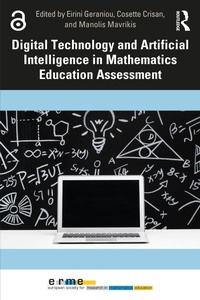
Digital Technology and Artificial Intelligence in Mathematics Education Assessment
1st Edition
Published on 22. January 2026
336 pages
978-1-040-67320-1 (ISBN)
Description

This timely and thought-provoking book explores how Artificial Intelligence (AI) and digital technologies more generally are reshaping educational assessment in the field of mathematics. It brings together a rich collection of international perspectives that offer a diverse and critical examination of the opportunities and challenges that digital technologies including artificial Intelligence play in assessment.
The chapters span a broad range of topics including the transition to a digital assessment format, designing multiple-choice items, and the use of AI for automated diagnosis, example generation and feedback provision. The book includes a framing chapter that critically examines current trends in the field and offers key recommendations for rethinking assessment. It calls for more empirical research and a fundamental rethink of assessment practices in light of digital technologies and AI. The volume as whole also invites readers to engage in a broader conversation about the future of educational assessment and the role of digital technologies in transforming assessment in mathematics education.
This essential resource for educators, researchers, curriculum developers, policymakers, and assessment stakeholders offers a comprehensive look at the evolving international landscape of assessment in mathematics education in the digital era, and invites readers to engage in the conversation about the future of educational assessment.
The chapters span a broad range of topics including the transition to a digital assessment format, designing multiple-choice items, and the use of AI for automated diagnosis, example generation and feedback provision. The book includes a framing chapter that critically examines current trends in the field and offers key recommendations for rethinking assessment. It calls for more empirical research and a fundamental rethink of assessment practices in light of digital technologies and AI. The volume as whole also invites readers to engage in a broader conversation about the future of educational assessment and the role of digital technologies in transforming assessment in mathematics education.
This essential resource for educators, researchers, curriculum developers, policymakers, and assessment stakeholders offers a comprehensive look at the evolving international landscape of assessment in mathematics education in the digital era, and invites readers to engage in the conversation about the future of educational assessment.
More details
Series
Edition
1. Auflage
Language
English
Place of publication
London
United Kingdom
Publishing group
Taylor & Francis Ltd
Target group
College/higher education
Professional and scholarly
Illustrations
30 Tables, black and white; 20 Line drawings, black and white; 2 Halftones, color; 46 Halftones, black and white; 2 Illustrations, color; 66 Illustrations, black and white
File size
7,47 MB
ISBN-13
978-1-040-67320-1 (9781040673201)
Copyright in bibliographic data and cover images is held by Nielsen Book Services Limited or by the publishers or by their respective licensors: all rights reserved.
Schweitzer Classification
Other editions
Additional editions
Eirini Geraniou | Cosette Crisan | Manolis Mavrikis
Digital Technology and Artificial Intelligence in Mathematics Education Assessment
Book
approx. 01/2026
1st Edition
Routledge
€234.10
Not yet published
Eirini Geraniou | Cosette Crisan | Manolis Mavrikis
Digital Technology and Artificial Intelligence in Mathematics Education Assessment
Book
approx. 01/2026
1st Edition
Routledge
€91.60
Not yet published
Persons
Eirini Geraniou is a Professor of Mathematics Education at University College London, UK. She has extensive expertise on task-design, course design and design-based research and the integration of digital technologies in mathematics education. Eirini has been an active member of the European Society for Research in Mathematics Education (ERME) since 2009 and became an elected member of the ERME board in 2021.
Cosette Crisan is a Professor at University College London, UK. She is a leading expert at the intersection of mathematics education and digital technology. Cosette has taught mathematics at university and school levels, as well as educated future mathematics teachers. She is a member of the prestigious London Mathematical Society Education Committee, which is involved in a wide range of activities from supporting mathematical education in schools, colleges and universities.
Manolis Mavrikis is a Professor of Artificial Intelligence and Analytics in Education at the UCL Knowledge Lab - an interdisciplinary research centre at UCL's Faculty of Education and Society. A former Turing Fellow at UK's Alan Turing Institute (ATI), and director of the master's in Education and Technology, where he continues to teach and supervise students in Artificial Intelligence in Education. Manolis has led large national and international projects in educational technology.
Cosette Crisan is a Professor at University College London, UK. She is a leading expert at the intersection of mathematics education and digital technology. Cosette has taught mathematics at university and school levels, as well as educated future mathematics teachers. She is a member of the prestigious London Mathematical Society Education Committee, which is involved in a wide range of activities from supporting mathematical education in schools, colleges and universities.
Manolis Mavrikis is a Professor of Artificial Intelligence and Analytics in Education at the UCL Knowledge Lab - an interdisciplinary research centre at UCL's Faculty of Education and Society. A former Turing Fellow at UK's Alan Turing Institute (ATI), and director of the master's in Education and Technology, where he continues to teach and supervise students in Artificial Intelligence in Education. Manolis has led large national and international projects in educational technology.
Content
1. Setting the scene on the use of technologies and artificial intelligence in feedback and assessment in mathematics education 2. The transfer of assessment from pen and paper to e-assessment: two case studies from one theoretical perspective 3. Digital technology and assessment validity: Exploring utilisation schemes for a basic spreadsheet tool used in PISA 2022 4. High-stakes mathematics assessment in Finland 5. Teachers insights from digital formative assessment compared to traditional pencil and paper assessments in elementary school geometry 6. Adaptive Feedback and (digital) Assessment of Conceptual Knowledge 7. Advancing Automated Assessment for Open-Ended Questions in Mathematics 8. A reconceptualisation of the instrumental genesis process in the context of human-LLM interactions: exploring students' perspective on their use of GPT-4o as a tool to support self-assessment 9. The power of well-designed multiple-choice items to enhance mathematics teaching and learning 10. Example-generation tasks for computer-aided assessment 11. Students' interaction with and appreciation of automated informative tutoring feedback 12. Using computer algebra to support automatic assessment of mathematics 13. Study Approaches in Interactive Learning Environments for Formative Assessment: detecting patterns aligned with Entwistle's theory 14. Introducing atomic, re-usable feedback for the semi-automated assessment of mathematics tasks 15. Developing mathematical competencies to assess ChatGPT-generated outputs: Three forms of mediations
