

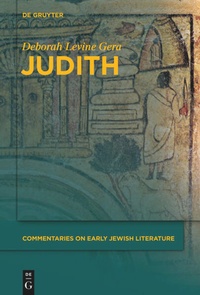
Judith
Description

The Book of Judith has aroused a great deal of scholarly interest in the last few decades.This volume, the first full length commentary on Judith to appear in over 25 years, includes a new translation and a detailed verse-by-verse commentary, which touches upon philological, literary, and historical questions. The extensive introduction discusses the work's date and historical background, and looks closely at the controversial question of the book's original language. Biblical influences on the book's setting, characters, plot, and language are investigated, and the heroine, Judith is viewed against the background of biblical women (and men). The influence of classical Greek writers such as Herodotus and Ctesias on the work is noted, as are the interesting differences between the Septuagint and Vulgate versions of Judith.
Reviews / Votes
"Insgesamt liegt mit Deborah Geras Kommentar ein weiterführender und kundiger Kommentar zum Buch Judit in englischer Sprache vor, den zu konsultieren sich lohnt."
Barbara Schmitz in: Biblische Notizen. Neue Folge 172 (2017) 145
"Für alle möglichen Einzelfragen [...] ist der Kommentar von DG eine wahre Schatzgrube: für grammatische und stilistische Besonderheiten und Feinheiten und bemerkenswerte Hapaxlegomena, für mögliche hebräische Äquivalente zu den bewusst die Septuaginta nachahmenden Wendungen (von DG oft "biblical" genannt) des griechischen Textes, besonders in den Erzählpartien, ebenso wie für Namen, Figuren und Situationen mit größerer oder geringerer Ähnlichkeit in der älteren biblischen, frühjüdischen, griechischen und altorientalischen Literatur. DG hat das Verständnis des Buches Judit erheblich vorangebracht."
Helmut Engel in: Biblica 96,3/2015
"This wealth, both of the Book of Judith and of the process of its preservation, adoption, and reworking centuries later, emanates from each and every page of this new translation and commentary, the meticulous work of an outstanding scholar, Professor Deborah Levine Gera, who devoted many years to their preparation.
Enriching this edition's seven introductory chapters and commentary are Gera's mastery of fifth-to-fourth-century B.C.E. Greek literature [...]; her familiarity with ancient royal inscriptions; her conversance with biblical studies; and her firm grasp of non-canonical Second Temple period literature. [...] Gera has consulted nearly every study written directly on Judith [...]. Nor can we overlook Gera's expertise in Classical Greek, her mastery of Biblical Hebrew, and of the language that bridges the two: Septuagint Greek. These qualifications enable her not only to move easily between languages but also underpin the broad perspective that governs her suggested emendations and accurate rendition of the text into English."
Cana Werman in: Scripta Classica Israelica XXXIV/2015
More details
Other editions
New editions
Person
Content
2 - Abbreviations [Seite 11]
3 - I. INTRODUCTION [Seite 13]
3.1 - Section 1: Preliminaries: The Story, Structure, and Message of Judith [Seite 15]
3.2 - Section 2: Transmission, Canonicity, and Later Jewish Tradition [Seite 23]
3.3 - Section 3: Dating Judith: History, Historicity, and Geography [Seite 38]
3.4 - Section 4: Biblical Influences [Seite 57]
3.5 - Section 5: Greek Influences [Seite 69]
3.6 - Section 6: Original Language and Milieu [Seite 91]
3.7 - Section 7: The Figure of Judith: Between Feminism and Theology [Seite 110]
4 - II. TRANSLATION AND COMMENTARY [Seite 123]
4.1 - A. 1:1-16 Nebuchadnezzar Goes to War with Arphaxad [Seite 125]
4.2 - B. 2:1-20 The Assyrians Prepare for War [Seite 145]
4.3 - C. 2:21-3:10 Holophernes' Conquests [Seite 162]
4.4 - D. 4:1-15 The Israelites Prepare for War and Pray to God [Seite 180]
4.5 - E. 5:1-6:21 Achior Describes the Israelites and is Expelled to Bethulia [Seite 203]
4.6 - F. 7:1-32 Holophernes Cuts Off Bethulia's Water Supply [Seite 244]
4.7 - G. 8:1-36 Judith Scolds Bethulia's Leaders [Seite 263]
4.8 - H. 9:1-14 Judith's Prayer [Seite 306]
4.9 - I. 10:1-17 Judith Prepares for her Mission and Leaves Bethulia [Seite 338]
4.10 - J. 10:18-12:9 Judith's First Encounter with Holophernes [Seite 352]
4.11 - K. 12:10-13:10 Judith Kills Holophernes at a Party [Seite 387]
4.12 - L. 13:11-14:10 Judith Returns Home and Achior Converts [Seite 412]
4.13 - M. 14:11-15:7 The Assyrians Are Defeated [Seite 435]
4.14 - N. 15:8-16:20 The Israelites Celebrate their Victory [Seite 449]
4.15 - O. 16:21-25 Epilogue [Seite 483]
5 - III. BIBLIOGRAPHY [Seite 489]
5.1 - Bibliography [Seite 489]
6 - IV. INDICES [Seite 511]
6.1 - Index of Ancient Sources [Seite 513]
6.2 - Index of Names and Subjects [Seite 557]
6.3 - Index of Modern Authors [Seite 578]
