

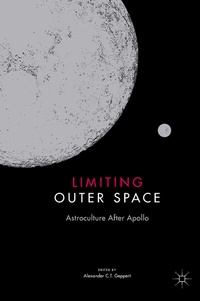
Limiting Outer Space
Description

Limiting Outer Space propels the historicization of outer space by focusing on the Post-Apollo period. After the moon landings, disillusionment set in. Outer space, no longer considered the inevitable destination of human expansion, lost much of its popular appeal, cultural significance and political urgency. With the rapid waning of the worldwide Apollo frenzy, the optimism of the Space Age gave way to an era of space fatigue and planetized limits. Bringing together the history of European astroculture and American-Soviet spaceflight with scholarship on the 1970s, this cutting-edge volume examines the reconfiguration of space imaginaries from a multiplicity of disciplinary perspectives. Rather than invoking oft-repeated narratives of Cold War rivalry and an escalating Space Race, Limiting Outer Space breaks new ground by exploring a hitherto underrated and understudied decade, the Post-Apollo period.
Reviews / Votes
"[This book] offer a fascinating reevaluation of space history from European perspectives. . I consider these books in the wider context of scholarship on Europe and space, asking how the concept of astroculture adds to these literatures as well as what limits it might hold." (Benjamin W. Goossen, Contemporary European History, June 17, 2022)
"The scholarship is generally good, and the case studies are well chosen . . this volume also celebrates the paradoxes of the 1970s, when idealism, power politics, and commercial savvy were seamlessly connected." (David Baneke, Isis, Vol. 110 (3), September, 2019)
"This ambitious publication program opens up new vistas in the cultural history of the space age, moving outward from accounts that prioritize the rivalry between the United States and the Soviet Union. . This is a book worth reading and rereading, depending upon your interests. It convinces that our understanding of the ways in which the brief, forceful projection of human beings into outer space matters has often been too limited. Limiting Outer Space . is a powerful re-survey of territory that might seem over-explored." (De Witt Douglas Kilgore, Science Fiction Studies, Vol. 46 (3), November, 2019)
"An excellent collection of essays which encompasses a wide sweep of the impact of space research and space dreams on the cultural landscape of society as a whole, beyond the limiting technological confines within which the enterprise is usually examined. . The entire book is a thoroughly worthwhile thought-provoking read." (Barry Kent, The Observatory, Vol. 139 (1270), June, 2019)
More details
Other editions
Additional editions
Person
Alexander C.T. Geppert is Associate Professor of History and European Studies and Global Network Associate Professor at New York University Shanghai as well as NYU's Center for European and Mediterranean Studies in New York City. From 2010 to 2016 he directed the Emmy Noether research group 'The Future in the Stars: European Astroculture and Extraterrestrial Life in the Twentieth Century' at Freie Universität Berlin.
