

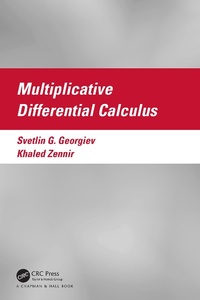
Multiplicative Differential Calculus
1st Edition
Published on 4. July 2022
216 pages
978-1-000-60542-6 (ISBN)
Description

This book is devoted to the multiplicative differential calculus. Its seven pedagogically organized chapters summarize the most recent contributions in this area, concluding with a section of practical problems to be assigned or for self-study.
Two operations, differentiation and integration, are basic in calculus and analysis. In fact, they are the infinitesimal versions of the subtraction and addition operations on numbers, respectively. From 1967 till 1970, Michael Grossman and Robert Katz gave definitions of a new kind of derivative and integral, moving the roles of subtraction and addition to division and multiplication, and thus established a new calculus, called multiplicative calculus. It is also called an alternative or non-Newtonian calculus. Multiplicative calculus can especially be useful as a mathematical tool for economics, finance, biology, and engineering.
Multiplicative Differential Calculus is written to be of interest to a wide audience of specialists such as mathematicians, physicists, engineers, and biologists. It is primarily a textbook at the senior undergraduate and beginning graduate level and may be used for a course on differential calculus. It is also for students studying engineering and science.
Authors
Svetlin G. Georgiev is a mathematician who has worked in various areas of the study. He currently focuses on harmonic analysis, functional analysis, partial differential equations, ordinary differential equations, Clifford and quaternion analysis, integral equations, and dynamic calculus on time scales. He is also the author of Dynamic Geometry of Time Scales (CRC Press). He is a co-author of Conformable Dynamic Equations on Time Scales, with Douglas R. Anderson (CRC Press).
Khaled Zennir earned his PhD in mathematics from Sidi Bel Abbes University, Algeria. He earned his highest diploma in Habilitation in Mathematics from Constantine University, Algeria. He is currently Assistant Professor at Qassim University in the Kingdom of Saudi Arabia. His research interests lie in the subjects of nonlinear hyperbolic partial differential equations: global existence, blowup, and long-time behavior.
The authors have also published: Multiple Fixed-Point Theorems and Applications in the Theory of ODEs, FDEs and PDE; Boundary Value Problems on Time Scales, Volume 1 and Volume II, all with CRC Press.
Two operations, differentiation and integration, are basic in calculus and analysis. In fact, they are the infinitesimal versions of the subtraction and addition operations on numbers, respectively. From 1967 till 1970, Michael Grossman and Robert Katz gave definitions of a new kind of derivative and integral, moving the roles of subtraction and addition to division and multiplication, and thus established a new calculus, called multiplicative calculus. It is also called an alternative or non-Newtonian calculus. Multiplicative calculus can especially be useful as a mathematical tool for economics, finance, biology, and engineering.
Multiplicative Differential Calculus is written to be of interest to a wide audience of specialists such as mathematicians, physicists, engineers, and biologists. It is primarily a textbook at the senior undergraduate and beginning graduate level and may be used for a course on differential calculus. It is also for students studying engineering and science.
Authors
Svetlin G. Georgiev is a mathematician who has worked in various areas of the study. He currently focuses on harmonic analysis, functional analysis, partial differential equations, ordinary differential equations, Clifford and quaternion analysis, integral equations, and dynamic calculus on time scales. He is also the author of Dynamic Geometry of Time Scales (CRC Press). He is a co-author of Conformable Dynamic Equations on Time Scales, with Douglas R. Anderson (CRC Press).
Khaled Zennir earned his PhD in mathematics from Sidi Bel Abbes University, Algeria. He earned his highest diploma in Habilitation in Mathematics from Constantine University, Algeria. He is currently Assistant Professor at Qassim University in the Kingdom of Saudi Arabia. His research interests lie in the subjects of nonlinear hyperbolic partial differential equations: global existence, blowup, and long-time behavior.
The authors have also published: Multiple Fixed-Point Theorems and Applications in the Theory of ODEs, FDEs and PDE; Boundary Value Problems on Time Scales, Volume 1 and Volume II, all with CRC Press.
More details
Series
Edition
1. Auflage
Language
English
Place of publication
London
United Kingdom
Publishing group
Taylor & Francis Ltd
Target group
College/higher education
ISBN-13
978-1-000-60542-6 (9781000605426)
Copyright in bibliographic data and cover images is held by Nielsen Book Services Limited or by the publishers or by their respective licensors: all rights reserved.
Schweitzer Classification
Other editions
Additional editions
Svetlin Georgiev | Khaled Zennir
Multiplicative Differential Calculus
Book
08/2024
1st Edition
Chapman & Hall/CRC
€85.40
Shipment within 10-20 days

Svetlin Georgiev | Khaled Zennir
Multiplicative Differential Calculus
Book
07/2022
1st Edition
Chapman & Hall/CRC
€132.30
Shipment within 10-20 days
Persons
Svetlin G. Georgiev is a mathematician who has worked in various areas of the study. He currently focuses on harmonic analysis, functional analysis, partial differential equations, ordinary differential equations, Clifford and quaternion analysis, integral equations, and dynamic calculus on time scales. He is also the author of Dynamic Geometry of Time Scales, CRC Press//Taylor & Francis Group. He is a co-author of Conformable Dynamic Equations on Time Scales, with Douglas R. Anderson, CRC Press/Taylor & Francis Group.
Khaled Zennir earned his PhD in mathematics from Sidi Bel Abbes University, Algeria. He earned his highest diploma in Habilitation in Mathematics from Constantine University, Algeria. He is currently Assistant Professor at Qassim University in the Kingdom of Saudi Arabia. His research interests lie in the subjects of nonlinear hyperbolic partial differential equations: global existence, blowup, and long-time behavior.
The authors have also published: Multiple Fixed-Point Theorems and Applications in the Theory of ODEs, FDEs and PDE; Boundary Value Problems on Time Scales, Volume 1 and Volume II, all with CRC Press//Taylor & Francis Group.
Khaled Zennir earned his PhD in mathematics from Sidi Bel Abbes University, Algeria. He earned his highest diploma in Habilitation in Mathematics from Constantine University, Algeria. He is currently Assistant Professor at Qassim University in the Kingdom of Saudi Arabia. His research interests lie in the subjects of nonlinear hyperbolic partial differential equations: global existence, blowup, and long-time behavior.
The authors have also published: Multiple Fixed-Point Theorems and Applications in the Theory of ODEs, FDEs and PDE; Boundary Value Problems on Time Scales, Volume 1 and Volume II, all with CRC Press//Taylor & Francis Group.
Content
1 The Field R*
1.1 Definition
1.2 An Order in R*
1.3 Multiplicative Absolute Value
1.4 The Multiplicative Factorial. Multiplicative Binomial Coefficients
1.5 Multiplicative Functions of One Variable
1.6 The Multiplicative Power Function
1.7 Multiplicative Trigonometric Functions
1.8 Multiplicative Inverse Trigonometric Functions
1.9 Multiplicative Hyperbolic Functions
1.10 Multiplicative Inverse Hyperbolic Functions
1.11 Multiplicative Matrices
1.12 Advanced Practical Problems
2 Multiplicative Differentiation
2.1 Definition
2.2 Properties
2.3 Higher Order Multiplicative Derivatives
2.4 Multiplicative Differentials
2.5 Monotone Functions
2.6 Local Extremum
2.7 The Multiplicative Rolle Theorem
2.8 The Multiplicative Lagrange Theorem
2.9 The Multiplicative Cauchy Theorem
2.10 The Multiplicative Taylor Formula
2.11 Advanced Practical Problems
3 Multiplicative Integration
3.1 Definition for the Multiplicative Improper Integral and
Multiplicative Cauchy Integral
3.2 Table of the Basic Multiplicative Integrals
3.3 Properties of the Multiplicative Integrals
3.4 Multiplicative Integration by Substitution
3.5 Multiplicative Integration by Parts
3.6 Inequalities for Multiplicative Integrals
3.7 Mean Value Theorems for Multiplicative Integrals
3.8 Advanced Practical Problems
4 Improper Multiplicative Integrals
4.1 Definition for Improper Multiplicative Integrals over Finite Intervals
4.2 Definition for Improper Multiplicative Integrals over Infinite Intervals
4.3 Properties of the Improper Multiplicative Integrals
4.4 Criteria for Comparison of Improper Multiplicative Integrals
4.5 Conditional Convergence of Improper Multiplicative Integrals
4.6 The Abel-Dirichlet Criterion
4.7 Advanced Practical Problems
5 The Vector Space Rn ?
5.1 Basic Definitions
5.2 Multiplicative Linear Dependence and Independence
5.3 Multiplicative Inner Product
5.4 Multiplicative Length and Multiplicative Distance
5.5 Advanced Practical Problems
6 Partial Multiplicative Differentiation
6.1 Definition for Multiplicative Functions of Several Variables
6.2 Definition for Multiplicative Partial Derivatives
6.3 Multiplicative Differentials
6.4 The Chain Rule
6.5 Multiplicative Homogeneous Functions
6.6 Multiplicative Directional Derivatives
6.7 Extremum of a Function
6.8 Advanced Practical Problems
7 Multiple Multiplicative Integrals
7.1 Multiplicative Integrals Depending on Parameters
7.2 Iterated Multiplicative Integrals
7.3 Multiple Multiplicative Integrals
7.4 Multiplicative Improper Multiple Multiplicative Integrals
7.5 Advanced Practical Problems
References
Index
1.1 Definition
1.2 An Order in R*
1.3 Multiplicative Absolute Value
1.4 The Multiplicative Factorial. Multiplicative Binomial Coefficients
1.5 Multiplicative Functions of One Variable
1.6 The Multiplicative Power Function
1.7 Multiplicative Trigonometric Functions
1.8 Multiplicative Inverse Trigonometric Functions
1.9 Multiplicative Hyperbolic Functions
1.10 Multiplicative Inverse Hyperbolic Functions
1.11 Multiplicative Matrices
1.12 Advanced Practical Problems
2 Multiplicative Differentiation
2.1 Definition
2.2 Properties
2.3 Higher Order Multiplicative Derivatives
2.4 Multiplicative Differentials
2.5 Monotone Functions
2.6 Local Extremum
2.7 The Multiplicative Rolle Theorem
2.8 The Multiplicative Lagrange Theorem
2.9 The Multiplicative Cauchy Theorem
2.10 The Multiplicative Taylor Formula
2.11 Advanced Practical Problems
3 Multiplicative Integration
3.1 Definition for the Multiplicative Improper Integral and
Multiplicative Cauchy Integral
3.2 Table of the Basic Multiplicative Integrals
3.3 Properties of the Multiplicative Integrals
3.4 Multiplicative Integration by Substitution
3.5 Multiplicative Integration by Parts
3.6 Inequalities for Multiplicative Integrals
3.7 Mean Value Theorems for Multiplicative Integrals
3.8 Advanced Practical Problems
4 Improper Multiplicative Integrals
4.1 Definition for Improper Multiplicative Integrals over Finite Intervals
4.2 Definition for Improper Multiplicative Integrals over Infinite Intervals
4.3 Properties of the Improper Multiplicative Integrals
4.4 Criteria for Comparison of Improper Multiplicative Integrals
4.5 Conditional Convergence of Improper Multiplicative Integrals
4.6 The Abel-Dirichlet Criterion
4.7 Advanced Practical Problems
5 The Vector Space Rn ?
5.1 Basic Definitions
5.2 Multiplicative Linear Dependence and Independence
5.3 Multiplicative Inner Product
5.4 Multiplicative Length and Multiplicative Distance
5.5 Advanced Practical Problems
6 Partial Multiplicative Differentiation
6.1 Definition for Multiplicative Functions of Several Variables
6.2 Definition for Multiplicative Partial Derivatives
6.3 Multiplicative Differentials
6.4 The Chain Rule
6.5 Multiplicative Homogeneous Functions
6.6 Multiplicative Directional Derivatives
6.7 Extremum of a Function
6.8 Advanced Practical Problems
7 Multiple Multiplicative Integrals
7.1 Multiplicative Integrals Depending on Parameters
7.2 Iterated Multiplicative Integrals
7.3 Multiple Multiplicative Integrals
7.4 Multiplicative Improper Multiple Multiplicative Integrals
7.5 Advanced Practical Problems
References
Index
