

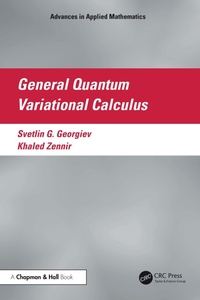
General Quantum Variational Calculus
1st Edition
Published on 19. December 2024
266 pages
978-1-040-25635-0 (ISBN)
Description

Quantum calculus is the modern name for the investigation of calculus without limits. Quantum calculus, or q-calculus, began with F.H. Jackson in the early twentieth century, but this kind of calculus had already been worked out by renowned mathematicians Euler and Jacobi.
Lately, quantum calculus has aroused a great amount of interest due to the high demand of mathematics that model quantum computing. The q-calculus appeared as a connection between mathematics and physics. It has a lot of applications in different mathematical areas such as number theory, combinatorics, orthogonal polynomials, basic hypergeometric functions and other quantum theory sciences, mechanics, and the theory of relativity. Recently, the concept of general quantum difference operators that generalize quantum calculus has been defined.
General Quantum Variational Calculus is specially designed for those who wish to understand this important mathematical concept, as the text encompasses recent developments of general quantum variational calculus. The material is presented in a highly readable, mathematically solid format. Many practical problems are illustrated, displaying a wide variety of solution techniques.
This book is addressed to a wide audience of specialists such as mathematicians, physicists, engineers, and biologists. It can be used as a textbook at the graduate level and as a reference for several disciplines.
Lately, quantum calculus has aroused a great amount of interest due to the high demand of mathematics that model quantum computing. The q-calculus appeared as a connection between mathematics and physics. It has a lot of applications in different mathematical areas such as number theory, combinatorics, orthogonal polynomials, basic hypergeometric functions and other quantum theory sciences, mechanics, and the theory of relativity. Recently, the concept of general quantum difference operators that generalize quantum calculus has been defined.
General Quantum Variational Calculus is specially designed for those who wish to understand this important mathematical concept, as the text encompasses recent developments of general quantum variational calculus. The material is presented in a highly readable, mathematically solid format. Many practical problems are illustrated, displaying a wide variety of solution techniques.
This book is addressed to a wide audience of specialists such as mathematicians, physicists, engineers, and biologists. It can be used as a textbook at the graduate level and as a reference for several disciplines.
More details
Series
Edition
1. Auflage
Language
English
Place of publication
London
United Kingdom
Publishing group
Taylor & Francis Ltd
Target group
College/higher education
ISBN-13
978-1-040-25635-0 (9781040256350)
Copyright in bibliographic data and cover images is held by Nielsen Book Services Limited or by the publishers or by their respective licensors: all rights reserved.
Schweitzer Classification
Other editions
Additional editions
Svetlin G. Georgiev | Khaled Zennir
General Quantum Variational Calculus
Book
12/2024
1st Edition
Chapman & Hall/CRC
€91.30
Shipment within 10-20 days
Svetlin G. Georgiev | Khaled Zennir
General Quantum Variational Calculus
Book
12/2024
1st Edition
Chapman & Hall/CRC
€218.00
Shipment within 10-20 days
Persons
Svetlin G. Georgiev is a mathematician who has worked in various areas of mathematics. He currently focuses on harmonic analysis, functional analysis, partial differential equations, ordinary differential equations, Clifford and quaternion analysis, integral equations, and dynamic calculus on time scales.
Khaled Zennir earned his PhD in mathematics in 2013 from Sidi Bel Abbes University, Algeria. In 2015, he received his highest diploma in Habilitation in mathematics from Constantine University, Algeria. He is currently an assistant professor at Qassim University in the Kingdom of Saudi Arabia. His research interests lie in the subjects of nonlinear hyperbolic partial differential equations: global existence, blowup, and longtime behavior.
Khaled Zennir earned his PhD in mathematics in 2013 from Sidi Bel Abbes University, Algeria. In 2015, he received his highest diploma in Habilitation in mathematics from Constantine University, Algeria. He is currently an assistant professor at Qassim University in the Kingdom of Saudi Arabia. His research interests lie in the subjects of nonlinear hyperbolic partial differential equations: global existence, blowup, and longtime behavior.
Content
1. Elements of the Multimensional General Quantum Calculus
1.1 The Multidimensional General Quantum Calculus
1.2 Line Integrals
1.3 The Green Formula
1.4 Advanced Practical Problems
2. ?-Differential Systems
2.1 Structure of ?-Differential Systems
2.2 ?-Matrix Exponential Function
2.3 The ?-Liouville Theorem
2.4 Constant Coefficients
2.5 Nonlinear Systems
2.6 Advanced Practical Problems
3. Functionals
3.1 Definition for Functionals
3.2 Self-Adjoint Second Order Matrix Equations
3.3 The Jacobi Condition
3.4 Sturmian Theory
4. Linear Hamiltonian Dynamic Systems
4.1 Linear Symplectic Dynamic Systems
4.2 Hamiltonian Systems
4.3 Conjoined Bases
4.4 Riccati Equations
4.5 The Picone Identity
4.6 "Big" Linear Hamiltonian Systems
4.7 Positivity of Quadratic Functionals
5. The First Variation
5.1 The Dubois-Reymond Lemma
5.2 The Variational Problem
5.3 The Euler-Lagrange Equation
5.4 The Legendre Condition
5.5 The Jacobi Condition
5.6 Advanced Practical Problems
6. Higher Order Calculus of Variations
6.1 Statement of the Variational Problem
6.2 The Euler Equation
6.3 Advanced Practical Problems
7. Double Integral Calculus of Variations
7.1 Statement of the Variational Problem
7.2 First and Second Variation
7.3 The Euler Condition
7.4 Advanced Practical Problems
8. The Noether Second Theorem
8.1 Invariance under Transformations
8.2 The Noether Second Theorem without Transformations of Time
8.3 The Noether Second Theorem with Transformations of Time
8.4 The Noether Second Theorem-Double Delta Integral Case
References
Index
1.1 The Multidimensional General Quantum Calculus
1.2 Line Integrals
1.3 The Green Formula
1.4 Advanced Practical Problems
2. ?-Differential Systems
2.1 Structure of ?-Differential Systems
2.2 ?-Matrix Exponential Function
2.3 The ?-Liouville Theorem
2.4 Constant Coefficients
2.5 Nonlinear Systems
2.6 Advanced Practical Problems
3. Functionals
3.1 Definition for Functionals
3.2 Self-Adjoint Second Order Matrix Equations
3.3 The Jacobi Condition
3.4 Sturmian Theory
4. Linear Hamiltonian Dynamic Systems
4.1 Linear Symplectic Dynamic Systems
4.2 Hamiltonian Systems
4.3 Conjoined Bases
4.4 Riccati Equations
4.5 The Picone Identity
4.6 "Big" Linear Hamiltonian Systems
4.7 Positivity of Quadratic Functionals
5. The First Variation
5.1 The Dubois-Reymond Lemma
5.2 The Variational Problem
5.3 The Euler-Lagrange Equation
5.4 The Legendre Condition
5.5 The Jacobi Condition
5.6 Advanced Practical Problems
6. Higher Order Calculus of Variations
6.1 Statement of the Variational Problem
6.2 The Euler Equation
6.3 Advanced Practical Problems
7. Double Integral Calculus of Variations
7.1 Statement of the Variational Problem
7.2 First and Second Variation
7.3 The Euler Condition
7.4 Advanced Practical Problems
8. The Noether Second Theorem
8.1 Invariance under Transformations
8.2 The Noether Second Theorem without Transformations of Time
8.3 The Noether Second Theorem with Transformations of Time
8.4 The Noether Second Theorem-Double Delta Integral Case
References
Index
