

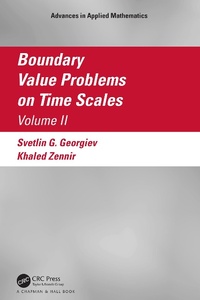
Boundary Value Problems on Time Scales, Volume II
1st Edition
Published on 14. October 2021
457 pages
978-1-000-42985-5 (ISBN)
Description

Boundary Value Problems on Time Scales, Volume II is devoted to the qualitative theory of boundary value problems on time scales. Summarizing the
most recent contributions in this area, it addresses a wide audience of specialists such as mathematicians, physicists, engineers and biologists. It can be used as
a textbook at the graduate level and as a reference book for several disciplines. The text contains two volumes, both published by Chapman & Hall/CRC Press.
Volume I presents boundary value problems for first- and second-order dynamic equations on time scales. Volume II investigates boundary value problems for
three, four, and higher-order dynamic equations on time scales. Many results to differential equations carry over easily to corresponding results
for difference equations, while other results seem to be totally different in nature. Because of these reasons, the theory of dynamic equations is an active area of
research. The time-scale calculus can be applied to any field in which dynamic processes are described by discrete or continuous time models.
The calculus of time scales has various applications involving noncontinuous domains such as certain bug populations, phytoremediation of metals, wound
healing, maximization problems in economics, and traffic problems. Boundary value problems on time scales have been extensively investigated in simulating
processes and the phenomena subject to short-time perturbations during their evolution.
The material in this book is presented in highly readable, mathematically solid format. Many practical problems are illustrated displaying a wide variety of
solution techniques.
AUTHORS
Svetlin G. Georgiev is a mathematician who has worked in various areas of the study. He currently focuses on harmonic analysis, functional analysis, partial
differential equations, ordinary differential equations, Clifford and quaternion analysis, integral equations, and dynamic calculus on time scales.
Khaled Zennir earned his PhD in mathematics in 2013 from Sidi Bel Abbes University, Algeria. In 2015, he received his highest diploma in Habilitation in
mathematics from Constantine University, Algeria. He is currently assistant professor at Qassim University in the Kingdom of Saudi Arabia. His research
interests lie in the subjects of nonlinear hyperbolic partial differential equations: global existence, blowup, and long-time behavior.
most recent contributions in this area, it addresses a wide audience of specialists such as mathematicians, physicists, engineers and biologists. It can be used as
a textbook at the graduate level and as a reference book for several disciplines. The text contains two volumes, both published by Chapman & Hall/CRC Press.
Volume I presents boundary value problems for first- and second-order dynamic equations on time scales. Volume II investigates boundary value problems for
three, four, and higher-order dynamic equations on time scales. Many results to differential equations carry over easily to corresponding results
for difference equations, while other results seem to be totally different in nature. Because of these reasons, the theory of dynamic equations is an active area of
research. The time-scale calculus can be applied to any field in which dynamic processes are described by discrete or continuous time models.
The calculus of time scales has various applications involving noncontinuous domains such as certain bug populations, phytoremediation of metals, wound
healing, maximization problems in economics, and traffic problems. Boundary value problems on time scales have been extensively investigated in simulating
processes and the phenomena subject to short-time perturbations during their evolution.
The material in this book is presented in highly readable, mathematically solid format. Many practical problems are illustrated displaying a wide variety of
solution techniques.
AUTHORS
Svetlin G. Georgiev is a mathematician who has worked in various areas of the study. He currently focuses on harmonic analysis, functional analysis, partial
differential equations, ordinary differential equations, Clifford and quaternion analysis, integral equations, and dynamic calculus on time scales.
Khaled Zennir earned his PhD in mathematics in 2013 from Sidi Bel Abbes University, Algeria. In 2015, he received his highest diploma in Habilitation in
mathematics from Constantine University, Algeria. He is currently assistant professor at Qassim University in the Kingdom of Saudi Arabia. His research
interests lie in the subjects of nonlinear hyperbolic partial differential equations: global existence, blowup, and long-time behavior.
More details
Series
Edition
1. Auflage
Language
English
Place of publication
London
United Kingdom
Publishing group
Taylor & Francis Ltd
Target group
College/higher education
ISBN-13
978-1-000-42985-5 (9781000429855)
Copyright in bibliographic data and cover images is held by Nielsen Book Services Limited or by the publishers or by their respective licensors: all rights reserved.
Schweitzer Classification
Other editions
Additional editions

Svetlin Georgiev | Khaled Zennir
Boundary Value Problems on Time Scales, Volume II
Book
08/2024
1st Edition
Chapman & Hall/CRC
€134.70
Shipment within 10-20 days
Svetlin Georgiev | Khaled Zennir
Boundary Value Problems on Time Scales, Volume II
Book
11/2021
1st Edition
Chapman & Hall/CRC
€253.50
Shipment within 10-20 days
Persons
AUTHORS
Svetlin G. Georgiev is a mathematician who has worked in various areas of mathematics. He currently focuses on harmonic analysis, functional analysis, partial differential equations, ordinary differential equations, Clifford and quaternion analysis, integral equations, and dynamic calculus on time scales.
Khaled Zennir earned his PhD in mathematics in 2013 from Sidi Bel Abbes University, Algeria. In 2015, he received his highest diploma in Habilitation in mathematics from Constantine University, Algeria. He is currently assistant professor at Qassim University in the Kingdom of Saudi Arabia. His research interests lie in the subjects of nonlinear hyperbolic partial differential equations: global existence, blowup, and long time behavior.
Svetlin G. Georgiev is a mathematician who has worked in various areas of mathematics. He currently focuses on harmonic analysis, functional analysis, partial differential equations, ordinary differential equations, Clifford and quaternion analysis, integral equations, and dynamic calculus on time scales.
Khaled Zennir earned his PhD in mathematics in 2013 from Sidi Bel Abbes University, Algeria. In 2015, he received his highest diploma in Habilitation in mathematics from Constantine University, Algeria. He is currently assistant professor at Qassim University in the Kingdom of Saudi Arabia. His research interests lie in the subjects of nonlinear hyperbolic partial differential equations: global existence, blowup, and long time behavior.
Content
Preface
1. Third Order Boundary Value Problems for Dynamic Equations
2. Boundary Value Problems for Third Order Impulsive Dynamic Equations
3. Fourth Order Boundary Value Problems
4. Boundary Value Problems for Fourth Order Impulsive Dynamic Equations
5. Higher Order Boundary Value Problems for Dynamic Equations
6. Higher Order Boundary Value Problems for Impulsive Dynamic
Equations
References
1. Third Order Boundary Value Problems for Dynamic Equations
2. Boundary Value Problems for Third Order Impulsive Dynamic Equations
3. Fourth Order Boundary Value Problems
4. Boundary Value Problems for Fourth Order Impulsive Dynamic Equations
5. Higher Order Boundary Value Problems for Dynamic Equations
6. Higher Order Boundary Value Problems for Impulsive Dynamic
Equations
References
