

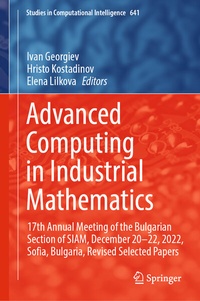
Advanced Computing in Industrial Mathematics
Description

This book gathers the peer-reviewed proceedings of the 17th Annual Meeting of the Bulgarian Section of the Society for Industrial and Applied Mathematics, BGSIAM'22, held in Sofia, Bulgaria. The general theme of BGSIAM'22 was industrial and applied mathematics with particular focus on: mathematical physics, numerical analysis, high performance computing, optimization and control, mathematical biology, stochastic modeling, machine learning, digitization and imaging, advanced computing in environmental, biomedical and engineering applications.
More details
Other editions
Additional editions

Persons
Ivan Georgiev is Professor of Mathematical Modelling at the Institute of Information and Communication Technologies, Bulgarian Academy of Sciences. He received a Master's degree in Mathematics from Sofia University St. Kliment Ohridski and a PhD in Computational Mathematics from the Bulgarian Academy of Sciences. His research interests are in mathematical modelling, numerical simulations, 3D digitization and microstructural analysis.
Hristo Kostadinov was born in So?a, Bulgaria, in 1974. He received the B. Sc. degree and M. Sc. degree in 1998, and 2001, respectively at So?a University, So?a, Bulgaria. In March 2005, he received his Ph. D. degree at the University of Electro-Communications, Tokyo, Japan. Since 2012 he is Associate Professor at the Institute of Mathematics and Informatics of the Bulgarian Academy of Sciences. His research interests are in coding theory, information and communication theory, signals, blockchain and internet of things.
Elena Lilkova is an Associate Professor of Applied Mathematics in Computational Physics and Biology at the Institute of Information and Communication Technologies, Bulgarian Academy of Sciences. She has a PhD in Atomic and Molecular Physics from Sofia University. Her research interests include computational modeling of biological macromolecules and their interactions, enhanced sampling techniques, methods for free energy estimation, and the development of new methods and protocols for more effective study of macromolecular interactions.
Content
1. Vera Angelova, Perturbation analysis of the matrix equation X - A^\ast \root 2^m X^{-1} A = I.- 2. Atanas Atanasov, Slavi Georgiev, Lubin Vulkov, Honeybee Population Dynamics Identification by Lagrange Multipliers Optimization.- 3. Dimitar Bakardzhiev, Nikolay K. Vitanov, KEDE (KnowledgE Discovery Efficiency): A Measure for Quantification of the Productivity of Knowledge Workers.- 4. Vilislav Boutchaktchiev, Some Properties of the Interest Rate Spread for Expected Risk of Consumer Loans.- 5. Hristo Chervenkov, Êiril Slavov, ETCCDI Precipitation-based Climate Indices in the CMIP5 Future Climate Projections over Southeast Europe.- 6. Dimo Dimov, Sofia Ivanovska, Kiril Alexiev, A. Hristov, Anastylosis of Frescos -- an optimised parallel implementation on Avitohol HPC.- 7. Jivko Jeliazkov, Hristo Kostadinov, Using EOSIO technology for publicly verifiable randomness.- 8. Jivko Jeliazkov, Biser Tsvetkov, Hristo Kostadinov, Decentralized Research Incentivization System.- 9. Juri Kandilarov, Lubin Vulkov, Loaded Equation Method for Recovering of Time-dependent Convection Coefficient and Source in Magnetohydrodynamics flow.- 10. Petia Koprinkova-Hristova, Simona Nedelcheva, Nadejda Bocheva, Reverse engineering of human brain using EEG recordings.- 11. Elena Nikolova Various solitary wave solutions of the KdV - type equation via Simple Equations Method (SEsM).- 12. Inna Nikolova, Pencho Marinov, Sum of powers. Bernoulli numbers in terms of Stirling numbers.-13. Miriana Raykovska, Ivan Georgiev, Maria Datcheva, The application of Region Growing as a segmentation method in Micro-CT studies in Endodontics.- 14. Angela Slavova, Ventsislav Ignatov, CNN Computing of Double Sine-Gordon Equation with Memristor Synapses.- 15. Kalina Sotirova-Valkova, Digital Maturity and Inclusion Guide for GLAM.- 16. Georgi Vasilev, Hristina Klecherova, Georgi Evtimov, Miglena Raykovska, Victoria Petrova, Interdisciplinary studies of "Kazlacha" circular enclosures complex: photogrammetry, laser scanning and 360-degree photography for creating a digital archive in ClaDa Bulgaria.- 17. Krassimira Vlachkova, Krum Radev, Scattered Data Interpolation with Quartic Triangular Bezier Patches: An Optimized Implementation.
