

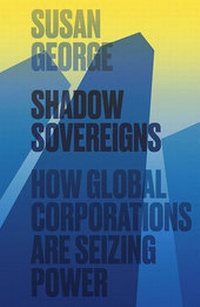
Shadow Sovereigns
Description

These business elites don t want to govern directly. They operate behind the scenes - directing planning, setting standards and fashioning government to maximise their own profits. Thanks to the UN Global Compact they have extended their influence to the highest levels of multilateral decision-making and now, via the Davos-inspired Global Redesign Initiative, they are setting their sights on managing world-wide public policy.
Elected by and accountable to no one, secretive and highly organized, these shadow sovereigns are destroying the very notion of the common good and making a mockery of democracy. It is high time we challenged this assault on our rights and our institutions. In this incisive and clear-sighted book Susan George provides us with the practical knowledge to do just that.
More details
Other editions
Additional editions
Person
Content
Chapter One: Lobbies, Mega-Lobbies and How To Join Them
Chapter Two: Transnational Treaties: Tailored By and For Transnational Corporations
Chapter Three: "Regulatory Cooperation": More Danger Ahead
Chapter Four: Corporate Troops Invade the United Nations
Chapter Five: Davos: Designer Of The Future?
Conclusion
1
LOBBIES, MEGA-LOBBIES AND HOW TO JOIN THEM
Lobbyists are common as houseflies in Washington DC and Brussels. Theirs is not perhaps the world's oldest profession, but they have been around for longer than any of the rest of us and, according to parliamentary lore, started hanging out in the lobby of the House of Commons in the early nineteenth century. In Washington it was a less dignified venue, but still a lobby - that of the Willard Hotel where President Ulysses S. Grant (from 1869 to 1877) liked to go to drink brandy and smoke cigars with his buddies and often with people who wanted something.
HOW IT WORKS IN WASHINGTON
They've improved their techniques, make good money and there's no denying they get results. Today, Washington lobbyists must declare themselves to the Clerk of Congress and register how much they're paid and by whom. The United States first tried to get lobbying under control after the end of World War II with the Legislative Reorganization Act of 1946, but when officials at the General Accounting Office evaluated the results several years down the road, they found that about 90 per cent of all the lobbyists were paying no attention to its requirements. Eventually, President Bill Clinton signed the Lobbying Disclosure Act of 1995, a bill with real teeth requiring quarterly reports and listings of all contacts with government officials and members of Congress.
In 2008, the Obama administration sought to tighten the law still further. This may have been too much of a good thing. The number of lobbyists listed in the congressional registry has declined from a peak of 14,837 in 2007 to a low point for the decade of 12,341 in 2013. The drop does not seem to be due to cutbacks in lobbying activities - it has occurred because people who are still lobbyists are not registering. The new law left the definition of a 'lobbyist' open to interpretation, and law firms admit they've been helping many clients to deregister. The director of government affairs for the American Bar Association explains that in the pre-Obama legal context, 'people in Washington would have said, "If in doubt, register . [in those days they would think] I like the publicity . I want to be able to tell potential clients how many [other clients] I am already registered for."' Not any more: One recently deregistered professional says, 'Lobbying isn't a crime. It's a profession and in my view it is an honourable one', but, he feels, the Obama administration doesn't see it that way. Today, lobbyists who can show they aren't spending more than 20 per cent of their time in direct contact with lawmakers - even though they might be dispatching busloads of employees to do that job - are, according to the New York Times, the ones who are no longer registering.1
However, and for whatever reason, American lobbying firms are also beginning to hurt financially. In 2009 and 2010 their industry had a stunning turnover of $3.5 billion but by 2013 had lost around $250 million of that bounty. In May 2014, the lob bying blog 'Open Secrets' announced that the first quarter was the 'worst in the last four years, continuing the downward slide of K Street'.2
Even so, K Street seems to have little enough to worry about. If I had been asked to guess which industries spent the most on lobbying, I would doubtless have said defence, oil and finance, probably in that order. Dead wrong. Health is, by a long way, the frontrunner, with pharmaceuticals and health products coming in at number one in 2013, at $65.4 million. But if you add to that the separately listed sums spent on lobbying by the categories 'hospitals and nursing homes', 'health professionals and health services' and HMOs (Health Maintenance Organizations), the bill comes to nearly $129 million.3 And we wonder why the US healthcare system is the most expensive in the world; why so many people are not cared for at all and so many others have become convinced that 'Obamacare' is an infringement of their liberty. It's because lobbyists are good at their jobs and their high-class, invisible brainwashing campaigns work - they work to protect the super-profits of private healthcare providers and insurance companies, and the expenditures end up in the prices of the services or the drugs. For decades now, 'socialized medicine' has been the bogeyman mantra that shuts people up and makes them afraid to support a politician who has the courage to propose public healthcare spending of the kind that obtains in every other civilized and moderately wealthy country in the world.
As for my spontaneous (and wrong) choices of defence, oil and finance as the biggest spenders, defence and aerospace rate only $15.5 million, but the whole complex comes to $30 million. Oil and gas by themselves weigh in at 'only' $34 million, but combined with all 'energy and natural resources' come to $91.4 million. The financial industry is doing better than both defence and oil if all financial sectors such as securities and investment, commercial banks and real estate are added together ($119 million). So my choices were mistaken, but that could also be at least partly because the big firms in these sectors know they'll get what they want, lobbying or no lobbying.
IT COST US $5 BILLION BUT WE WON: LOBBYING TO CREATE A REALLY SPECTACULAR FINANCIAL CRISIS
However much the banks and funds may actually be spending on lobbying today, they have a proven capacity for endangering the rest of us and a long history of doing so. From the mid-1980s onwards, no doubt emboldened by the rising tide of neoliberalism, the largest American banking, securities, insurance and accounting TNCs joined forces, employed nearly 3,000 people and spent roughly $5 billion to get rid of a dozen New Deal laws passed in the 1930s under the Roosevelt administration. These laws were precisely those that had protected the American economy from catastrophe for more than 60 years.
That shield was shattered thanks to their collective lobbying push. Incredibly, the financial corporations won the freedom to remove money-losing assets from their balance-sheets and place them in 'shadow' or undeclared banks, where even their shareholders would never find them. They could create and trade, with no regulation whatsoever, hundreds of billions of dollars worth of toxic 'derivative' products, based on huge piles of consumer debts such as bundles of sub-prime mortgages.
For near-total financial ruin, one can't surpass the fall of the Glass-Steagall Act of 1933, without a doubt the financial lobbying coup of the twentieth century. This New Deal measure had separated commercial (retail) banks from investment banks, and it remained in place until President Clinton signed the act that abrogated it in 1999. The financial lobby had pushed to obtain this for a dozen years before Clinton finally complied. He was vigorously backed, or shoved, by Federal Reserve chairman Alan Greenspan, not to mention his chief economic advisor Larry Summers and, above all, his treasury secretary Robert Rubin, formerly chairman of Goldman Sachs.4
The coup soon enough fell on the backs of governments and their taxpayers. Mega-takeovers, mergers and acquisitions immediately followed the end of Glass-Steagall, creating gigantic structures which thus became 'too big to fail', according to the now-classic phrase. The banks didn't even call themselves 'banks' anymore, but 'financial services corporations', and they knew they could concentrate henceforward on creating the casino economy unsupervised and unrestrained. They had just added countless pots of gold to their hoards and could speculate with their customers' deposits. All the newly legal mergers gave predator capitalists the right to play with everybody's money.
They knew, first, that if their bets went wrong, the government would have to jump in and save them; second, that they were ideally placed: too big to fail, but not too big to bail. It turned out later that they were also too powerful to jail - some banks paid fines, but no bankers went to jail for their part in creating the crisis.
Such are the victories lobbying can achieve. It reminds one of the high official who castigated, 'business and financial monopoly, speculation, reckless banking . [these businesses] had begun to consider the government of the United States as a mere appendage to their own affairs.' That was Franklin Roosevelt in 1936.5
The financial crash had a severe impact on countries far distant from the USA, particularly in Europe, but for sheer mass mayhem, the lobbyists hadn't finished. Nearly anything could now become a 'derivative'.6 Futures trading of such commodities as wheat, corn and soya had for decades, not to say centuries, tended to the usefully boring - and their 'volatility' was measured in pennies per day. But as soon as certain factors pointed to reduced food supplies, rampant speculation invaded the commodities markets. Thanks to the work of the financial lobby brigades, traders and speculators could purchase unlimited futures contracts on...
