

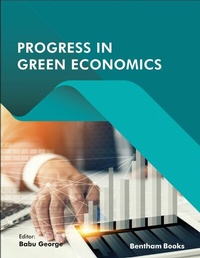
Progress in Green Economics
Description

Green economics refers to the discipline in which economists and businesses pursue policies that are conducive to minimizing environmental and ecological damage and therefore sustainable development.
Progress in Green Economics primarily focuses on developments in the transition of different industries and sectors to a sustainable, environment-friendly economic model. The book presents 7 chapters that cover different topics that reflect these developments in the field from a number of academic and practical angles.
The topics covered in the book include a review of the Food Energy Water Waste (FEWW) paradigm in Asian countries, an analysis of green economic forces in the Arctic region, green economics for protected area tourism, a conceptual analysis of green economics strategy, sustainable development and green banking in South Africa, and six sigma methodology for implementing green economic policies in different industries. Each chapter is organized into reader-friendly sections and is supplemented with references for the benefit of more involved scholars.
The multi-regional perspectives, along with the theoretical and practical information on the topic make this reference a timely and handy resource on green economics and sustainable development for academics, scholars, industrialists, policymakers and economics enthusiasts alike.
All prices
More details
Other editions
Additional editions
Content
- Cover
- Title
- Copyright
- End User License Agreement
- Contents
- Preface
- List of Contributors
- The "FEWW" Nexus in Green Economics for Asian Countries
- Hari Srinivas1,*
- WHAT IS A CIRCULAR ECONOMY?
- THE FEWW NEXUS
- Food
- Energy
- Water
- Waste
- THE GET MATRIX FOR ACTION
- The Global-National-Local Pattern
- The Governments-private Sector-civil Society Pattern
- The Governance-Education-Technology Pattern
- CONCLUSION: DO MORE WITH LESS
- CONSENT FOR PUBLICATION
- CONFLICT OF INTEREST
- ACKNOWLEDGEMENTS
- REFERENCES
- Green Economic Transition Scenarios in the Arctic Region
- Filip Lestan1,2,* and Sajal Kabiraj3
- INTRODUCTION
- LITERATURE REVIEW
- Advantages & Strengths of Scenario Analysis
- Disadvantages & Weaknesses of Scenario Analysis
- Wild Scenarios - "Black Swan"
- Scenarios in Practice - International Energy Agency
- SCENARIO APPROACH AND METHODOLOGY
- ASSUMPTIONS
- Global and National Climate Policies
- Delayed COVID-19 Recovery
- Circumpolar and Arctic Energy Policy
- Desire for Innovations
- Tradeable Instruments
- Continuity of International Relations and National Security
- Investments as Social and Environmental Costs
- Technological and Energy Development
- KEY DRIVING FORCES
- Total Primary Energy Demand (TPED)
- Total Primary Energy Supply (TPES)
- Fossil Fuels Production and Supply
- Fossil Fuels Demand
- Green Energy Production and Supply
- Green Energy Demand
- CO2 Emissions
- Decarbonization
- CORRELATION BETWEEN KEY DRIVING FORCES
- GREEN TRANSITION SCENARIOS IN THE ARCTIC REGION BY 2030
- Introduction to Scenarios
- SCENARIO 1: "LIME TRANSITION"
- - A Soft and Light Green Transition that is Handy but Sour, like the Fruit Lime
- SCENARIO 2: "WATERMELON TRANSITION"
- - A Dark and Giant Green Transition that is Notorious and Sweet, Like Fresh Watermelon
- SCENARIO 3: "OLIVE TRANSITION"
- - A Negligible and Minor Green Transition that is Oil-Based, Like the Oil From Olives
- "BLACK SWANS"
- Energy War
- Global Cooling
- CONCLUSION
- CONSENT FOR PUBLICATION
- CONFLICT OF INTEREST
- ACKNOWLEDGEMENTS
- REFERENCES
- Green Economy in the Services: The Context of Protected Area Tourism
- Supriya Dam1,*
- INTRODUCTION
- OBJECTIVES AND METHODOLOGY
- REVIEW OF LITERATURE
- A BRIEF ACCOUNT OF STUDY AREA
- TOURIST VISITATION AND REVENUE EARNED AT WLS
- CONSERVATION EFFORTS AT WLS
- SURVEY OF TOURISTS
- DISCUSSION AND CONCLUSION
- NOTES
- CONSENT FOR PUBLICATION
- CONFLICT OF INTEREST
- ACKNOWLEDGEMENTS
- REFERENCES
- Strategic Policies for Green Economy: A Conceptual Analysis
- Mauricio Umana1,*
- INTRODUCTION
- STRATEGIC POLICIES FOR GREEN ECONOMY
- PUBLIC POLICY FOR WHITE SPACE INNOVATION & INNOVATION TERRITORIES
- PUBLIC POLICY FOR INCENTIVES IN SOCIAL INNOVATION
- PUBLIC POLICY FOR INCENTIVES IN CLEAN TECHNOLOGY AND THE BASE OF THE PYRAMID
- FIRST YEAR: BUSINESS CONCEPT IN EXECUTION
- SECOND YEAR: CO-DEVELOPED BUSINESS MODEL
- THIRD YEAR: AUTO SUSTAINABILITY OF THE BOP POLICY
- PUBLIC POLICY FOR ENERGY USE
- PUBLIC POLICY FOR WATER USE
- CONCLUSION
- CONSENT FOR PUBLICATION
- CONFLICT OF INTEREST
- ACKNOWLEDGEMENTS
- REFERENCES
- Green Economy For Sustainable Development
- Michael Adelowotan1,*
- INTRODUCTION AND BACKGROUND
- GREEN ECONOMY IN AFRICA
- GREEN ECONOMY IN SOUTH AFRICA
- GREEN ECONOMY PROGRAMMES IN SOUTH AFRICA
- GREEN ECONOMY POLICIES IN SOUTH AFRICA
- GREEN ECONOMY INVENTORY FOR SOUTH AFRICA (GEISA)
- THE GREEN FUND
- CONCLUSION
- CONSENT FOR PUBLICATION
- CONFLICT OF INTEREST
- ACKNOWLEDGEMENTS
- REFERENCES
- Case Studies In Green Banking
- Varaidzo Denhere1,*
- INTRODUCTION
- THE GREEN ECONOMY
- GREEN BANKING
- SUSTAINABILITY IN BANKING
- TOP 5 SOUTH AFRICAN BANKS
- STANDARD BANK GROUP
- Minimising Direct Environmental Impacts
- International Contribution
- Green Solutions in Asset Finance
- FIRTSRAND LTD
- Climate Resilience and Energy Management
- ABSA GROUP LTD
- Materials
- Energy
- Water
- Effluents and Waste
- NEDBANK GROUP LTD
- Products and Services: Sustainable Development Finance
- Operations
- Partnerships
- INVESTEC LTD
- Responsible Financing and Investing
- Responsible Asset Management
- Responsible Property Management
- Participating in Renewable Energy
- Conserving the Environment
- Direct Operational Impact
- CONCLUSION
- CONSENT FOR PUBLICATION
- CONFLICT OF INTEREST
- ACKNOWLEDGEMENTS
- REFERENCES
- Lean Six Sigma as a Methodology to Implement Green Economics Initiatives
- Abeni El-Amin1,*
- INTRODUCTION
- THE LEAN SIX SIGMA PROCESS
- GREEN ECONOMICS IN MANUFACTURING
- GREEN ECONOMICS IN AUTOMOTIVE PRODUCTION
- GREEN ECONOMICS IN HEALTHCARE
- GREEN ECONOMICS IN HIGHER EDUCATION
- PROMOTING GREEN ECONOMICS
- DISTRIBUTED LEADERSHIP THEORY
- FOSTERING EFFECTIVE COMMUNICATION AND COLLABORATION
- GREEN ECONOMICS LEADERS AS PROJECT MANAGERS
- EVALUATING GREEN ECONOMICS LEADERSHIP EFFECTIVENESS
- INCORPORATING INNOVATIVE LEADERSHIP
- GREEN ECONOMICS FOR A GLOBAL ENVIRONMENT
- CONCLUSION
- CONSENT FOR PUBLICATION
- CONFLICT OF INTEREST
- ACKNOWLEDGEMENTS
- REFERENCES
- Subject Index
- Back Cover
