

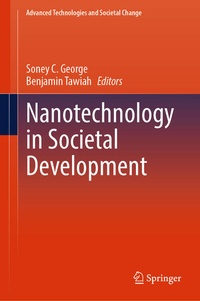
Nanotechnology in Societal Development
Description

This book investigates the complex effects of nanotechnology across numerous fields such as nanomedicine, tailored therapy in medicine and health care, transformational treatment choices for various illnesses, electronics, and computing via miniaturization. In addition, the contributions of nanotechnology to quantum computing, and flexible electronics has been examined. More so, the book discusses the advantages of nanotechnology in the energy and environmental sectors, such as solar cells, energy storage systems, and water purification technologies, in order to solve major global concerns. The impact of nanotechnology on materials and production processes, with applications in construction, aerospace, and other fields, is highlighted. The book further discusses the ethical and societal issues such as safety, privacy, equal access, and thoroughly examined how to strike a balance between innovation and responsible development of nanotechnology in the context of stringent rules and proactive risk assessment. Furthermore, the ability of nanotechnology to bridge the technological divide in underdeveloped nations while minimizing environmental implications is also highlighted.
More details
Other editions
Additional editions
Persons
Dr. Soney C. George is currently Dean Research at Amal Jyothi College of Engineering, Kanjirappaly, and Director of Center for Nanoscience Technology. He obtained his Ph.D. in Polymer Chemistry from the Mahatma Gandhi University, India. He completed his postdoctoral studies at the University of Blasé Pascal, France, and Inha University South Korea. He is a Fellow of the Royal Society of Chemistry, London, and a recipient of " National Technical Teachers Award 2022 from All India Council for Technical Education, Govt of India and best researcher of the year 2018" award from APJ Abdul Kalam Technological University, Thiruvananthapuram, India. He has published and presented almost 260 publications in journals and in conferences and his h-index is 34 with a citation of 4667 and i10 index is 80. His research interests are in the areas of Polymer Science, Polymer Blends & Composites, Nanocomposites, Polymer Tribology, Supercapacitors, Polymer Membranes & Transport phenomena.
Dr. Benjamin Tawiah is a lecturer in the Textiles and Fashion Section in the Department of Industrial Art, Kwame Nkrumah University of Science and Technology. He obtained his Ph.D. from the Hong Kong Polytechnic University. He then worked as Postdoctoral Fellow in the Hong Kong Polytechnic University and the City University of Hong Kong. He currently a Visiting Scholar at the Hong Kong Polytechnic University. His research interests are in the areas of inkjet formulation, nanofillers, nanocomposites, flame retardant polymer composites, and second-generation batteries for energy storage.
Content
Introduction Nanotechnology and Human societal Development.- Nanotechnology Social acceptance cultural impact and privacy.- The Promise of Nanotechnology in Healthcare.- The Role of Nanotechnology in Agriculture and Food Security.- Nanotechnology and the Environment Opportunities and Challenges.- Nanotechnology and Energy Sustainable Solutions for the Future.
