

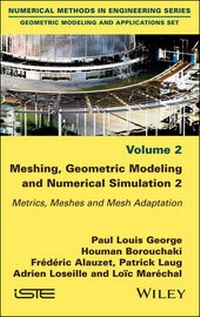
Meshing, Geometric Modeling and Numerical Simulation, Volume 2
Metrics, Meshes and Mesh Adaptation
1st Edition
Published on 24. January 2019
416 pages
978-1-119-38435-9 (ISBN)
Description

Triangulations, and more precisely meshes, are at the heart of many problems relating to a wide variety of scientific disciplines, and in particular numerical simulations of all kinds of physical phenomena. In numerical simulations, the functional spaces of approximation used to search for solutions are defined from meshes, and in this sense these meshes play a fundamental role. This strong link between meshes and functional spaces leads us to consider advanced simulation methods in which the meshes are adapted to the behaviors of the underlying physical phenomena. This book presents the basic elements of this vision of meshing.
These mesh adaptations are generally governed by a posteriori error estimators representing an increase of the error with respect to a size or metric. Independently of this metric of calculation, compliance with a geometry can also be calculated using a so-called geometric metric. The notion of mesh thus finds its meaning in the metric of its elements.
More details
Other editions
Additional editions
Paul Louis George | Houman Borouchaki | Frederic Alauzet
Meshing, Geometric Modeling and Numerical Simulation, Volume 2
Metrics, Meshes and Mesh Adaptation
Book
03/2019
1st Edition
Wiley-ISTE
€164.50
Shipment within 3-4 weeks
Content
- Cover
- Half-Title Page
- Title Page
- Copyright Page
- Contents
- Foreword
- Introduction
- Chapter 1. Metrics, Definitions and Properties
- 1.1. Definitions and properties
- 1.2. Metric interpolation and intersection
- 1.2.1. Metric interpolation
- 1.2.2. Metric intersection
- 1.3. Geometric metrics
- 1.3.1. Geometric metric for a curve
- 1.3.2. Geometric metric for a surface
- 1.3.3. Turning any metric into a geometric metric
- 1.4. Meshing metrics
- 1.5. Metric gradation
- 1.6. Element metric
- 1.6.1. Metric of a simplicial element
- 1.6.2. Metric of a non-simplicial element
- 1.6.3. Metric of an element of arbitrary degree
- 1.7. Element shape and metric quality
- 1.8. Practical computations in the presence of a metric
- 1.8.1. Calculation of the length
- 1.8.2. The calculation of an angle, area or volume
- Chapter 2. Interpolation Errors and Metrics
- 2.1. Some properties
- 2.2. Interpolation error of a quadratic function
- 2.3. Bézier formulation and interpolation error
- 2.3.1. For a quadratic function
- 2.3.2. For a cubic function
- 2.3.3. For a polynomial function of arbitrary degree
- 2.3.4. Error threshold or mesh density
- 2.4. Computations of discrete derivatives
- 2.4.1. The L2 double projection method
- 2.4.2. Green formula
- 2.4.3. Least square and Taylor
- Chapter 3. Curve Meshing
- 3.1. Parametric curve meshing
- 3.1.1. Curve in R3
- 3.1.2. About metrics used and computations of lengths
- 3.1.3. Curve plotted on a patch
- 3.2. Discrete curve meshing
- 3.3. Remeshing a meshed curve
- Chapter 4. Simplicial Meshing
- 4.1. Definitions
- 4.2. Variety (surface) meshing
- 4.2.1. Patch-based meshing
- 4.2.2. Discrete surface remeshing
- 4.2.3. Meshing using a volume mesher
- 4.3. The meshing of a plane or of a volume domain
- 4.3.1. Tree-based method
- 4.3.2. Front-based method
- 4.3.3. Delaunay-based method
- 4.3.4. Remeshing of a meshed domain
- 4.4. Other generation methods?
- Chapter 5. Non-simplicial Meshing
- 5.1. Definitions
- 5.2. Variety meshing
- 5.3. Construction methods for meshing a planar or volume domain
- 5.3.1. Cylindrical geometry and extrusion method
- 5.3.2. Algebraic methods and block-based methods
- 5.3.3. Tree-based method
- 5.3.4. Pairing method
- 5.3.5. Polygonal or polyhedral cell meshing
- 5.3.6. Construction of boundary layers
- 5.4. Other generation methods
- 5.4.1. "Q-morphism" or "H-morphism" meshing
- 5.4.2. Meshing using a reference frame field
- 5.5. Topological invariants (quadrilaterals and hexahedra)
- Chapter 6. High-order Mesh Construction
- 6.1. Straight meshes
- 6.1.1. Local node numbering
- 6.1.2. Overall node numeration
- 6.1.3. Node positions
- 6.1.4. On filling up matrices according to element degrees
- 6.2. Construction of curved meshes
- 6.2.1. First-degree mesh
- 6.2.2. Node creation
- 6.2.3. Deformation and validation
- 6.2.4. General scheme
- 6.3. Curved meshes on a variety, curve or surface
- Chapter 7. Mesh Optimization
- 7.1. Toward a definition of quality
- 7.2. Optimization process
- 7.2.1. Global methods
- 7.2.2. Local operators and local methods
- 7.3. Planar mesh
- 7.4. Surface mesh
- 7.5. Volume meshing
- 7.6. High-degree meshing
- Chapter 8. Mesh Adaptation
- 8.1. Generic framework for adaptive computation, the continuous mesh
- 8.1.1. Duality between discrete and continuous geometric entities
- 8.1.2. Duality between discrete and continuous interpolation error
- 8.1.3. Discrete-continuous duality in one diagram
- 8.2. Optimal control of the interpolation error in Lp-norm
- 8.3. Generic scheme of stationary adaptation
- 8.3.1. Error estimators
- 8.3.2. Interpolation of solution fields
- 8.4. Unsteady adaptation
- 8.4.1. Space-time error estimators based on the characteristics of the solution
- 8.4.2. Extension of the error analysis for the fixed-point algorithm for unsteady mesh adaptation
- 8.4.3. Mesh adaptation for unsteady problems
- 8.4.4. Unsteady mesh adaptation targeted at a function of interest
- 8.4.5. Conservative interpolation of solution fields
- 8.5. Mobile geometry with or without deformation
- 8.5.1. General context of the adaptation for mobile and/or deformable geometries
- 8.5.2. ALE continuous optimal mesh minimizing the interpolation error in Lp-norm
- 8.5.3. Space-time error estimator for moving geometry problems
- Chapter 9. Meshing and Parallelism
- 9.1. Renumbering via a filling curve
- 9.2. Parallelism: two memory paradigms and different strategies
- 9.3. Algorithm parallelization for mesh construction
- 9.4. Parallelization of a mesh construction process, partition then meshing
- 9.5. Mesh parallelization, meshing then partition
- Chapter 10. Applications
- 10.1. Surface meshing
- 10.2. In computational fluid dynamics
- 10.3. Computational solid mechanics
- 10.4. Computational electromagnetism
- 10.5. Renumbering and parallelism
- 10.6. Other more exotic applications
- Chapter 11. Some Algorithms and Formulas
- 11.1. Local numbering of nodes of high-order elements
- 11.2. Length computations etc., in the presence of a metric field
- 11.3. Quality
- Conclusions and Perspectives
- Bibliography
- Index
- Other titles from iSTE in Numerical Methods in Engineering
- EULA
