

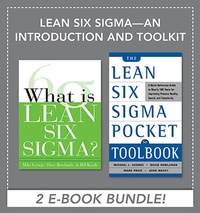
Lean Six Sigma - An Introduction and Toolkit (EBOOK BUNDLE)
1st Edition
Published on 16. November 2011
339 pages
978-0-07-179654-5 (ISBN)
Available for download
Description

Meet all your customers' needs-and your company's goals-with the tools and techniques of Lean Six Sigma2 top-quality guides in 1 powerful eBook package!When you combine Lean Production and Six Sigma, you can't fail to deliver positive results on a continual basis. This powerful mix-called Lean Six Sigma-is what some of the world's most successful organizations use to launch themselves ahead of the competition-and stay there.Now, from one convenient ebook, you can access everything you need to accomplish the same goals. Lean Six Sigma-An Introduction and Toolkit provides all the background and tools you need to start your company on the path to long-term success. This two-in-one ebook contains:What Is Lean Six Sigma?This plain-English guide explains how you can use Lean Six Sigma to identify and eliminate waste, cut costs, and grow revenue. Featuring charts, diagrams, and case studies, it walks you through all the fundamentals, explaining the "four keys" and how they apply to your own job: - Delight your customers with speed and quality
- Improve your processes
- Work together for maximum gain
- Base decisions on data and facts
The Lean Six Sigma Pocket ToolboxThe Lean Six Sigma Pocket Toolbook is today's most complete and results-based reference to the tools and concepts you need to understand, implement, and leverage Lean Six Sigma. This hands-on reference provides: - Analyses of nearly 100 tools and methodologies--from DMAIC and Pull Systems to Control Charts and Pareto Charts
- Detailed explanations of each tool to help you know how, when, and why to use it for maximum efficacy
- Sections for each tool explaining how to create it, how to interpret what you find, and expert tips
- Improve your processes
- Work together for maximum gain
- Base decisions on data and facts
The Lean Six Sigma Pocket ToolboxThe Lean Six Sigma Pocket Toolbook is today's most complete and results-based reference to the tools and concepts you need to understand, implement, and leverage Lean Six Sigma. This hands-on reference provides: - Analyses of nearly 100 tools and methodologies--from DMAIC and Pull Systems to Control Charts and Pareto Charts
- Detailed explanations of each tool to help you know how, when, and why to use it for maximum efficacy
- Sections for each tool explaining how to create it, how to interpret what you find, and expert tips
More details
Person
Content
- Cover Page
- Copyright Page
- Contents
- What is Lean Six Sigma?
- A Note to Our Reader
- Introduction
- Part 1: Foundations of Lean Six Sigma
- 1. The Four Keys to Lean Six Sigma
- 2. Key #1: Delight Your Customers with Speed and Quality
- 3. Key #2: Improve Your Processes
- 4. Key #3: Work Together for Maximum Gain
- 5. Key #4: Base Decisions on Data and Facts
- 6. Beyond the Basics: The Five Laws of Lean Six Sigma
- Part 2: Implementing Lean Six Sigma
- 7. When Companies Start Using Lean Six Sigma
- 8. Making Improvements That Last: An Illustrated Guide to DMAIC and the Lean Six Sigma Toolkit
- 9. The Experience of Making Improvements: What It's Like to Work on Lean Six Sigma Projects
- 10. Six Things Managers Must Do: How to Support Lean Six Sigma
- The Lean Six Sigma Pocket Toolbook
- Chapter 1: Using DMAIC to Improve Speed, Quality, and Cost
- Define
- Measure
- Analyze
- Improve
- Control
- Kaizen DMAIC
- Project selection
- Chapter 2: Working With Ideas
- Brainstorming
- Affinity diagrams
- Multivoting
- Chapter 3: Value Stream Mapping and Process Flow Tools
- Process mapping
- Process observation
- SIPOC
- Process mapping steps
- Transportation and spaghetti (workflow) diagrams
- Swim-lane (deployment) flowcharts
- Value stream maps (basic)
- Flowchart and value stream symbols
- Value-add (VA) vs. non-value-add (NVA) analysis
- Time value maps
- Value-add chart (task time or takt time chart)
- Chapter 4: Voice of the Customer (VOC)
- Customer segmentation
- Sources of customer data
- Collecting VOC: Interviews
- Collecting VOC: Point-of-use observation
- Collecting VOC: Focus groups
- Collecting VOC: Surveys
- Kano analysis
- Developing critical-to-quality requirements
- Chapter 5: Data Collection
- Types of data
- Input vs. output data
- Data collection planning
- Measurement selection matrix
- Stratification factors
- Operational definitions
- Cautions on using existing data
- Making a checksheet
- Basic checksheets
- Frequency plot checksheet
- Traveler checksheet
- Location checksheet
- Sampling basics
- Factors in sample selection
- Stable process (and population) sampling
- Formulas for determining minimum sample size (population or stable process)
- Measurement System Analysis (MSA) and Gage R&R Overview
- Gage R&R: Collecting the data
- Interpreting Gage R&R Results
- MSA: Evaluating bias
- MSA: Evaluating stability
- MSA: Evaluating discrimination
- MSA for attribute/discrete data
- Chapter 6: Descriptive Statistics and Data Displays
- Statistical term conventions
- Measures of central tendency (mean, median, mode)
- Measures of spread (range, variance, standard deviation)
- Boxplots
- Frequency plot (histogram
- Normal distribution
- Non-normal distributions and the Central Limit Theorem
- Chapter 7: Variation Analysis
- Review of variation concepts
- Time series plots (Run charts)
- Run chart table
- Control chart basics
- Selecting a control chart
- Control charts for continuous data
- Subgrouping for continuous data
- Control limit formulas for continuous data
- Factors for Control Chart Formulas
- Creating an ImR Chart
- Creating X,R charts or X,S charts
- Control charts for attribute data
- Creating p-, np-, c-, and u-charts
- Control limit formulas for attribute data
- Assumptions for interpreting control charts
- Interpreting control charts (Tests for Special Cause Variation)
- Background on process capability calculations
- Confusion in short-term vs. long-term process capability calculations
- Calculating process capability
- Chapter 8: Identifying and Verifying Causes
- PART A: Identifying potential causes
- Pareto charts
- 5 Whys
- Cause-and-effect diagrams (fishbone or Ishikawa diagrams)
- C&E Matrix
- PART B: Tools for confirming causal effects
- Stratified data charts
- Testing quick fixes or obvious solutions
- Scatter plots
- Hypothesis testing overview
- Confidence intervals
- Type I and Type II errors, Confidence, Power, and p-values
- Confidence intervals and sample size
- t-test Overview
- 1-Sample t-test
- 2-Sample t-test
- Overview of correlation
- Correlation statistics (coefficients)
- Regression overview
- Simple linear regression
- Multiple regression
- ANOVA (ANalysis Of VAriance)
- One-way ANOVA
- Degrees of Freedom
- ANOVA assumptions
- Two-way ANOVA
- Chi-Square test
- Design of Experiments (DOE) notation and terms
- Planning a designed experiment
- DOE: Full-factorial vs.
- Fractional-factorials (and notations)
- Interpreting DOE results
- Chapter 9: Reducing Lead Time and Non-Value-Add Cost
- Basic Lean concepts
- Metrics of time efficiency
- Time Traps vs. Capacity Constraints
- Identifying Time Traps and Capacity Constraints
- 5S Overview
- Implementing 5S
- Generic Pull System
- Replenishment Pull Systems
- Two-Bin Replenishment System
- Computing minimum safe batch sizes
- Four Step Rapid Setup Method
- Adapting Four Step Rapid Setup for service processes
- Total Productive Maintenance (TPM)
- Mistake proofing & prevention (Poka-yoke)
- Process balancing design principles
- Work cell optimization
- Visual Process Controls
- Chapter 10: Complexity Value Stream Mapping and Complexity Analysis
- Product/service family grid
- Complexity Value Stream Map (CVSM)
- Process Cycle Efficiency (PCE)
- The Complexity Equation
- Complexity matrix
- PCE destruction calculations (for a Complexity Matrix)
- Substructure analysis
- "What-if" analyses with Complexity Matrix data
- Chapter 11: Selecting and Testing Solutions
- Sources of solution ideas
- Benchmarking
- Tips on solution selection
- Developing and using evaluation criteria
- Solution selection matrix
- Pairwise ranking
- Cost evaluation
- Impact/effort matrix
- Pugh matrix
- Other evaluation techniques
- Controls assessment matrix
- Failure Modes and Effects Analysis (FMEA)
- Pilot testing
- Index
- About the Author

