

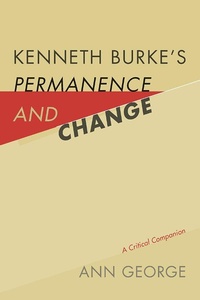
Kenneth Burke's Permanence and Change
Description

A guide to and analysis of a seminal books key concepts and methodology
Since its publication in 1935, Kenneth Burke's Permanence and Change, a text that can serve as an introduction to all his theories, has become a landmark of rhetorical theory. Using new archival sources and contextualizing Burke in the past and present, Ann George offers the first sustained exploration of this work and seeks to clarify the challenging book for both amateurs and scholars of rhetoric.
This companion to Permanence and Change explains Burke's theories through analysis of key concepts and methodology, demonstrating how, for Burke, all language and therefore all culture is persuasive by nature. Positioning Burke's book as a pioneering volume of New Rhetoric, George presents it as an argument against systemic violence, positivism, and moral relativism. Permanence and Change has become the focus of much current rhetorical study, but George introduces Burke's previously unavailable outlines and notes, as well as four drafts of the volume, to investigate his work more deeply than ever before. Through further illumination of the book's development, publication, and reception, George reveals Burke as a public intellectual and critical educator, rather than the eccentric, aloof genius earlier scholars imagined him to be.
George argues that Burke was not ahead of his time, but rather deeply engaged with societal issues of the era. She redefines Burke's mission as one of civic engagement, to convey the ethics and rhetorical practices necessary to build communities interested in democracy and human welfare-lessons that George argues are as needed today as they were in the 1930s.
More details
Other editions
Additional editions
Person
Ann George is a professor of English at Texas Christian University, where she teaches courses in rhetorical theory and criticism, style, and 1930s America. She is coauthor of Kenneth Burke in the 1930s and coeditor of Women and Rhetoric between the Wars.
Content
- Cover
- Kenneth Burke's Permanence and Change
- Title
- Copyright
- Dedication
- CONTENTS
- List of Illustrations
- Series Editor's Preface
- Preface
- Abbreviations
- Introduction A Reshaping of the Terms
- Part I. Translating Burkean Terms
- One. Pieties, Perspectives, and Incongruities
- Two. Metabiology as Purification of War
- Three. Enacting the Poetic Orientation
- Part II. Archival Interventions
- Four. Caught in the Act A Writer in the Archives
- Five. Archival Recalcitrance The Ins and Outs of Communism
- Six. Finding the Time for Burke
- Conclusion A New Rhetoric and Civic Pedagogy (to Save the World)
- Appendix A Toward a P&C Chronology
- Appendix B Works Referenced in P&C
- Notes
- Works Cited
- Index
