

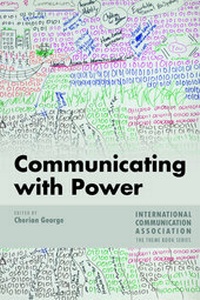
Communicating with Power
Description

Communication is ubiquitous and information is abundant. Political and economic markets are more open than they have ever been. Yet, there is no escaping the fact that communication continues to flow across fields where power is distributed unevenly. This collection of articles analyzes and responds to asymmetries of power in a diversity of contexts. They are drawn from presentations at the 2016 Annual Conference of the International Communication Association, held in Fukuoka, Japan. The conference theme presented an opening for scholars from various disciplines and academic traditions to engage with the questions of power at different levels of analysis-from micro sites of power like a doctor's consultation room, to the geopolitical arenas where nations wage war, make peace, and spy on one another. The resulting collection straddles different methodologies and styles, from survey research to essays. Leading scholars and junior researchers have combined to create a volume that reflects the breadth of communication scholarship and its contemporary concerns.
More details
Other editions
Additional editions
Person
Cherian George (Ph.D., Stanford University) is Associate Professor in the Department of Journalism at Hong Kong Baptist University. His latest monograph is Hate Spin: The Manufacture of Religious Offense and Its Threat to Democracy (2016).
Content
The Contributors - Peng Hwa Ang: Foreword - Cherian George: Editor's Introduction - Sandra Braman: The Medium as Power: Information and Its Flows as Acts of War - John D. H. Downing: Pointless or Potent? A Long View on Antiwar Movement Media - Omar Al-Ghazzi: The Politics of Recognition and the Safety of Syrian Media Practitioners - Marc Jungblut/Adolfo Carratalá/Beatriz Herrero: Media, Parliaments and NGOs in the Israeli-Palestinian Conflict - Robin Mansell: The Rise of Computational Power: Accountability, Imagination and Choice - Jenifer Sunrise Winter: Big Data and Information/Power Asymmetries: What Role for Scholars? - Kerstin Thummes/Ulrike Röttger: Public Discourse on the Responsibility of Corporations: A Holistic Framework - Min Liu/Valarie Shaw/Wai Hsien Cheah: Struggling to be Understood: Deaf Patients and the American Healthcare System - Bingqing Xia: Internet Workers' Emerging Agency and New Political Dynamics in China - Debbie Goh/Elmie Nekmat/Natalie Pang/Carol Soon/Weiyu Zhang: Shifts in Communicative Power: Social Media and Elections in Singapore - Nicholas Busalacchi/Sonia Jawaid Shaikh/François Bar/Ann Pendleton-Jullian: Academic-Community Collaboration through World Building - Sharon Strover: Breaching Sites of Power in Law and Policy Debates: Four Models - Cherian George: Dealing with Demagoguery and Hate Propaganda in an Age of Unreason - Perry Parks: We Know How to Communicate with Power: We Just Don't Do It - John Gowdy: Disinformation, Economic Fallacies and Environmental Catastrophe - Index.
