

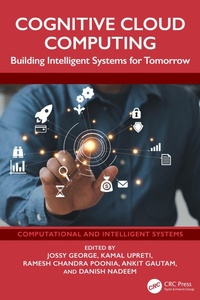
Cognitive Cloud Computing
Building Intelligent Systems for Tomorrow
Published on 30. December 2025
354 pages
978-1-040-54278-1 (ISBN)
Description

This book serves as a comprehensive guide, covering the fundamentals of cloud computing, advanced concepts, and practical applications.
Discusses cyber-physical systems, cloud integration for environmental management, and cloud security intelligence systems for sustainable operations
Presents case studies based on computational intelligence-based optimization for sustainable operations and cloud integration
Emphasizes how cloud computing revolutionizes traditional processes, enabling direct input of assembly details into a computation model, streamlining development cycles, and reducing costs
Bridges the gap between theory and practice by offering guidelines on problem encoding and implementation strategies, empowering readers to apply their acquired knowledge to solve complex industrial problems
Covers wireless security in the cloud era, mechatronics and cloud integration, and cloud-enabled manufacturing for eco-friendly operations
The text is primarily written for senior undergraduates, graduate students, and academic researchers in electrical engineering, electronics and communications engineering, computer engineering, and information technology.
Discusses cyber-physical systems, cloud integration for environmental management, and cloud security intelligence systems for sustainable operations
Presents case studies based on computational intelligence-based optimization for sustainable operations and cloud integration
Emphasizes how cloud computing revolutionizes traditional processes, enabling direct input of assembly details into a computation model, streamlining development cycles, and reducing costs
Bridges the gap between theory and practice by offering guidelines on problem encoding and implementation strategies, empowering readers to apply their acquired knowledge to solve complex industrial problems
Covers wireless security in the cloud era, mechatronics and cloud integration, and cloud-enabled manufacturing for eco-friendly operations
The text is primarily written for senior undergraduates, graduate students, and academic researchers in electrical engineering, electronics and communications engineering, computer engineering, and information technology.
More details
Series
Language
English
Place of publication
London
United Kingdom
Publishing group
Taylor & Francis Ltd
Target group
College/higher education
Professional and scholarly
Illustrations
22 Tables, black and white; 28 Line drawings, black and white; 4 Halftones, black and white; 32 Illustrations, black and white
File size
28,45 MB
ISBN-13
978-1-040-54278-1 (9781040542781)
Copyright in bibliographic data and cover images is held by Nielsen Book Services Limited or by the publishers or by their respective licensors: all rights reserved.
Schweitzer Classification
Other editions
Additional editions
Jossy George | Kamal Upreti | Ramesh Chandra Poonia
Cognitive Cloud Computing
Building Intelligent Systems for Tomorrow
Book
approx. 12/2025
1st Edition
CRC Press
€180.90
Not yet published
Persons
Fr. Jossy George holds a dual degree in computer science and human resources and completed his FDPM from IIM, Ahmedabad. Awarded a doctorate in computer science from CHRIST University, Bengaluru, he specialized in image processing with a thesis titled "Development of Efficient Biometric Recognition Algorithms Based on Fingerprint and Face." An active member of various international associations, his primary research focus is on developing algorithms to enhance accuracy in biometrics. His extensive research portfolio includes numerous major and minor projects, notably in the realm of technology in higher education. He has authored multiple research papers published in both national and international journals. Beyond his research endeavors, he is a prolific author, having written two motivational books on management, namely, Boost Your Ability to Make Great Decisions and Leadership Par Excellence. Additionally, he coauthored the books Data Ethics and Challenges and Introduction to Principles of Data Science. Recognized for his outstanding contributions, he received the Visionary Leader of 2019 award for his exemplary role in education, skill development, and research. He was also honored with the Certificate of Academic Excellence (2021) for his dedicated contributions to Education, presented by H.D. Deve Gowda, former prime minister of India. Currently, he serves on several esteemed officiating bodies in the field of computer science and holds numerous patents and copyrights. Since 2002, he has been associated with CHRIST University (formerly Christ College), Bengaluru, India, and other affiliated institutions, assuming various roles. Presently, he serves as the director and CHRIST (Deemed to be University), BGR Campus Bengaluru, Karnataka, India.
Kamal Upreti is currently working as an associate professor in the Department of Computer Science, CHRIST (Deemed to be University), Delhi NCR, Ghaziabad, India. He completed his BTech (Hons.) from UPTU, MTech (Gold Medalist), PGDM (Executive) from IMT Ghaziabad, and PhD from the Department of Computer Science & Engineering. He has completed a postdoc at the National Taipei University of Business, Taiwan, funded by MHRD. He has published 50-plus patents, 32-plus magazine issues, and 135-plus research papers in various reputed journals and international conferences. His areas of interest include modern physics, data analytics, cybersecurity, machine learning, health care, embedded systems, and cloud computing. He has published more than 45 authored and edited books in reputed publications. He has many years of experience in corporate and teaching experience in engineering colleges. He worked with HCL, NECHCL, Hindustan Times, Dehradun Institute of Technology, and Delhi Institute of Advanced Studies, with more than 15 years of enriching experience in research, academics, and corporate. He also worked at NECHCL in Japan, where he had a project called "Hydrastore" funded by a collaboration between HCL and NECHCL. Upreti worked on a government project, "Integrated Power Development Scheme (IPDS)," launched by the Ministry of Power, Government of India, to strengthen the subtransmission and distribution network in urban areas. He recently completed work in collaboration with GB PANT & AIIMS Delhi on the funded project of the ICMR scheme on cardiovascular disease prediction strokes using machine learning techniques from 2017 to 2020, which has a fund of 80 lakhs. He got 5 lakhs in funding from DST SERB for conducting the International Conference, ICSCPS-2024. Recently, he got a 10 lakhs fund from AICTE- Inter-Institutional Biomedical Innovations and Entrepreneurship Program (AICTE-IBIP) for 2024-2026. He has attended as a session chairperson at national and international conferences and was a keynote speaker on various platforms such as skill-based training, corporate training, guest faculty, and faculty development programs. He was awarded best teacher, researcher, extra academic performer, and gold medalist in the MTech program.
Ramesh Chandra Poonia completed a postdoctoral fellowship at the Cyber- Physical Systems Laboratory (CPS Lab), Department of ICT and Natural Sciences, Norwegian University of Science and Technology (NTNU), Alesund, Norway. He also completed a part-time post-doctoral fellowship on the International Collaborative Project for a prediction model for pandemic disease using machine learning at Oakland University, USA, and Imam University, Saudi Arabia. He received his PhD in computer science from Apaji Institute of Mathematics & Applied Computer Technology, Banasthali University, Banasthali, India, in July 2013. He has also completed a master of technology (MTech) in data science and engineering, Work Integrated Learning Programme (WILP) from Birla Institute of Technology and Science, Pilani (BITS Pilani), India. He works as a professor at the Department of Computer Science, CHRIST (Deemed to be University), Banglore, India. His research interests are sustainable technologies, cyber-physical systems, computational intelligence, and network protocol evaluation. He is chief editor of TARU Journal of Sustainable Technologies and Computing (TJSTC) and associate editor of the Journal of Sustainable Computing: Informatics and Systems. He also serves on the editorial boards of a few international journals. He is the principal author and coauthor of 6 books and an editor of more than 25 special issues of journals, books, and conference proceedings. He has also authored/coauthored over 75 research publications in peer-reviewed reputed journals, book chapters, and conference proceedings. Moreover, he is a regular reviewer for international journals and conferences. He also serves as conference chair of the conference series, International Conference on Sustainable Computing in Science, Technology and Management (SUSCOM). He was endorsed with the prestigious Faculty Appreciation Award 2013 for commendable services.
Ankit Gautam, currently a project lead at BUSINESSNEXT with over eight years of industrial experience, excels in cloud-based solutions and fullstack artificial intelligence and data platforms for the banking, financial services, and insurance (BFSI) sector. Holding an MBA from K J Somaiya Institute of Management and a BTech in electrical and electronics engineering, he combines technical expertise with managerial acumen. Having previously contributed significantly to Adani, Bajaj, and Fino Payment Bank, his diverse experience showcases adaptability across industries. He specializes in steering projects toward efficiency and security through cloud computing. His expertise in full-stack development underscores his capability to handle end-to-end solutions, particularly in the BFSI domain, where he navigates complexities related to security and compliance. He emerges as a dynamic professional, seamlessly integrating technology and business strategies to address contemporary challenges in the ever-evolving corporate landscape.
Danish Nadeem is a senior data scientist and technical consultant working in the Netherlands. Along with his education in computer science and artificial intelligence from Germany, he has over 18 years of industry and research experience on the applications of cutting-edge AI-based and machine learning technologies while working within EU-funded framework and Horizon2020 projects. Working in industries such as education, health, pharmaceuticals, media and entertainment, finance, and logistics, he has also contributed about 13 research publications in various international conferences and journals. He spent several years working in R&D at the German Research Center for Artificial Intelligence before moving to the Netherlands to further develop his career by taking up leading roles, advocating innovative information and communication technologies. With years of experience living and working in Europe, he has been actively involved in promoting strategies for tech startups, innovation, and entrepreneurship, as well as mentoring young professionals for careers in academic research and industry.
Kamal Upreti is currently working as an associate professor in the Department of Computer Science, CHRIST (Deemed to be University), Delhi NCR, Ghaziabad, India. He completed his BTech (Hons.) from UPTU, MTech (Gold Medalist), PGDM (Executive) from IMT Ghaziabad, and PhD from the Department of Computer Science & Engineering. He has completed a postdoc at the National Taipei University of Business, Taiwan, funded by MHRD. He has published 50-plus patents, 32-plus magazine issues, and 135-plus research papers in various reputed journals and international conferences. His areas of interest include modern physics, data analytics, cybersecurity, machine learning, health care, embedded systems, and cloud computing. He has published more than 45 authored and edited books in reputed publications. He has many years of experience in corporate and teaching experience in engineering colleges. He worked with HCL, NECHCL, Hindustan Times, Dehradun Institute of Technology, and Delhi Institute of Advanced Studies, with more than 15 years of enriching experience in research, academics, and corporate. He also worked at NECHCL in Japan, where he had a project called "Hydrastore" funded by a collaboration between HCL and NECHCL. Upreti worked on a government project, "Integrated Power Development Scheme (IPDS)," launched by the Ministry of Power, Government of India, to strengthen the subtransmission and distribution network in urban areas. He recently completed work in collaboration with GB PANT & AIIMS Delhi on the funded project of the ICMR scheme on cardiovascular disease prediction strokes using machine learning techniques from 2017 to 2020, which has a fund of 80 lakhs. He got 5 lakhs in funding from DST SERB for conducting the International Conference, ICSCPS-2024. Recently, he got a 10 lakhs fund from AICTE- Inter-Institutional Biomedical Innovations and Entrepreneurship Program (AICTE-IBIP) for 2024-2026. He has attended as a session chairperson at national and international conferences and was a keynote speaker on various platforms such as skill-based training, corporate training, guest faculty, and faculty development programs. He was awarded best teacher, researcher, extra academic performer, and gold medalist in the MTech program.
Ramesh Chandra Poonia completed a postdoctoral fellowship at the Cyber- Physical Systems Laboratory (CPS Lab), Department of ICT and Natural Sciences, Norwegian University of Science and Technology (NTNU), Alesund, Norway. He also completed a part-time post-doctoral fellowship on the International Collaborative Project for a prediction model for pandemic disease using machine learning at Oakland University, USA, and Imam University, Saudi Arabia. He received his PhD in computer science from Apaji Institute of Mathematics & Applied Computer Technology, Banasthali University, Banasthali, India, in July 2013. He has also completed a master of technology (MTech) in data science and engineering, Work Integrated Learning Programme (WILP) from Birla Institute of Technology and Science, Pilani (BITS Pilani), India. He works as a professor at the Department of Computer Science, CHRIST (Deemed to be University), Banglore, India. His research interests are sustainable technologies, cyber-physical systems, computational intelligence, and network protocol evaluation. He is chief editor of TARU Journal of Sustainable Technologies and Computing (TJSTC) and associate editor of the Journal of Sustainable Computing: Informatics and Systems. He also serves on the editorial boards of a few international journals. He is the principal author and coauthor of 6 books and an editor of more than 25 special issues of journals, books, and conference proceedings. He has also authored/coauthored over 75 research publications in peer-reviewed reputed journals, book chapters, and conference proceedings. Moreover, he is a regular reviewer for international journals and conferences. He also serves as conference chair of the conference series, International Conference on Sustainable Computing in Science, Technology and Management (SUSCOM). He was endorsed with the prestigious Faculty Appreciation Award 2013 for commendable services.
Ankit Gautam, currently a project lead at BUSINESSNEXT with over eight years of industrial experience, excels in cloud-based solutions and fullstack artificial intelligence and data platforms for the banking, financial services, and insurance (BFSI) sector. Holding an MBA from K J Somaiya Institute of Management and a BTech in electrical and electronics engineering, he combines technical expertise with managerial acumen. Having previously contributed significantly to Adani, Bajaj, and Fino Payment Bank, his diverse experience showcases adaptability across industries. He specializes in steering projects toward efficiency and security through cloud computing. His expertise in full-stack development underscores his capability to handle end-to-end solutions, particularly in the BFSI domain, where he navigates complexities related to security and compliance. He emerges as a dynamic professional, seamlessly integrating technology and business strategies to address contemporary challenges in the ever-evolving corporate landscape.
Danish Nadeem is a senior data scientist and technical consultant working in the Netherlands. Along with his education in computer science and artificial intelligence from Germany, he has over 18 years of industry and research experience on the applications of cutting-edge AI-based and machine learning technologies while working within EU-funded framework and Horizon2020 projects. Working in industries such as education, health, pharmaceuticals, media and entertainment, finance, and logistics, he has also contributed about 13 research publications in various international conferences and journals. He spent several years working in R&D at the German Research Center for Artificial Intelligence before moving to the Netherlands to further develop his career by taking up leading roles, advocating innovative information and communication technologies. With years of experience living and working in Europe, he has been actively involved in promoting strategies for tech startups, innovation, and entrepreneurship, as well as mentoring young professionals for careers in academic research and industry.
Content
1. Cognitive Robotics for Social, Educational, and Therapeutic Applications 2. A Sustainable Approach to Cloud Computing: A Comprehensive Analysis of Load Balancing Techniques in Cognitive Environments 3. Next-Gen Cloud Intelligence: Cognitive Computing for a Sustainable Digital Future 4. Cognitive Cloud Skies: AI-Driven Air Traffic Control in the Era of Sustainable Cloud Intelligence 5. Quantum-Inspired Algorithms for Cognitive Computing: Enhancing Cloud-Based Problem Solving 6. Implementing Smart Cyber-Physical Systems in Industrial and Urban Applications: A Practical Approach 7. Integration of Cyber-Physical Systems with Wearable Devices: A New Paradigm for Patient Monitoring 8. Building Resilient and Sustainable Operations through Cloud Security Intelligence 9. Integrating Cyber-Physical Systems with Intelligent Transportation: Challenges and Opportunities 10. Defending Against Threats: Machine Learning Approaches For Malware Detection And Analysis 11. Eco-Friendly Operations Hype : Analysis of Key Factors of Sustainability Performance in Manufacturing Companies 12. AI-Driven Defense Mechanisms for Sybil and DDoS Attacks in Cloud Networks 13. A Comparative Study of Machine Learning Models for Web Tracker Detection 14. Bridging the Present and Future: Emerging Trends in Smart Cyber Physical Systems 15. Enhancing Operational Efficiency in Cloud Computing through Computational Intelligence for Environmental Sustainability 16. The Evolution of Cyber-Physical Systems
