

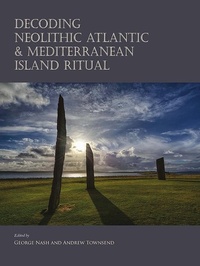
Decoding Neolithic Atlantic and Mediterranean Island Ritual
Published on 31. March 2016
304 pages
978-1-78570-051-4 (ISBN)
Description

What constitutes an island and the archaeology contained within? Is it the physicality of its boundary (between shoreline and sea)? Does this physical barrier extend further into a watery zone? Archaeologically, can islands be defined by cultural heritage and influence? Clearly, and based on these few probing questions, islands are more than just lumps of rock and earth sitting in the middle of a sea or ocean. An island is a space which, when described in terms of topography, landscape form and resources, becomes a place. A place can sometimes be delineated with barriers and boundaries; it may also have a perimeter and can be distinguished from the space that surrounds it.
The 16 papers presented here explore the physicality, and levels of insularity of individual islands and island groups during prehistory through a series of case studies on Neolithic island archaeology in the Atlantic and Mediterranean regions. For the eastern Atlantic (the Atlantic Archipelago) papers discuss the sacred geographies and material culture of Neolithic Gotland, Orkney, and Anglesey and the architecture of and ritual behavior associated with megalithic monuments in the Channel Islands and the Scilly Isles.
The Mediterranean region is represented by a different type of Neolithic, both in terms of architecture and material culture. Papers discuss theoretical constructs and ritual deposition, cave sites, ritualized and religious aspects of Neolithic death and burial; metaphysical journeys associated with the underworld in Late Neolithic Malta and the possible role of its Temple Period art in ritual activities; and palaeoenvironmental evidence from the Neolithic monuments of Corsica.
The cases examined illustrate the diversity of the evidence available that affords a better understanding of the European-Mediterranean Neolithic ''island society'', not least the effects of interaction/contact and/or geographical insularity/isolation, all factors that are considered to have consequences for the establishment and modification of cultures in island settings.
The 16 papers presented here explore the physicality, and levels of insularity of individual islands and island groups during prehistory through a series of case studies on Neolithic island archaeology in the Atlantic and Mediterranean regions. For the eastern Atlantic (the Atlantic Archipelago) papers discuss the sacred geographies and material culture of Neolithic Gotland, Orkney, and Anglesey and the architecture of and ritual behavior associated with megalithic monuments in the Channel Islands and the Scilly Isles.
The Mediterranean region is represented by a different type of Neolithic, both in terms of architecture and material culture. Papers discuss theoretical constructs and ritual deposition, cave sites, ritualized and religious aspects of Neolithic death and burial; metaphysical journeys associated with the underworld in Late Neolithic Malta and the possible role of its Temple Period art in ritual activities; and palaeoenvironmental evidence from the Neolithic monuments of Corsica.
The cases examined illustrate the diversity of the evidence available that affords a better understanding of the European-Mediterranean Neolithic ''island society'', not least the effects of interaction/contact and/or geographical insularity/isolation, all factors that are considered to have consequences for the establishment and modification of cultures in island settings.
More details
Other editions
Additional editions
George Nash | Andrew Townsend
Decoding Neolithic Atlantic and Mediterranean Island Ritual
Book
01/2016
Oxbow Books
€81.90
Shipment within 3-4 weeks
Content
- Front Cover
- Title
- Copyright
- Contents
- Contributors
- Dedication: Andrew Townsend
- Introduction George Nash & Andrew Townsend
- 1. Collective spaces and material expressions: ritual practice and island identities in Neolithic Gotland
- 2. Monuments from the doorstep: exploring the temporal, spatial and social relationship between chambered cairns and settlements during the Orcadian Neolithic
- 3. An island archaeology of Neolithic Ynys Môn (Anglesey)
- 4. Uniformity and uniqueness: the extraordinary Scillonian entrance graves
- 5. Ritual competition in the Final Neolithic of the Channel Islands
- 6. Establishing a diverse architecture: contextualising the Delancey Park gallery grave, north-east Guernsey
- 7. Re-viewing the megaliths of northern Guernsey
- 8. Defying expectations: Neolithic life in the Isles of Scilly
- 9. Rite to memory: Neolithic depositional histories of an Adriatic cave
- 10. Moving worlds: memory, mobility and mortality in the aceramic Neolithic of Cyprus
- 11. Ritual and religion in Neolithic Crete?
- 12. Ancestors in the rock: a new evaluation of the development and utilisation of rock-cut tombs in Copper Age Sicily (4000-3000 cal BC)
- 13. Journeys through the underworld in Late Neolithic Malta
- 14. Searching beyond the artefact for ritual practices: evidence for ritual surrounding the unclothed human body on prehistoric Malta during the temple period
- 15. The Neolithic in La Balagne, Corsica: an evaluation using palynological, geoarchaeological and landscape archaeological data
- 16. Houses fit for deceased dwellers: assessing architectural devices within the rock-cut tombs of north-western Sardinia
