

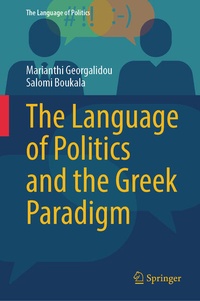
The Language of Politics and the Greek Paradigm
Description

This book seeks to identify the manifold ways in which the multiple European crises, debt, financial, sociopolitical, refugee (re)construct political polarizations in Greece on the basis of the country's divided past. This is the first book in the context of Discourse Studies and Political Communication which addresses specifically the Greek political particularities and their importance in both the construction and the expression of different notions of political identity in discourse.
The book, written by two linguists, provides a critical interactional approach that combines critical discourse analysis, sociolinguistics, argumentation, political sociology, and social theory. Its interdisciplinary character enriches its theoretical platform and makes it distinctive.
While the book centers on the Greek political landscape, it offers valuable insights for the broader study of Western politics and societies, which, like Greece, have in recent years been marked by overlapping crises, polarization, and political instability. We anticipate that readers will identify parallels between the Greek case and their own political realities. Coupled with an innovative methodological approach, this study aims to open new pathways in the analysis of political discourses.
More details
Other editions
Additional editions
Persons
Marianthi Georgalidou is Professor of Linguistics-Discourse Analysis in the Department of Mediterranean Studies, University of the Aegean, Greece, where she teaches Discourse Analysis, Pragmatics, and Sociolinguistics. She has published articles on the pragmatics of code-switching and minority discourse, on child discourse, gender, and im/politeness. She has investigated sexist language in Greek parliamentary discourse and administrative documents. She co-authored the Guide for non-sexist language use in Greek administration that was officially published by the Greek National Printing House in 2018. Her recent research focuses on political discourse. She investigates impoliteness and aggression in the Greek parliament as well as in traditional and new media engaging in political action (Georgalidou, M. et al. (2020). Aggression in media-sharing websites in the context of Greek political/parliamentary discourse in the years of the economic crisis. Journal of Language Aggression and Conflict , 8 (2), 321-350)). She also examines humor and satirical discourse as established strategies in political communication.
Salomi Boukala is Assistant Professor of Critical Discourse Analysis at Panteion University of Social & Political Sciences, Greece, and Visiting Professor at Newcastle University, UK. She is a specialist on Greek political discourse and has published widely in the fields of argumentation and Critical Discourse Studies. She is the author of European Identity and The Representation of Islam in the Mainstream Press: Argumentation and Media Discourse (Palgrave, 2019). In 2020, she co-edited a volume on Critical Discourse Analysis that is the first book on the field being published in Greece. Her research interests fall within the areas of the discursive construction of political and (supra) national identities, political rhetoric, discriminatory discourse, ethnographic approaches, and media discourse.
Content
Preface.- Chapter 1 Introduction.- Chapter 2 Contemporary Greek Politics: From the Transition to Democracy to the Revival of Authoritarianism.- Chapter 3 Methodological Frameworks.- Chapter 4 "From Dystopia to EUtopia" - Analyzing Election Campaigns on the Basis of Fear and Hope Affects.- Chapter 5 Mainstreaming Anti-Communist Propaganda.- Chapter 6 Populist Discourse and Discourses about Populism in Political Confrontation: Instrumentalizing Anti-Populism in Contemporary Greek Politics.- Chapter 7 From the Refugee Crisis to Greece's Policy of Exclusion.
