

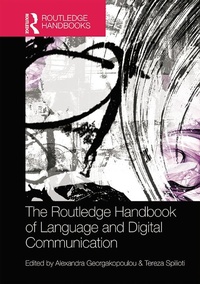
The Routledge Handbook of Language and Digital Communication
Published on 16. July 2015
448 pages
978-1-317-43929-5 (ISBN)
Description

The Routledge Handbook of Language and Digital Communication provides a comprehensive, state of the art overview of language-focused research on digital communication, taking stock and registering the latest trends that set the agenda for future developments in this thriving and fast moving field. The contributors are all leading figures or established authorities in their areas, covering a wide range of topics and concerns in the following seven sections:
* Methods and Perspectives;
* Language Resources, Genres, and Discourses;
* Digital Literacies;
* Digital Communication in Public;
* Digital Selves and Online-Offline Lives;
* Communities, Networks, Relationships;
* New debates and Further directions.
This volume showcases critical syntheses of the established literature on key topics and issues and, at the same time, reflects upon and engages with cutting edge research and new directions for study (as emerging within social media). A wide range of languages are represented, from Japanese, Greek, German and Scandinavian languages, to computer-mediated Arabic, Chinese and African languages.
The Routledge Handbook of Language and Digital Communication will be an essential resource for advanced undergraduates, postgraduates and researchers within English language and linguistics, applied linguistics and media and communication studies.
* Methods and Perspectives;
* Language Resources, Genres, and Discourses;
* Digital Literacies;
* Digital Communication in Public;
* Digital Selves and Online-Offline Lives;
* Communities, Networks, Relationships;
* New debates and Further directions.
This volume showcases critical syntheses of the established literature on key topics and issues and, at the same time, reflects upon and engages with cutting edge research and new directions for study (as emerging within social media). A wide range of languages are represented, from Japanese, Greek, German and Scandinavian languages, to computer-mediated Arabic, Chinese and African languages.
The Routledge Handbook of Language and Digital Communication will be an essential resource for advanced undergraduates, postgraduates and researchers within English language and linguistics, applied linguistics and media and communication studies.
Reviews / Votes
'This book brings together the insights of an outstanding group of researchers in the area of digital communication, drawn from a range of linguistic fields. The approaches surveyed range from network analysis, and digital ethnography, to multimodal discourse analysis and sociolinguistics. It is key reading for anyone aiming to understand digital cultures and computer-mediated communication.' Michele Zappavigna, The University of New South Wales, Australia'This handbook provides a comprehensive and critical overview of cutting-edge research, drawing on data from many different languages and varied contexts. The collection addresses current trends as well as methodological challenges within the field of computer-mediated communication in linguistics and will provide novices and seasoned scholars with a rich resource for future studies.' Miriam A. Locher, University of Basel, Switzerland
'The Routledge Handbook of Language and Digital Communication showcases critical syntheses of the established literature on key topics and issues, including discourse analysis, pragmatics, sociolinguistics, linguistic anthropology, and literary studies...the handbook is a substantial contribution to the burgeoning field of digital communication, which can intrigue and inspire further fruitful research. Readers can surely benefit greatly from this comprehensive collection of research; therefore, I highly recommend it for anyone aiming to understand digital cultures and computer-mediated communication.' - Zsuzsanna Zsubrinszky, Budapest Business School, LINGUIST List
More details
Series
Language
English
Place of publication
London
United Kingdom
Publishing group
Taylor & Francis Ltd
Target group
College/higher education
Product notice
Reflowable
Illustrations
6 s/w Tabellen, 20 s/w Photographien bzw. Rasterbilder
6 Tables, black and white; 20 Halftones, black and white
File size
8,46 MB
ISBN-13
978-1-317-43929-5 (9781317439295)
Copyright in bibliographic data and cover images is held by Nielsen Book Services Limited or by the publishers or by their respective licensors: all rights reserved.
Schweitzer Classification
Other editions
Additional editions
Alexandra Georgakopoulou | Tereza Spilioti
The Routledge Handbook of Language and Digital Communication
Book
01/2020
1st Edition
Routledge
€75.60
Shipment within 15-20 days
Alexandra Georgakopoulou | Tereza Spilioti
The Routledge Handbook of Language and Digital Communication
Book
07/2015
1st Edition
Routledge
€394.33
Shipment within 15-20 days
Persons
Alexandra Georgakopoulou is Professor of Discourse Analysis & Sociolinguistics, King's College London. She is on the Editorial Board of: Narrative Inquiry: 1999-; Language@Internet: 2005-; Journal of Greek Linguistics: 2009-; Reading Research Quarterly :2010-; Discourse, Context and Media: 2011-; Journal of Sociolinguistics: 2012-.
Tereza Spilioti is Senior Lecturer in English Language and Communication at Kingston University (London) where she has introduced the teaching of computer-mediated communication into the BA English Language and Communication and designed a new module on 'Discourse and Social Media' offered to both undergraduate and postgraduate students (MA Media and Communication).
Tereza Spilioti is Senior Lecturer in English Language and Communication at Kingston University (London) where she has introduced the teaching of computer-mediated communication into the BA English Language and Communication and designed a new module on 'Discourse and Social Media' offered to both undergraduate and postgraduate students (MA Media and Communication).
Content
Acknowledgements
Contributors
Editors' Introduction
Section 1. Methods and Perspectives
Approaches to language variation, Lars Hinrichs
Network analysis, John Paolillo
Digital ethnography, Piia Varis
Multimodal analysis, Carey Jewitt
Section 2. Language Resources, Genres, and Discourses
Digital genres and processes of remediation, Theresa Heyd
Style, creativity and play, Yukiko Nishimura
Multilingual resources and practices in digital communication, Carmen Lee
Digital discourses: a critical perspective Tereza Spilioti
Section 3. Digital Literacies
Digital media and literacy development, Michele Knobel & Colin Lankshear
Vernacular literacy: orthography and literacy practices, Josh Iorio
Texting and language learning, Clare Wood, Nenagh Kemp & Sam Waldron
Section 4. Digital Communication in Public
Digital media in workplace interactions, Erika Darics
Digital advertising, Helen Kelly-Holmes
Corporate blogging and corporate social media, Cornelius Puschmann and Rebecca Hagelmoser
Twitter: design, discourse, and the implications of public text, Lauren Squires
Section 5. Digital Selves and Online and Offline Lives
5.1. The role of the body and space in digital multimodality, Elizabeth Keating
5.2. Second Life: language and virtual identity, Ashraf Abdullah
5.3. Online multiplayer games, Lisa Newon
5.4. Relationality, friendship & identity in digital communication, Sage Lambert Graham
Section 6. Communities, Networks, Relationships
Online communities and communities of practice, Jo Angouri
Facebook and the discursive construction of the social network, Caroline Tagg & Philip Seargeant
YouTube: language and discourse practices in participatory culture, Jannis Androutsopoulos and Jana Tereick
Translocality, Samu Kytola
Section 7. New Debates and Further Directions
7.1. Social reading in a digital world, Naomi Baron
7.2. New frontiers in interactive multimodal communication, Susan Herring
7.3. Moving between the big and the small: identity and interaction in digital contexts, Ruth Page
7.4. Surveillance, Rodney Jones
7.5. Choose now! media, literacies, identities, politics Charles Ess
Contributors
Editors' Introduction
Section 1. Methods and Perspectives
Approaches to language variation, Lars Hinrichs
Network analysis, John Paolillo
Digital ethnography, Piia Varis
Multimodal analysis, Carey Jewitt
Section 2. Language Resources, Genres, and Discourses
Digital genres and processes of remediation, Theresa Heyd
Style, creativity and play, Yukiko Nishimura
Multilingual resources and practices in digital communication, Carmen Lee
Digital discourses: a critical perspective Tereza Spilioti
Section 3. Digital Literacies
Digital media and literacy development, Michele Knobel & Colin Lankshear
Vernacular literacy: orthography and literacy practices, Josh Iorio
Texting and language learning, Clare Wood, Nenagh Kemp & Sam Waldron
Section 4. Digital Communication in Public
Digital media in workplace interactions, Erika Darics
Digital advertising, Helen Kelly-Holmes
Corporate blogging and corporate social media, Cornelius Puschmann and Rebecca Hagelmoser
Twitter: design, discourse, and the implications of public text, Lauren Squires
Section 5. Digital Selves and Online and Offline Lives
5.1. The role of the body and space in digital multimodality, Elizabeth Keating
5.2. Second Life: language and virtual identity, Ashraf Abdullah
5.3. Online multiplayer games, Lisa Newon
5.4. Relationality, friendship & identity in digital communication, Sage Lambert Graham
Section 6. Communities, Networks, Relationships
Online communities and communities of practice, Jo Angouri
Facebook and the discursive construction of the social network, Caroline Tagg & Philip Seargeant
YouTube: language and discourse practices in participatory culture, Jannis Androutsopoulos and Jana Tereick
Translocality, Samu Kytola
Section 7. New Debates and Further Directions
7.1. Social reading in a digital world, Naomi Baron
7.2. New frontiers in interactive multimodal communication, Susan Herring
7.3. Moving between the big and the small: identity and interaction in digital contexts, Ruth Page
7.4. Surveillance, Rodney Jones
7.5. Choose now! media, literacies, identities, politics Charles Ess
