


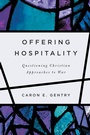
Offering Hospitality
Questioning Christian Approaches to War
1st Edition
Published on 30. September 2013
277 pages
978-0-268-08075-4 (ISBN)
Description

In Offering Hospitality: Questioning Christian Approaches to War, Caron E. Gentry reflects on the predominant strands of American political theology-Christian realism, pacifism, and the just war tradition-and argues that Christian political theologies on war remain, for the most part, inward-looking and resistant to criticism from opposing viewpoints.
In light of the new problems that require choices about the use of force-genocide, terrorism, and failed states, to name just a few-a rethinking of the conventional arguments about just war and pacifism is timely and important. Gentry's insightful perspective marries contemporary feminist and critical thought to prevailing theories, such as Christian realism represented in the work of Reinhold Niebuhr and the pacifist tradition of Stanley Hauerwas. She draws out the connection between hospitality in postmodern literature and hospitality as derived from the Christian conception of agape, and relates the literature on hospitality to the Christian ethics of war. She contends that the practice of hospitality, incorporated into the jus ad bellum criterion of last resort, would lead to a "better peace."
Gentry's critique of Christian realism, pacifism, and the just war tradition through an engagement with feminism is unique, and her treatment of failed states as a concrete security issue is practical. By asking multiple audiences-theologians, feminists, postmodern scholars, and International Relations experts-to grant legitimacy and credibility to each other's perspectives, she contributes to a reinvigorated dialogue.
In light of the new problems that require choices about the use of force-genocide, terrorism, and failed states, to name just a few-a rethinking of the conventional arguments about just war and pacifism is timely and important. Gentry's insightful perspective marries contemporary feminist and critical thought to prevailing theories, such as Christian realism represented in the work of Reinhold Niebuhr and the pacifist tradition of Stanley Hauerwas. She draws out the connection between hospitality in postmodern literature and hospitality as derived from the Christian conception of agape, and relates the literature on hospitality to the Christian ethics of war. She contends that the practice of hospitality, incorporated into the jus ad bellum criterion of last resort, would lead to a "better peace."
Gentry's critique of Christian realism, pacifism, and the just war tradition through an engagement with feminism is unique, and her treatment of failed states as a concrete security issue is practical. By asking multiple audiences-theologians, feminists, postmodern scholars, and International Relations experts-to grant legitimacy and credibility to each other's perspectives, she contributes to a reinvigorated dialogue.
Reviews / Votes
"Gentry brings together theory, data, and practice in a stark analysis of conflict and puts forth a robust Christian approach to war. . . Though Gentry writes with an American Christian audience in mind, the principles embodied in this work find support in a plurality of religious and political traditions and extend beyond the purview of American politics, even to include a variety of inter-communal as well as inter-personal relationships. This work contributes a fresh and overdue perspective to the conversation." -Journal for Peace and Justice Studies"By applying the concept of 'hospitality' in both the Christian notion of agape and in post-modern thought, [Gentry] seeks to transform each of these approaches to war in order to pave the way for a 'better peace' . . . Offering Hospitality is a provocative and compelling book that makes a vital contribution to Christian thinking about war." -Political Studies Review
"Gentry . . . presents an alternative approach to building and sustaining international political life through the Christian ethic of hospitality. . . . She argues that a Christian approach of hospitality offers a morally preferable approach to coping with failed states and international political conflicts because it can bypass hegemonic power and is better able to incorporate the needs and wants of the weak, the vulnerable, and the poor." -Choice
"Caron [E. Gentry] brings a lens of feminism and a theology of the marginalized to bear against popular political theologies that rely on a state-centric view of the world. A dense and interesting read." -Prism
"This is a work that adds another voice to the chorus calling for Christians not just to avoid war or practice it with restraint, but to build peace. May the numbers increase." -America Magazine
"Gentry challenges modern just-war theologians to move beyond abstract notions of the state to embrace both the new realities of global warfare and the eternal reality of agape love. . . . Gentry's book contributes an informed feminist and postmodern critique to the just-war conversation. She does a fine job of outlining gaps in current just-war theorizing and begins to scratch the surface of envisioning new answers." -Publishers Weekly
"Caron Gentry offers a daring constructive moral proposal here calling for a reconstruction of the just war ethic's criterion of last resort as a platform for embodying a deep form of Christian hospitality in international affairs. Along the way she analyzes the work of Reinhold Niebuhr, Stanley Hauerwas, and Jean Bethke Elshtain. A must read for students of political theology, international relations, and feminist theory." -Shaun Casey, Wesley Theological Seminary
"This is a bold and brave book that tackles weighty matters pertaining to violence and community with a deft touch. Caron Gentry's perspective, which marries contemporary feminist and critical thought to Christian realist, just war, and pacifist concerns, is fresh and insightful. She succeeds wonderfully in carving out a space that relates the literature on hospitality to the contemporary ethics of war. This book will be of major interest to scholars working in theology, international relations, political theory, and religious ethics." -Cian O'Driscoll, University of Glasgow
More details
Language
English
Place of publication
Notre Dame IN
United States
Target group
Professional and scholarly
ISBN-13
978-0-268-08075-4 (9780268080754)
Copyright in bibliographic data and cover images is held by Nielsen Book Services Limited or by the publishers or by their respective licensors: all rights reserved.
Schweitzer Classification
Other editions
Additional editions
Book
09/2013
University of Notre Dame Press
€29.70
Shipment within 10-20 days
Person
Caron E. Gentry is lecturer in the School of International Relations at the University of St. Andrews. She is coauthor with Laura Sjoberg of Mothers, Monsters, and Whores: Women's Violence in Global Politics.
Content
- Cover
- Half title
- Title page
- Copyright
- Dedication
- Contents
- Acknowledgments
- Introduction
- Chapter One: Harming Others
- Chapter Two: Marginal Wars
- Chapter Three: Hospitality toward Others
- Chapter Four: The Invulnerability Myth
- Chapter Five: The Presence of Suffering
- Chapter Six: The Offer of Hospitality
- Chapter Seven: A Liturgy
- Notes
- Bibliography
- Index
