

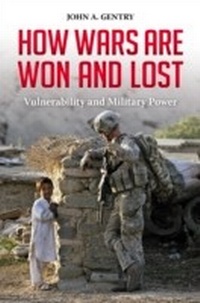
How Wars Are Won and Lost
Vulnerability and Military Power
1st Edition
Published on 10. November 2011
328 pages
978-0-313-39583-3 (ISBN)
Description

This provocative book seeks to answer a most crucial-and embarrassing-question concerning the U.S. military: why the United States is so often stymied in military confrontations with seemingly weaker opponents, despite its "superpower" status.
This fascinating book examines a question that continues to puzzle soldiers, statesmen, and scholars: why do major powers-including the ostensible superpower United States-repeatedly perform poorly against seemingly overmatched adversaries? And what can they, and the United States, do to better achieve their military objectives?
How Wars are Won and Lost: Vulnerability and Military Power argues that beyond relying solely on overwhelming military might, the United States needs to focus more on exploiting weaknesses in their adversaries-such as national will, resource mobilization, and strategic miscues-just as opposing forces have done to gain advantage over our military efforts. The author tests the "vulnerability theory" by revisiting six conflicts from the Philippine War of 1899-1902 to the ongoing actions in Iraq and Afghanistan, showing again and again that victory often depends more on outthinking the enemy than outmuscling them.
This fascinating book examines a question that continues to puzzle soldiers, statesmen, and scholars: why do major powers-including the ostensible superpower United States-repeatedly perform poorly against seemingly overmatched adversaries? And what can they, and the United States, do to better achieve their military objectives?
How Wars are Won and Lost: Vulnerability and Military Power argues that beyond relying solely on overwhelming military might, the United States needs to focus more on exploiting weaknesses in their adversaries-such as national will, resource mobilization, and strategic miscues-just as opposing forces have done to gain advantage over our military efforts. The author tests the "vulnerability theory" by revisiting six conflicts from the Philippine War of 1899-1902 to the ongoing actions in Iraq and Afghanistan, showing again and again that victory often depends more on outthinking the enemy than outmuscling them.
More details
Series
Edition
1. Auflage
Language
English
Place of publication
New York
United States
Publishing group
Bloomsbury Publishing Plc
Target group
Interest Age: From 7 to 17 years
ISBN-13
978-0-313-39583-3 (9780313395833)
Copyright in bibliographic data and cover images is held by Nielsen Book Services Limited or by the publishers or by their respective licensors: all rights reserved.
Schweitzer Classification
Other editions
Additional editions
Book
11/2011
Praeger Publishers Inc
€80.50
Shipment within 15-20 days
Person
John A. Gentry, PhD, is adjunct associate professor with the Security Studies Program of Georgetown University's Edmund A. Walsh School of Foreign Service.
Content
Acknowledgments
1 Introduction
2 The Philippine War of 1899-1902
3 The Allied Bomber Offensive against Germany (1943-1945)
4 The United States in Vietnam (1961-1975)
5 NATO's War against Yugoslavia (1999)
6 The U.S. War in Iraq (2003-2011)
7 The U.S. War in Afghanistan (2001-?)
8 Summary and Conclusions
Notes
Bibliography
Index
1 Introduction
2 The Philippine War of 1899-1902
3 The Allied Bomber Offensive against Germany (1943-1945)
4 The United States in Vietnam (1961-1975)
5 NATO's War against Yugoslavia (1999)
6 The U.S. War in Iraq (2003-2011)
7 The U.S. War in Afghanistan (2001-?)
8 Summary and Conclusions
Notes
Bibliography
Index
